Call Support
Email Address
Running a construction business is not a piece of cake as it requires a lot of careful planning and decision-making especially when it is about heavy machinery. If your construction site is covered with jagged stones, thick mud, steep slopes, or loose soil, then using the standard wheeled machines will not work at all. To keep your productivity high and to stop any kind of downtime, you need to count on the finest multi-terrain loaders for rough construction sites.
These highly advanced machines are made to offer great traction, top lifting power, and a super low ground footprint, therefore, they are the most important asset for heavy earthmoving and site development.
Determining the right equipment to purchase through machinery online resources means identifying which machine features best meet the challenges of the very environment in which you will work. No matter whether you are doing heavy material handling, grading with precision, or demolition of structures, you need to know what makes a difference among the designs of these powerful tracked machines.
To help you out with this decision, we have put together a thorough guide that will analyze the main multi-terrain loaders (MTLs) and compact track loaders (CTLs) which are meant to handle the toughest terrain, thus making your fleet productive and profitable.
Rough construction environments are challenging and full of unpredictable factors which sometimes can make the standard wheeled skid steers disappear. The innovation of advanced tracked undercarriages has totally transformed the area of excavation, landscaping, and infrastructure projects. Multi-terrain loaders feature highly advanced, suspended undercarriage designs with lightweight, flexible rubber tracks that distribute the machine’s weight evenly over a large area.
It is especially important to take a close look at the technical specs when selecting the best multi-terrain loaders for rough construction sites as you want to avoid ending up with an underpowered machine. The way engine horsepower, hydraulic flow set-up, and the structural design of the lift all interact will directly determine the capability of a loader in performing tough, real-life job tasks.
| Operational Parameter | Radial Lift Path Configuration | Vertical Lift Path Configuration |
| Mid-Height Reach Capacity | Maximum forward reach at the middle | Optimized reach at maximum height |
| Primary Application Focus | Digging, grading, and site preparation | Truck loading and heavy pallet lifting |
| Structural Mechanical Simplicity | Fewer pivot points; easier maintenance | Complex linkage; requires care |
Besides offering the latest cabin ergonomics to their operators, each of the major manufacturers of tracked loaders has their models designed with heavy steel-reinforced tracks that ensure their durability even under the most extreme working conditions.
Maximizing Performance on the Jobsite
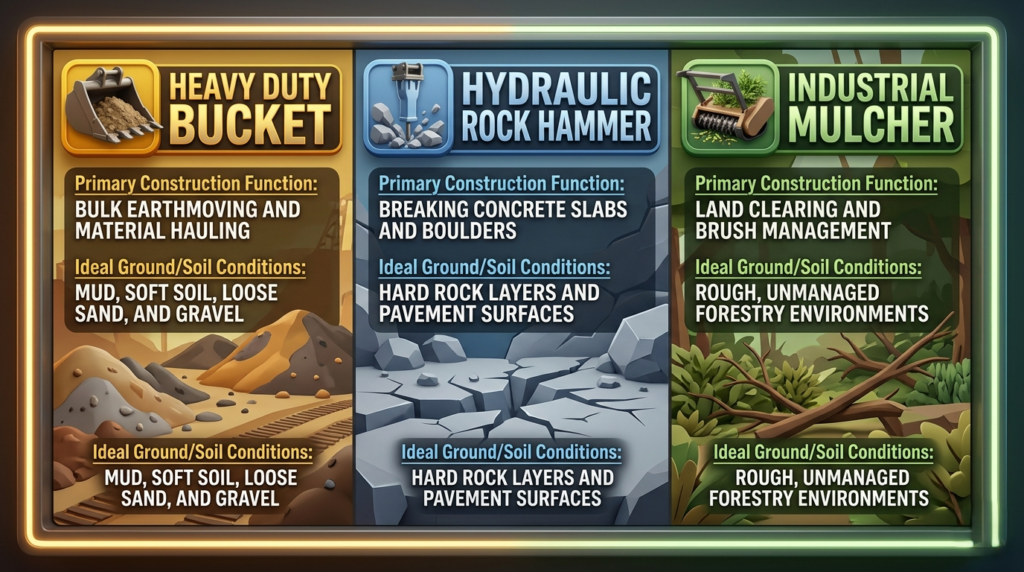
by Using Specialized Attachments The real advantage of best multi-terrain loaders for rough construction sites is their great capability to do many different jobs. Thanks to a universal quick-attach coupler system, one loader can be quite simply – and quickly – turned into a very specialized piece of equipment by a single person.
| Attachment Type | Primary Construction Function | Ideal Ground/Soil Conditions |
| Heavy Duty Bucket | Bulk earthmoving and material hauling | Mud, soft soil, loose sand, and gravel |
| Hydraulic Rock Hammer | Breaking concrete slabs and boulders | Hard rock layers and pavement surfaces |
| Industrial Mulcher | Land clearing and brush management | Rough, unmanaged forestry environments |
Along with your machinery online orders or purchases, developing a habit of daily track maintenance almost becomes a necessity when it comes to extending the lifespan of the undercarriage parts of tracked loaders.
Of course, operating heavy equipment on rough construction sites is a safety risk on its own, so additional measures must be taken to effectively minimize safety incidents such as the risk of rolling over or mechanical breakdowns.
What is the main difference between a compact track loader (CTL) and a multi-terrain loader (MTL)?
Although both machines use rubber tracks, the key difference is in the construction of their undercarriage and distribution of machine weight on the ground through the tracks. The compact track loaders (CTLs) have a rigid steel undercarriage frame and steel-reinforced tracks which make them very durable for aggressive demolition, rock work, and scraping tasks. The multi-terrain loaders (MTLs) have a suspended, lighter undercarriage and they use unreinforced rubber tracks that result in less ground pressure which in turn preserves delicate turf and offers a smoother ride.
Can you operate a multi-terrain loader on jagged rock and concrete debris?
There is no problem using an MTL on rough terrain, however, if you use a regular multi-terrain loader on sharp rock, concrete debris, or jagged rebar, it will result in accelerated wear of tracks, punctures, etc. For demolition sites where there is a lot of abrasive material scattered, the compact track loader with steel reinforced tracks would be a better choice. If you do decide to use an MTL in these environments, you should change your driving habits by avoiding fast pivot turns since they can damage the rubber parts through tearing.
How do I determine what size multi-terrain loader my construction site requires?
You will select the right machine size if you do a thorough analysis of how much space is physically available on the site, what should be the lift capacities, and how you will have it transported. Smaller-frame loaders can work very efficiently in tight spaces and residential areas, while the larger-frame units have the horsepower and the hydraulic flow necessary to lift heavy pallets and load high-sided dump trucks. Also, make sure that your existing trucks and trailers are capable of safely handling the total operating weight of the machine.
Why are track loaders preferred over wheeled skid steers on muddy construction sites?
A tracked loader is preferred to a wheeled skid steer on muddy conditions because the weight of the machine is shared over a much larger surface area. This low ground pressure enables the tracked loader to float on mud, wet clay, and sand where wheels would spin, sink, and get stuck very fast. This flotation capability allows the projects to be moved forward even after heavy rainstorms and thus it prevents expensive weather delays.
How long do the rubber tracks on a multi-terrain loader typically last?
Usually, a top-notch set of multi-terrain loader rubber tracks can last from 1,200 up to 2,000 working hours. Their actual service life is largely influenced by the types of surfaces that are worked on, the cleaning routines of the undercarriage, and also the operator’s habits. Frequent working on abrasive surfaces like hot asphalt or sharp gravel will wear down the tracks more quickly than working on soft soil or sand.
Is it more cost-effective to buy or rent a loader for a short-term project?
For short-term projects less than a few months, renting equipment usually is the most cost-efficient route as it eliminates large upfront capital expenses as well as water and maintenance costs. Renting also gives you the opportunity to select the exact machine size and configuration needed for the particular jobsite. However, if you find that the long-term utilization rate of the machine equipment exceeds 60% to 70% throughout the year, then buying a machine is cheaper.
What daily maintenance checks should an operator perform on a tracked loader?
Every operator must do a thorough pre-operation walk-around each time they start a shift. This includes checking engine oil, coolant, and hydraulic fluid levels, checking tracks for cracks or missing lugs, and making sure the track tension is just right. Also, check the undercarriage for debris, examine hydraulic hoses for leaks, and make sure all safety lights and cabin controls are working correctly.