How Much Weight Can a 4000 lb mini excavator lift capacity
Regarding small construction equipment, professionals and homesteaders alike frequently find themselves wondering one essential issue, what is the real 4000 lb mini excavator lift capacity? If you’re planning to buy a machine from Machinery Online, such as the excellent TYPHON TERROR XX, it’s important to know just how much weight a 2-ton mini excavator can lift for work site safety and productivity.
A lot of operators find 4,000 lbs (about 2 tons) to be the sweet spot for a machine. It’s tiny enough to get through narrow residential gates or thick woods, but heavy enough to give you the stability for substantial lifting and digging.
To lift a large concrete slab or a hefty pallet of pavers, you need to know the mechanics of compact excavators before you attempt. The lifting limit is not a one static figure, it is always moving depending on how you are working the machine. As a general rule, a 4,000 kg mini excavator may safely lift 1,000 to 1,500 pounds when the load is near to the machine’s center of gravity.
But if you swing the boom all the way forward or the cab over the side of the rails, the capacity lowers dramatically. Knowing these levels helps you safeguard your investment, keep your operation running at optimal efficiency and avoid hazardous tipping dangers.
What is the Real 4000 lb Mini Excavator Lift Capacity?
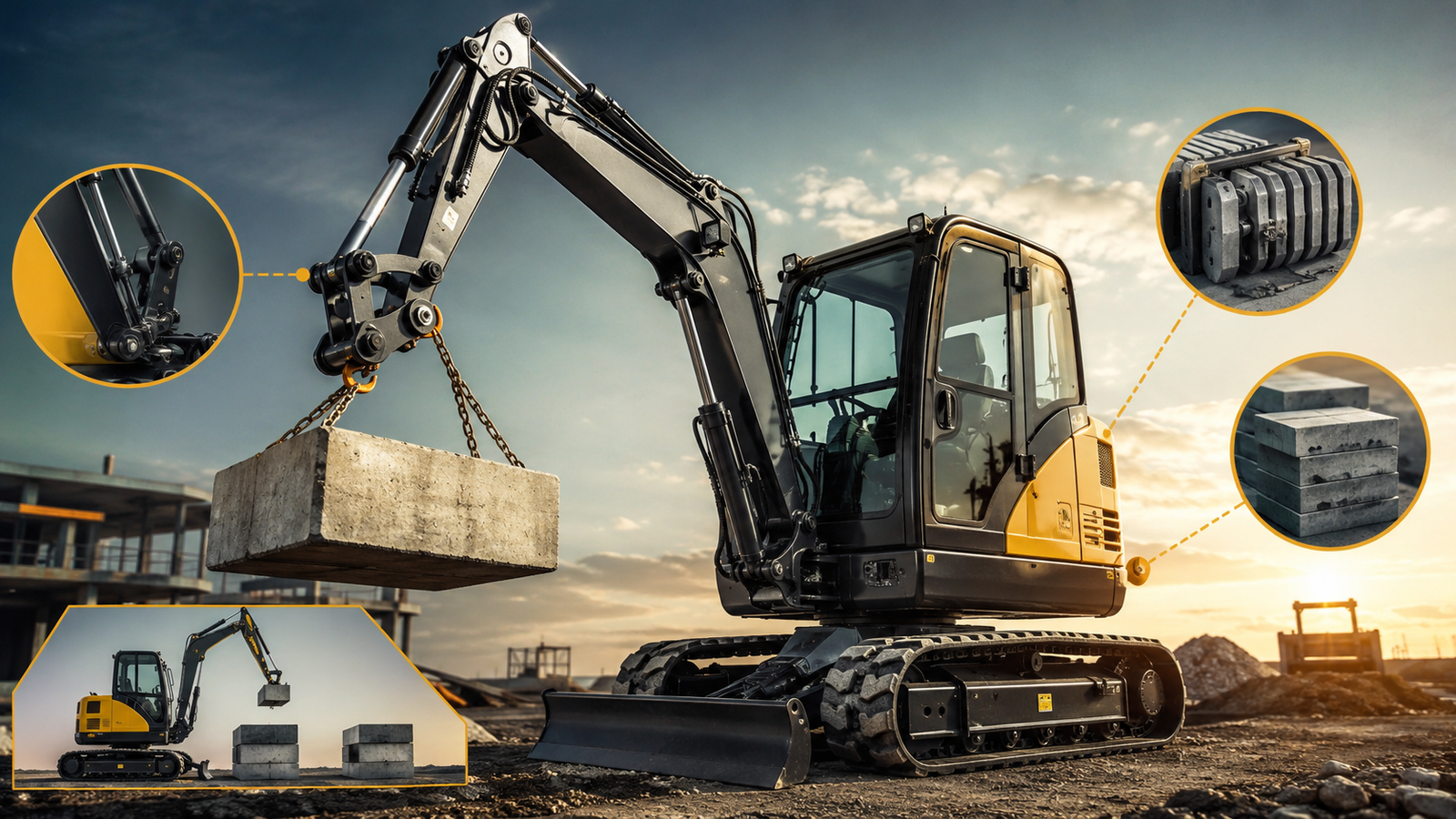
The one thing to keep in mind regarding the 4000 lb mini excavator lift capacity is that this is very much reliant on the location of the boom and undercarriage of the machine. The hefty dozer blade is driven into the ground to serve as an anchor and the load is placed just forward of the front of the machine and lifting power is at maximum.
At this best “short reach” position, a 4,000 pound excavator can normally take loads of 1500 pounds. That makes it a great tool for lifting regular root balls, retaining wall blocks or large buckets of wet gravel.
The more you stretch the boom away from the machine, the more leverage you offer the load against the excavator’s counterweight. A machine that weighs 4,000 lbs may lift as little as 500 to 700 lbs at the end of its reach. This significant decrease is achieved via the relocation of the center of gravity.
If you attempt to lift a 1,000 lb rock with your arms fully extended, the machine will certainly topple forward. Operators must constantly design their lifts dynamically during transport or hoisting to keep heavy goods as near to the undercarriage as feasible.
- Short Reach Lifting: The machine is most powerful when the load is near the blade, often reaching a maximum of around 1,500 lbs.
- Full Extension Lifting: The 4000 lb mini excavator lift capacity drops to around 500-700 lbs when the boom is extended fully.
- Blade Down Stability: Always drop the front dozer blade to the ground before lifting. This greatly enhances stability and the total lift rating.
What Determines How Much Weight Mini Excavator Can Lift?
The reality is that there are a number of factors that go into the real 4000 lb mini excavator lift capacity on any given day. Ground conditions are a big factor. If you are working on a firm concrete pad or deep compacted dirt, the machine’s rubber tracks provide a level sturdy platform to spread weight out.
However, while operating on soft mud, loose gravel or on an incline, the excavator stability is impaired and thus artificially reduces the safe lifting capability of the excavator. The tracks may not settle uniformly, changing the gravity, and making tipping much more probable even with lesser loads.
Another key issue is the swing radius of the machine. The strongest position is lifting a load directly over the front of the rails (particularly with the blade down). Once you swing the cab over the edge of the tracks you lose the longitudinal stability that the length of the track provides.
Side-lifting capabilities are generally 30% to 50% less than front-lifting capacities. This is why experienced operators would always get the equipment in place so they can lift over the front, rather than trying hefty side lifts in restricted locations.
- Ground Density: Firm, flat ground will boost your safe lifting thresholds, whereas soft or sloping terrain demands you to reduce your burden.
- Over-Front and Over-Side: Lifting over the front of the tracks is a more stronger and safer way to lift than slinging a large load over the side.
- Counterweight Mass: The counterweight is the physical weight engineered into the back of the excavator to balance off the load. Machines in the 4,000 lb. range come with counterweights particularly designed for 2-ton operations.
Typhon Mini Excavators: When Power Meets Precision
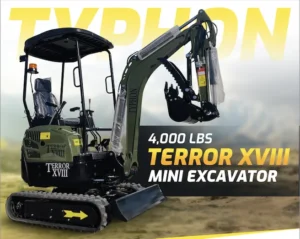
When you browse the live inventory on Machinery Online you will come across the excellent TYPHON TERROR XX and TYPHON TERROR XVII series. These devices are a wonderful example of current engineering maximizing 4000 lb mini excavator lifting capability.
The TERROR XX is powered by a rugged Kubota D902 diesel engine that can provide the hydraulic flow needed for severe lifts without bogging the engine down. Hydraulic pressure is the lifeblood of your excavator’s lifting power. A superior engine means constant breakout force and lifting torque when you need it the most.
Furthermore, the TYPHON TERROR XX is fitted with high quality rubber track systems. Rubber tracks are quite useful for home contractors since they don’t tear up driveways or sensitive lawns, but yet provide good grip to move large objects. With the free 13-attachment package on Machinery Online, a TYPHON 4,000 lb mini excavator is no longer just a digger, but a whole material handling powerhouse ready to handle landscaping, trenching and hardscaping with total ease.
- Premium Hydraulics: The Kubota D902 engine provides great hydraulic pressure for constant, powerful lifting without power drain.
- Rubber Track Systems: Excellent grip and stability on the ground for lifting, without harming finished concrete or landscaped surfaces.
- Flexible Attachments: Machines like the TYPHON TERROR XX are sometimes sold with a suite of attachments that make it possible to securely lift a variety of things.
Mini Excavator Lift Chart and Safe Lifting Practices
It is essential to know how to read a compact excavator lift chart to ensure safe jobsite operations. Every manufacturer will include a load chart. These are normally in the operators canopy or the technical instructions. This chart shows the 4000 lb mini excavator lift capacity based on two metrics.
The first is the height of the lift point (how high the load is off the ground). The second is the lift radius (how far the load is from the center of the machine). You use the junction of your boom height and your horizontal reach to calculate the absolute maximum safe weight. This is how you utilize it.
Never do a “test lift” by only estimating the weight of an item. When the rear of your tracks start to rise off the ground, then you have already beyond the safe working limitations of the machine.
It’s also worth considering how much weight your connection carries. For example, if your lift chart shows that your maximum capacity is 1,200 lbs., and you have a 200 lb hydraulic grapple connected, then your real lifting capability of the item itself is just 1,000 lbs.
- Check Load Chart: Always reference the manufacturer’s lift chart for lift height and horizontal reach before lifting.
- Think Attachments: The chart’s total lift capacity is not your real payload limit. You’ve have to subtract the weight of the bucket, thumb or grapple.
- Watch for Tracks: If the back of your tracks rise or float off the ground in a hoist, lower the load quickly to avoid toppling.
Comparison of Attachments and Their Influence on Lifting Capacity
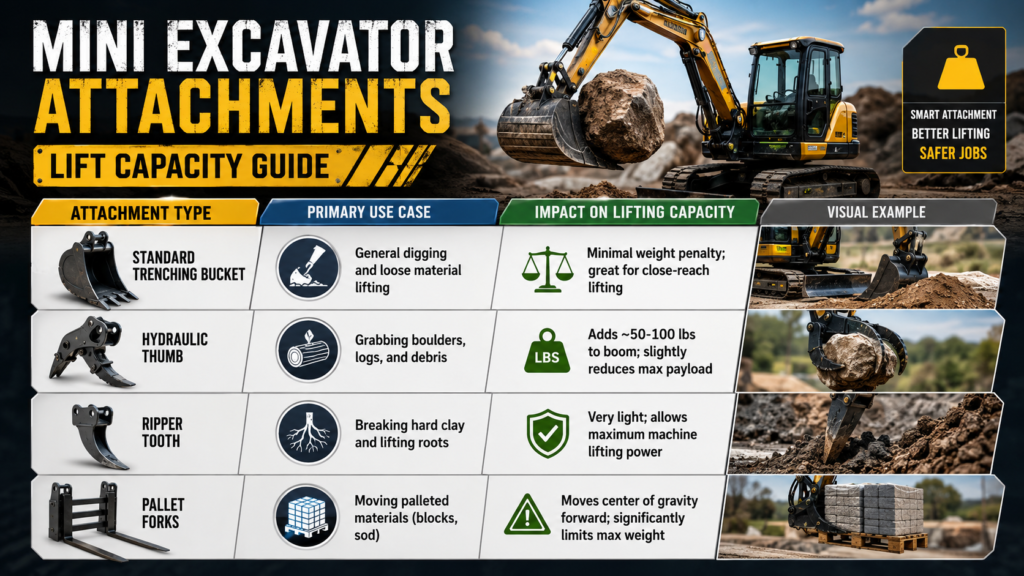
The effectiveness of your 4000 lb mini excavator will depend on the attachments you select for mini excavator lift capacity. A basic digging bucket is fine for moving soil, but might be problematic for picking up pipes, rocks or logs. One of the finest enhancements you can do is to add a hydraulic thumb. Uneven materials may be ” pinched ” solidly between your thumb and will not move about while in transportation . But don’t forget that a heavy-duty thumb adds weight to the end of the boom, which significantly cuts the total amount of material weight you can safely take up.
If your lifting is more specialized, you may want to consider pallet forks or a specialist grapple. It’s tempting to utilize a tiny excavator as a forklift, but remember that a 4,000 lb excavator does not work like a warehouse lift. Here is a handy comparison of popular attachments and how they work with a 2-ton machine’s lifting power.
Table: Top Mini Excavator Attachment Types:
| Attachment Type | Primary Use Case | Impact on Lifting Capacity |
| Standard Trenching Bucket | General digging and loose material lifting | Minimal weight penalty; great for close-reach lifting |
| Hydraulic Thumb | Grabbing boulders, logs, and debris | Adds ~50-100 lbs to boom; slightly reduces max payload |
| Ripper Tooth | Breaking hard clay and lifting roots | Very light; allows maximum machine lifting power |
| Pallet Forks | Moving palleted materials (blocks, sod) | Moves center of gravity forward; significantly limits max weight |
- Hydraulic Thumbs: Essential for securely gripping irregular loads, but you must consider their structural weight.
- Pallet Forks: Handy, but add to the center of gravity of the load away from the machine therefore you need a lighter machine.
- Quick Couplers: Enable rapid attachment changes, but add some weight to the end of the stick, somewhat reducing capacity.
Maximize Worksite Efficiency Using a 2-Ton Mini Excavator
To maximize your 4000 lb mini excavator lift capability, you need excellent gear and clever jobsite methods. Professional operators don’t force the excavator to its tipping limit, they divide loads down into manageable portions.
If you are required to transport a 2000 lb load of boulders, it is far quicker and safer to make two trips with a 1,000 lb load than to wrestle with an overloaded bucket that would either topple the machine or blow a hydraulic seal.
The machine placement is also more efficient. Position your material staging places such that the excavator does not have to go far with a suspended load. Driving with a big load is very risky, raised (“tramming”).
Keep the load as low as possible to the ground while traveling . Do not raise the boom to the necessary dump height until safely located at your destination . The TYPHON TERROR XX models will give years of dependable, heavy-duty service by respecting the physics of the machine.
- Keep Loads Low: Always travel with your load or bucket as low as possible to keep your center of gravity low.
- Batch Your Lifts: Rather of straining the machine to its very greatest capacity, break up big material heaps into smaller, safer loads.
- Stage Materials Wisely: Position your dump trucks or staging locations near the work zone to save travel distance with heavy loads.
FAQs – 4000 lb Mini Excavator Lift Capacity
What is the typical lifting capability of a 4000 lb mini excavator?
An average 4,000 lb (2 ton) mini excavator can safely lift between 1,000 and 1,500 pounds with the load near to the machine and the dozer blade down. This capacity reduces to around 500 to 700 pounds at full boom extension.
Is it possible for a small excavator 2 tons to lift a concrete block pallet?
Not usually. A complete pallet of concrete blocks may be more than 3,000 pounds, much beyond the safe lifting limit of a 4,000 lb machine. You will need to split the pallet down and pick up the blocks in smaller loads.
Why does the capacity drop while elevating over the edge of the tracks?
Lifting over the side reduces the undercarriage length as a stabilising element. The machine is smaller across than it is front to back, which makes it considerably more prone to tipping over when swinging a large load side to side.
Does it assist to lower the dozer blade while lifting large weight?
Yes, to a great extent. The dozer blade is lowered into the ground at the front of the machine to function as a mechanical anchor and stabilizer. It changes the pivot point of the machine and considerably enhances your safe lifting capacity in front of you.
What is the added weight of a hydraulic thumb to the boom ?
The weight of a hydraulic thumb for a 4,000 kg excavator is typically an additional 50 to 100 pounds on the end of the arm, depending on the manufacturer and heavy-duty grade. This weight will be removed from your overall lifting ability.
Can a regular half-ton pickup vehicle pull a 4,000 kg small excavator?
Yes, most regular half-ton vehicles are rated for 7,000 to 9,000 pounds towing. A 4000 lb excavator with a 2000 twin axle trailer is usually well under safe towing limitations for a half ton vehicle.
Where can I locate the proper lift chart for my small excavator?
The precise lifting capability chart is calibrated by the producer in a unique way . Typically, it is on a metal sign located within the operator’s cab, near the controls, or is well recorded in the machine’s official operating handbook.