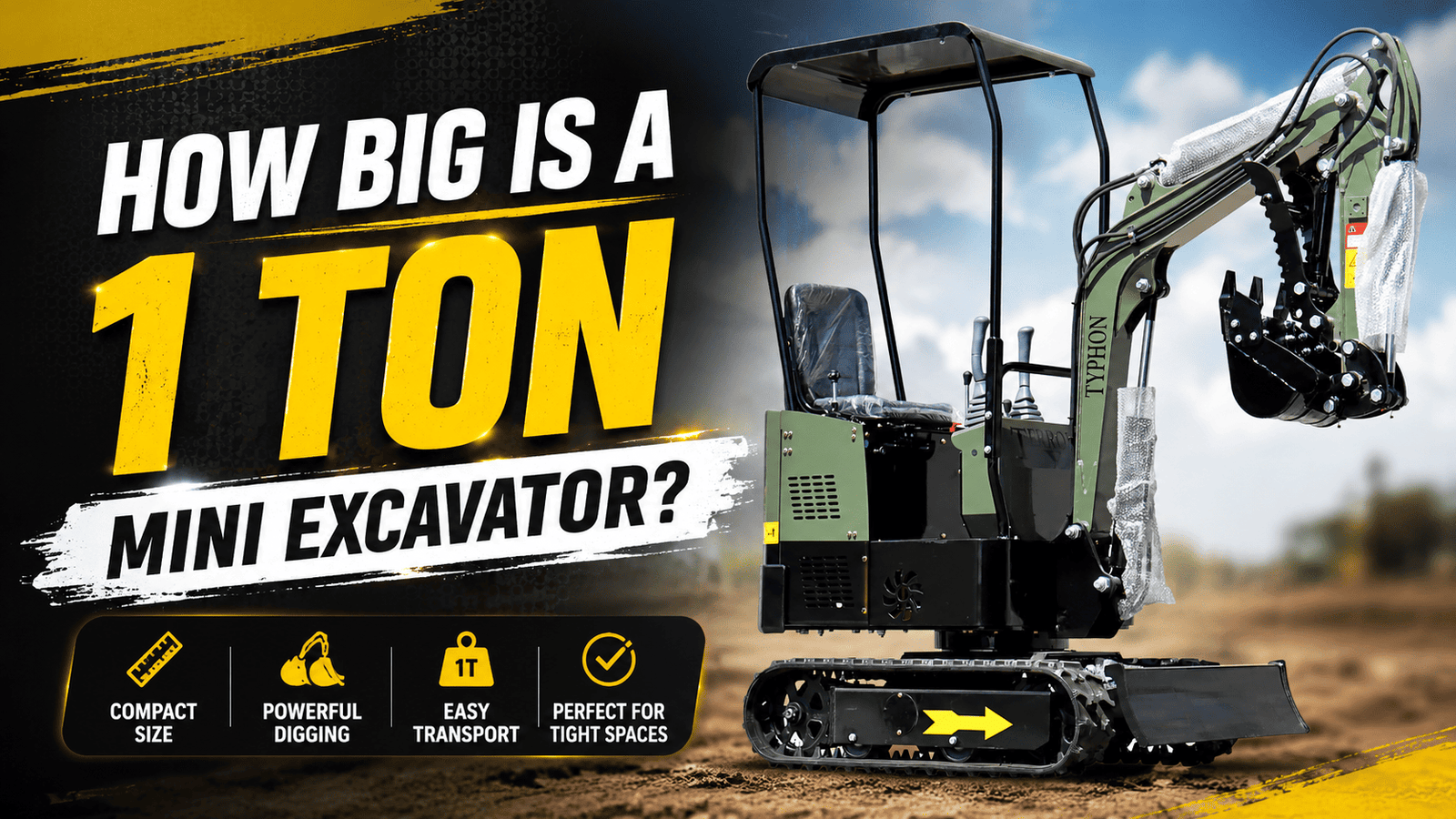
How Big Is a 1 Ton Mini Excavator?
A 1 ton mini excavator is one of the smallest machines you can rent or buy in the excavator lineup, typically weighing somewhere in the neighborhood of 2,000 to 2,700 pounds and measuring narrow enough to fit through a standard backyard gate. That’s the short answer. But if you’ve been shopping around, you’ve probably noticed that no two “1 ton” machines list identical specs. That’s because the 1-ton label describes a weight class, not a fixed blueprint, and the actual size of the machine sitting on a dealer’s lot can shift depending on who built it.
If you’re trying to figure out whether one of these machines will actually fit your job site, get through your gate, or ride safely on your trailer, you need more than a single number. You need real ranges, an understanding of what “1 ton” actually means, and a sense of where this class of machine shines versus where it falls short.
How Big Is a 1 Ton Mini Excavator?
A 1 ton mini excavator generally has an operating weight between roughly 2,000 and 2,700 pounds, a width around 28 to 36 inches, a height of about 6.5 to 7.5 feet with the cab or ROPS bar in place, and an overall length in the 8 to 10 foot range when the machine is folded up for transport. Digging depth typically falls somewhere between 5 and 7 feet, depending on the boom and dipper arm configuration.
These figures aren’t universal. Manufacturers configure their 1-ton class machines differently based on engine placement, track design, counterweight, and boom geometry, so two excavators marketed in the same weight class can still differ by several inches in width or a foot or more in reach. Here’s a general breakdown of what you’ll typically encounter in this class.
| Specification | Typical 1-Ton Mini Excavator |
|---|---|
| Operating Weight | Approximately 2,000–2,700 lbs |
| Width | Approximately 28–36 inches |
| Height | Approximately 6.5–7.5 feet |
| Overall Length | Approximately 8–10 feet |
| Digging Depth | Approximately 5–7 feet |
| Maximum Reach | Approximately 8–10 feet |
Treat this table as a starting point for comparison shopping, not a spec sheet for a specific machine. Always confirm exact dimensions against the manufacturer’s published data sheet before making a purchase or rental decision, since even small differences in width or height can matter when you’re working around tight fences or low garage doors.
What Does “1 Ton” Mean on a Mini Excavator?
“1 ton” refers to the excavator’s approximate operating-weight class, not how much material or weight the machine can lift. This is probably the single biggest point of confusion for first-time buyers, and it’s worth clearing up early.
Operating weight includes the machine itself, a full tank of fuel, the operator, and standard attachments like the bucket. It’s essentially how much the excavator weighs when it’s ready to work — which matters for trailer selection, ground pressure, and stability, but it says nothing directly about lifting capacity.
Lifting capacity is a separate spec entirely, and it changes constantly depending on boom position, dipper arm extension, the attachment installed, the angle of the machine, and the ground conditions underneath the tracks. A 1-ton excavator can lift meaningfully less at full reach than it can with the arm tucked in close to the machine. So when someone asks “how much can a 1 ton excavator lift,” the honest answer is: it depends on where the load is positioned, and you should check the manufacturer’s lift chart rather than assuming the weight class equals lifting power.
1 Ton Mini Excavator Dimensions Explained
Width
Width is usually the number that matters most for residential jobs, because it’s the dimension that determines whether the machine can actually get into your backyard in the first place. Most 1-ton machines fall somewhere between 28 and 36 inches wide, which is narrow enough to clear a standard 36-inch gate on most models, though it’s worth measuring your gate opening before assuming it’ll fit — hinges, latches, and fence posts can eat up an inch or two of usable clearance.
Some manufacturers offer retractable or variable-width undercarriages on their 1-ton machines, letting the tracks widen for stability once the excavator is inside the work area and narrow again for passing through tight gaps. That feature isn’t universal, so it’s worth asking about if gate access is tight.
Height
Overall height typically runs 6.5 to 7.5 feet with a canopy or ROPS bar attached, which becomes important the moment you’re working near a garage entrance, a low tree canopy, a shed overhang, or a covered patio. Some machines can fold the ROPS bar down to reduce height further for transport or for squeezing under an obstacle, so if overhead clearance is a known issue on your property, ask about a folding canopy option specifically.
Length
Overall length in the 8 to 10 foot range affects more than just how the machine looks parked in your driveway. A longer machine needs more turning space in tight yards, takes up more trailer deck, and can be trickier to maneuver around corners or between structures. Shorter machines generally handle confined residential lots better, while slightly longer ones may offer a bit more stability and reach.
Tail Swing
Tail swing describes how far the rear counterweight extends beyond the tracks when the upper structure rotates. Conventional tail swing designs let the counterweight overhang the tracks during a full rotation, which can be a problem next to a fence, foundation wall, or parked vehicle. Zero or reduced tail swing designs keep the rear end tucked within the width of the tracks throughout the entire swing, which is a genuinely useful feature for working close to structures in tight residential settings. If your job involves digging near a house foundation or a fence line, this is worth checking before you commit to a specific model.
How Deep Can a 1 Ton Mini Excavator Dig?
A 1 ton mini excavator can typically dig to a depth of around 5 to 7 feet, though the exact figure depends on the boom style, dipper arm length, and whether the machine uses a standard or extendable arm. Machines with a two-piece or extendable boom generally reach deeper and farther than fixed-boom designs in the same weight class.
That depth range covers a surprising amount of everyday work. Utility trenching for irrigation lines, drainage pipe, or electrical conduit usually falls well within 5 feet. Footings for a small deck or shed addition, fence post holes, and most residential drainage work also fit comfortably inside a 1-ton machine’s dig envelope. Where you start running into limits is basement excavation, deep utility work, or anything requiring a hole beyond about 6 to 7 feet — at that point you’re generally looking at a larger machine.
How Much Space Does a 1 Ton Mini Excavator Need?
Fitting through a gate is only half the equation — the machine also needs room to actually operate once it’s inside. A 1-ton excavator generally needs enough clearance to swing its boom and bucket without hitting a fence, wall, or parked vehicle, plus a bit of extra room to maneuver forward and back while digging.
Before booking a rental or scheduling a job, it helps to walk the site and check a few things: the width of every gate or gap the machine has to pass through, the height of any overhangs, branches, or doorways along the route, the turning radius available once inside the work area, and the condition of the ground itself. Soft, muddy, or sloped terrain can limit where a mini excavator can safely operate even if there’s technically enough physical space. A machine that fits through the gate but can’t turn around once it’s inside isn’t going to get much done.
Can You Transport a 1 Ton Mini Excavator With a Trailer?
Yes, a 1 ton mini excavator can typically be hauled on a standard utility or equipment trailer, since its operating weight of roughly 2,000 to 2,700 pounds falls within the payload capacity of many single-axle and tandem-axle trailers. That said, the trailer itself, any attachments loaded alongside the machine, and your towing vehicle’s rated capacity all factor into whether a specific setup is safe and legal.
Before hauling, confirm the excavator’s actual operating weight from its data plate or spec sheet, check that figure against your trailer’s rated payload capacity — not just its overall weight rating — and make sure your tow vehicle is rated to handle the combined weight of the trailer and machine. Use rated tie-down points on the excavator, load it with appropriate ramps, and double-check local and state regulations on trailer width, lighting, and licensing, since these vary by jurisdiction. If any of this is unfamiliar, it’s worth having a rental company or dealer walk you through proper loading procedure the first time.
What Can a 1 Ton Mini Excavator Do?
This size class earns its popularity because it handles the jobs most homeowners and small contractors actually face. Typical applications include:
- Trenching for irrigation, drainage, or low-voltage electrical lines
- Landscaping work like grading, bed preparation, and material moving
- Digging footings for small structures, decks, or fence posts
- Stump removal in tight backyard spaces
- Small demolition tasks, like breaking up a section of walkway
- Utility installation in residential yards
- Pond or garden feature excavation
- Farm maintenance work like ditch clearing or gate post holes
- General residential excavation where a full-size machine won’t fit
Where a 1-ton machine starts to struggle is high-volume dirt moving, deep basement digs, or jobs that call for heavy lifting capacity. TYPHON Machinery, along with several other manufacturers in the compact equipment space, offers 1-ton mini excavators aimed specifically at this residential and light-commercial niche — machines sized to get through a gate and handle a day of trenching or landscaping work without the footprint of a full-size excavator. As with any brand, it’s worth pulling the specific model’s published spec sheet before comparing it against the general ranges in this article.
Is a 1 Ton Mini Excavator Big Enough for Your Job?
A 1-ton mini excavator is usually the right call when access is restricted, the work site is residential, minimal ground disturbance matters, the digging is relatively shallow, and you want a machine that’s simple to transport on a smaller trailer. If your project checks most of those boxes, this weight class will likely handle it well.
It’s time to consider moving up to a 1.5-ton, 2-ton, or 3-ton excavator when you need more digging depth or reach than the 1-ton class offers, you’re moving large volumes of material and need more bucket capacity, the ground is harder or rockier and demands more breakout force, or your job site has enough room that the narrower footprint of a 1-ton machine no longer offers a meaningful advantage.
1 Ton vs Larger Mini Excavators
| Feature | 1-Ton | 1.5-Ton | 2-Ton | 3-Ton |
|---|---|---|---|---|
| Size & Footprint | Smallest, narrowest | Slightly larger | Noticeably larger | Larger still, less nimble |
| Maneuverability | Best for tight spaces | Very good | Good | Moderate |
| Digging Capability | Light to moderate | Moderate | Moderate to strong | Strong |
| Transport | Fits on small trailers easily | Slightly heavier hauling needs | May need a larger trailer | Often needs a dedicated equipment trailer |
| Typical Applications | Residential, landscaping, utility work | Similar jobs with a bit more power | Small commercial jobs, larger trenching | Site prep, heavier excavation |
These comparisons describe general tendencies across the class, not guaranteed specs for any single model — always verify against the manufacturer’s actual data sheet.
Frequently Asked Questions
How big is a 1 ton mini excavator? A 1 ton mini excavator typically weighs between 2,000 and 2,700 pounds, measures roughly 28 to 36 inches wide, stands about 6.5 to 7.5 feet tall, and runs 8 to 10 feet in overall length. Exact dimensions vary by manufacturer and model, so it’s worth checking the specific machine’s spec sheet before assuming it will fit your job site.
How much does a 1 ton mini excavator weigh? Most 1 ton mini excavators have an operating weight in the range of 2,000 to 2,700 pounds, which includes the machine, a full tank of fuel, the operator, and a standard bucket. This figure matters for trailer selection and towing capacity, so always confirm the exact weight before hauling.
How wide is a 1 ton mini excavator? Typical width falls between 28 and 36 inches, narrow enough to pass through most standard residential gates. Measure your actual gate opening before booking, since hardware and fence posts can reduce usable clearance by an inch or two.
How deep can a 1 ton mini excavator dig? A 1 ton mini excavator generally digs to a depth of about 5 to 7 feet, depending on boom and dipper arm configuration. That range covers most utility trenching, footing excavation, and residential drainage work, though deeper digs typically call for a larger machine.
Can a 1 ton mini excavator fit through a gate? In most cases, yes — a 1 ton excavator’s typical 28 to 36 inch width fits through a standard 36-inch gate. It’s still smart to physically measure your gate opening and account for hinges or latches before assuming clearance.
Can you tow a 1 ton mini excavator? Yes, a 1 ton mini excavator’s operating weight generally falls within the payload capacity of many standard equipment trailers. Always verify the machine’s actual weight, your trailer’s rated payload, and your tow vehicle’s towing capacity before transporting it.
Is a 1 ton mini excavator good for residential work? Yes, this weight class is well suited to residential work because of its narrow footprint, light ground pressure, and ability to navigate backyards, gates, and tight side yards that larger equipment can’t access.
Is a 1 ton mini excavator big enough for landscaping? For most landscaping tasks — grading, bed preparation, small trenching, and material moving — a 1 ton excavator is more than capable. Larger grading projects or heavy material moving may call for a bigger machine.