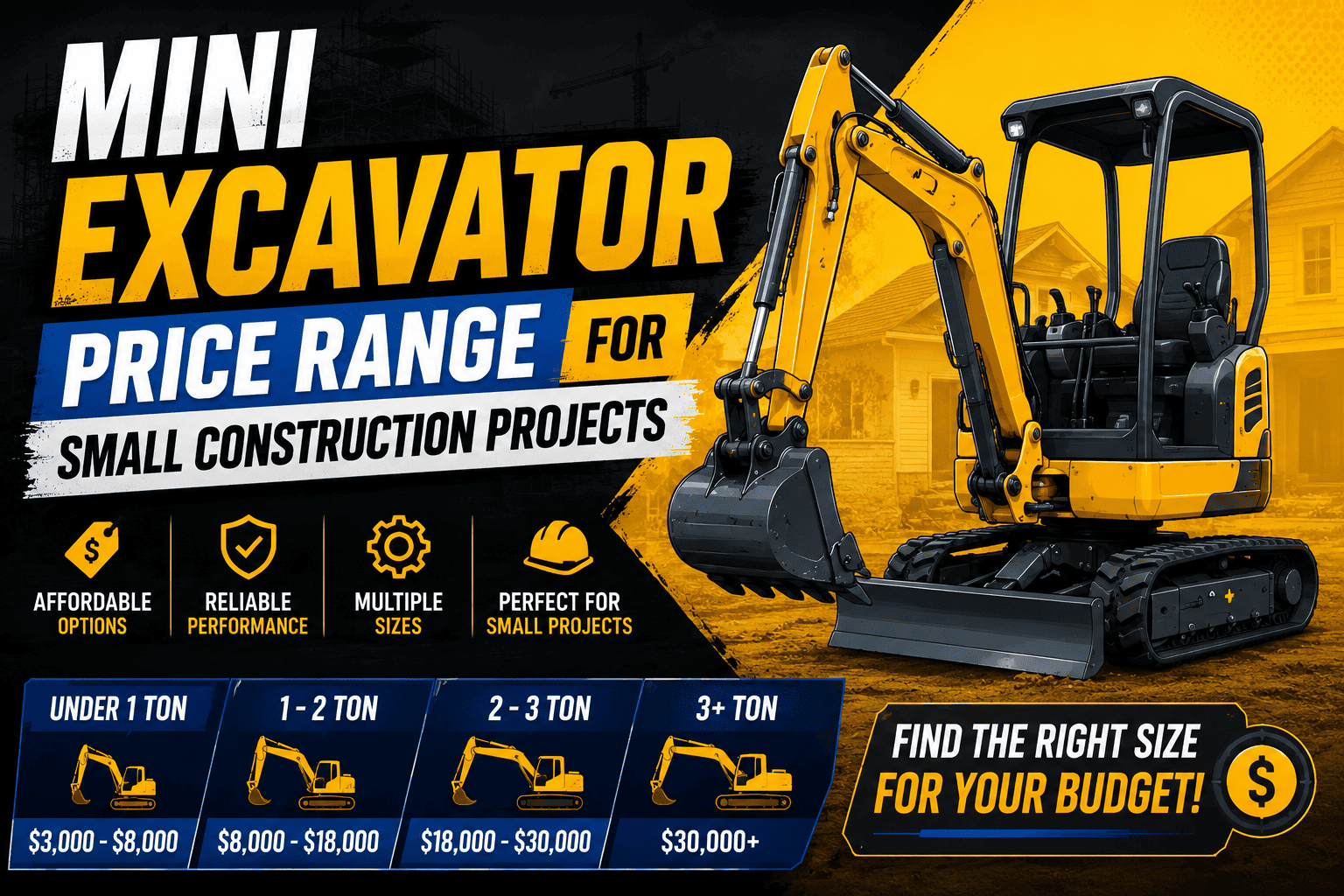
Mini Excavator Price Range for Small Construction Projects
If you’re pricing out a mini excavator for a small construction project, expect somewhere between $25,000 and $110,000 for a new machine, or $12,000 to $60,000 used, depending almost entirely on the weight class you need. That’s a wide window, and it’s wide on purpose — a 1-ton unit you can tow behind a half-ton pickup and an 8-ton machine with a full cab sit at opposite ends of the market, even though both get sold under the same “mini excavator” label.
The honest answer is that there isn’t one mini excavator price. There’s a price for your size class, your brand, your configuration, and your region — and those four things can move the number by tens of thousands of dollars. This guide breaks the market down the way a dealer or a rental counter actually breaks it down, so you walk into a purchase or rental decision knowing what you should be paying, not just what a headline number says.
How Much Does a Mini Excavator Cost?
A new mini excavator typically runs $25,000 to $110,000+, with the bulk of small-contractor and homeowner purchases landing in the $35,000–$75,000 band once you get into a 2-to-4-ton machine with a hydraulic quick coupler and second auxiliary hydraulic circuit. Used machines run 30–60% below new pricing depending on hours and condition, which is why so many small operators start their search in the used market.
Here’s the general shape of the market:
| Mini Excavator Category | Typical New Price | Best For |
|---|---|---|
| Under 1 ton (micro/ultra-compact) | $25,000–$40,000 | Indoor demolition, tight-access residential work |
| 1–2 ton | $30,000–$60,000 | Landscaping, backyard digging, small trenching |
| 2–3 ton | $40,000–$75,000 | General contractor work, foundations, utility trenching |
| 3–5 ton | $60,000–$95,000 | Heavier excavation, larger footings, grading |
| 5–8 ton with cab | $85,000–$120,000 | Commercial-adjacent small construction, deeper digging |
| Used machines (any class) | $12,000–$60,000 | Budget-conscious buyers willing to inspect carefully |
These are market-wide ranges, not one manufacturer’s price sheet — treat them as a planning tool, then get an out-the-door quote from an actual dealer once you’ve picked a class.
Mini Excavator Prices by Size
Under 1 Ton
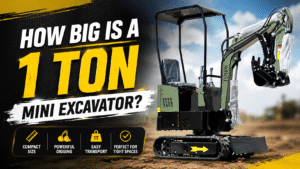
These are the machines designed to fit through a standard gate and work inside a finished basement or a fenced backyard. They’re light enough to trailer with a pickup, which cuts your transportation cost compared to anything bigger. The tradeoff is digging depth and breakout force — they’re built for finesse work, not moving large volumes of material. Expect the lowest price point in the mini excavator category, but also the narrowest range of jobs they’re suited for.
1–2 Ton
This is the workhorse class for residential construction, landscaping crews, and homeowners doing their own site work. You get enough digging depth for most footing and utility trenching jobs while staying light enough for easy transport and minimal ground disturbance on finished lawns. It’s also the size where you’ll see the widest selection of used inventory, since it’s the most commonly purchased class among small operators.
2–3 Ton
For a lot of small contractors, this is the sweet spot. You gain meaningful digging depth and lift capacity over the 1–2 ton class without stepping into the transportation and storage demands of a larger machine. Auxiliary hydraulics become standard rather than optional at this size, which matters if you’re running augers, breakers, or a hydraulic thumb regularly.
3–5 Ton
Here you get real digging capability — deeper reach, higher lift, and enough stability to handle heavier attachments like breakers and larger buckets. Cab options become more common in this range, adding operator comfort and weather protection but also adding to the price. Transportation gets more involved too: you’re generally looking at a proper equipment trailer and a tow vehicle rated for the added weight, not a light-duty setup.
New vs. Used Mini Excavator Prices
New Mini Excavator
Buying new means a full manufacturer warranty, predictable maintenance history from day one, and the latest emissions and hydraulic technology. You’ll also have financing options that are harder to get on older used equipment, and resale value tends to hold better on well-known brands. The tradeoff is straightforward: you’re paying the highest price point in the market for that certainty.
Used Mini Excavator
A used machine can cut your upfront cost by roughly a third to well over half compared to new, which is why used inventory moves quickly for well-maintained, lower-hour machines. The catch is that you’re now responsible for verifying condition yourself, since there’s no factory warranty backing up your purchase in most cases.
Before buying used, inspect:
- Engine hours and whether they match the wear you’re seeing
- Hydraulic leaks around cylinders, hoses, and fittings
- Track condition — cracking, stretching, missing lugs
- Sprocket and roller wear
- Boom and bucket pin play (excessive movement signals wear)
- Bucket and thumb linkage condition
- Cylinder rod scoring or pitting
- Engine smoke color and unusual noise at startup and under load
- Available service records and maintenance history
A machine with low hours but no service records is a bigger question mark than a higher-hour machine with a documented maintenance history. Ask for both before you commit.
What Affects Mini Excavator Price?
Operating weight. This is the single biggest price driver. Heavier machines need more steel, more hydraulic capacity, and more powerful engines, and all of that shows up in the sticker price.
Engine and horsepower. More horsepower generally means faster cycle times and better performance under load, which manufacturers price accordingly.
Hydraulic system. A machine with a second auxiliary hydraulic circuit and a quick coupler for swapping attachments costs more than a base configuration, but it also opens up a much wider range of attachments you can run without a dealer retrofit.
Cab vs. open canopy. A cab adds weather protection, noise reduction, and often climate control — all of which add real cost. Canopy models are lighter on the wallet and common on smaller machines.
Zero tail swing. Machines designed so the counterweight doesn’t extend past the tracks are more valuable on tight residential and urban jobsites, and that design complexity is reflected in price.
Brand. Established manufacturers with strong dealer networks, parts availability, and service support tend to command a premium over lesser-known brands — and that premium often shows back up as stronger resale value later.
Attachments. The base machine price frequently covers only the standard digging bucket. Everything else — grading buckets, thumbs, augers, breakers — is typically priced separately.
Dealer and location. Regional demand, freight distance from the factory or port, and local dealer overhead all shift the out-the-door number, sometimes by several thousand dollars for the same model.
How Much Do Mini Excavator Attachments Cost?
Attachments are where a lot of buyers get surprised, because the base machine price rarely includes more than a single digging bucket.
| Attachment | What It’s Used For |
|---|---|
| Digging bucket (extra sizes) | Trenching, general excavation |
| Grading bucket | Backfilling, leveling, finish grading |
| Hydraulic thumb | Handling rocks, debris, brush |
| Auger | Post holes, footings, tree planting |
| Trencher | Utility lines, drainage, irrigation |
| Hydraulic breaker | Concrete removal, rock breaking |
| Grapple | Demolition debris, brush clearing |
| Ripper | Breaking up hard or compacted ground |
| Plate compactor | Compacting trench backfill |
Attachment pricing depends heavily on size, hydraulic flow requirements, brand, and whether you buy new or used — a breaker sized for a 2-ton machine costs meaningfully less than one sized for a 5-ton machine. Rather than guessing, get a quote from your dealer for the specific attachments your projects actually require, and confirm your machine’s auxiliary hydraulics can run them before you buy.
What Is the Total Cost of Owning a Mini Excavator?
The purchase price is just the entry fee. Real ownership cost includes:
- Purchase price
- Sales tax
- Delivery or shipping
- Trailer (if you don’t already own one rated for the machine’s weight)
- Attachments beyond the base bucket
- Insurance
- Routine maintenance (filters, fluids, greasing)
- Fuel
- Hydraulic fluid changes
- Track replacement over the machine’s life
- Unplanned repairs
- Storage
- Financing interest, if applicable
None of these individually looks huge, but stacked together they can add 20–40% on top of the purchase price over the first few years of ownership. This is why the cheapest machine on the lot isn’t automatically the cheapest machine to own — a low sticker price with poor parts availability or weak dealer support can cost you more in downtime and repair delays than you saved upfront.
How Much Does It Cost to Rent a Mini Excavator?
Rental pricing for mini excavators in the U.S. generally runs about $150–$500 per day, $600–$1,700 per week, and $1,800–$4,500 per month, with the exact number driven by machine size, region, rental duration, and whether attachments are included. A 1–2 ton machine typically sits near the bottom of that range, while a 5–8 ton unit runs toward the top.
Daily vs. weekly vs. monthly: Daily rates are the most expensive per day by a wide margin. Weekly rates commonly cut the effective daily cost by 40–60% compared to booking single days, and monthly rates push that savings even further. If your project runs more than three or four days, a weekly rate is almost always cheaper than stacking daily rentals — ask the rental yard directly rather than assuming.
Watch for costs that don’t show up in the headline rate: delivery and pickup (often $75–$400 each way depending on distance), fuel surcharges, damage waivers, and hour-meter overage fees. Budget an extra 15–30% on top of the quoted rental rate to cover these.
Is It Cheaper to Rent or Buy a Mini Excavator?
Renting tends to make sense when:
- The project is short-term or a one-off
- You use a mini excavator only occasionally through the year
- You don’t have secure storage for a machine you own
- You’d rather not take on maintenance and repair responsibility
Buying tends to make sense when:
- You’ll use the machine regularly across multiple projects
- Your business has recurring excavation or grading work
- You’ll be running several different attachments over time
- You’ve run the numbers and ownership pencils out over your expected usage
A rough industry rule of thumb: if your annual usage is somewhere above 20–30 days a year, ownership often starts to beat renting once you account for depreciation, maintenance, and storage against what you’d otherwise spend on rental fees. Below that, renting is usually the more capital-efficient choice. Run your own numbers against your actual project load before deciding either way — the breakeven point depends on your rental rates, financing terms, and how much attachment flexibility you need.
What Size Mini Excavator Should You Buy for Small Construction Projects?
1 ton — best for tight-access residential work and light digging where maneuverability matters more than depth or power.
1.5–2 ton — a strong general-purpose choice for landscaping and residential construction, balancing capability against transport and storage demands.
2–3 ton — the class most small contractors settle into once they need consistent digging depth and lift capacity for a range of job types.
3–5 ton — better matched to heavier construction work, but with a real jump in purchase price and transportation requirements to plan around.
Choose based on the deepest, heaviest, or widest job you’ll realistically face on a regular basis — not the lightest one. Sizing down to save money on a machine that can’t handle your typical job usually costs more in the long run through slower cycle times, rental top-ups, or a premature upgrade.
How Much Should You Budget for a Mini Excavator?
Build your budget from five components, not just the base machine price:
Machine + attachments + transportation + taxes/fees + operating costs
Get a complete out-the-door price before comparing two dealers or two machines — a lower base price with extra fees tacked on at delivery isn’t actually the better deal. Before signing anything, ask the seller directly:
- Is the digging bucket included, and what size?
- Are auxiliary hydraulics and a quick coupler included or optional?
- Is delivery included, and to what radius?
- What warranty coverage applies, and for how long?
- Are sales tax and documentation fees included in the quoted price?
- Which attachments, if any, come with the machine?
- What financing options are available, and what’s the total cost over the loan term?
Financing a Mini Excavator
Most buyers finance through either an equipment loan from a bank or credit union, or dealer-arranged financing tied to the specific machine. Key variables that shape your monthly payment and total cost include the down payment amount, loan term, interest rate, and your business or personal credit profile.
Financing terms vary significantly by lender and by buyer — a strong equipment-financing credit profile can secure meaningfully better terms than a first-time buyer with limited business history. Get quotes from more than one lender before committing, and compare total cost over the loan term, not just the monthly payment.
Where Can You Buy a Mini Excavator in the US?
- Authorized dealers — factory-backed warranty, established parts and service support
- Equipment distributors — sometimes carry multiple brands under one roof
- Manufacturer dealerships — direct brand relationship, often the strongest resale support
- Online equipment marketplaces — wide selection, but verify condition carefully before buying sight-unseen
- Used-equipment dealers — inspected inventory, sometimes with limited warranty coverage
- Direct sellers — often the lowest price, but with no dealer support or warranty
Whichever channel you choose, evaluate the same things: warranty coverage, parts availability, service support, shipping arrangements, financing options, seller reputation, and how easy replacement components will be to source down the road.
Is a Cheap Mini Excavator Worth Buying?
A low purchase price and good value aren’t the same thing. A budget machine can be a smart purchase if it fits your workload and the seller has reasonable parts and service support behind it. It can also be a costly mistake if downtime from limited parts availability eats into your project timelines.
Before buying strictly on price, weigh:
- Parts availability in your region
- Strength of dealer or seller support
- Whether a meaningful warranty is included
- Resale value if you plan to sell later
- Consistency of build quality across units
- How difficult repairs are likely to be if something breaks
None of this means budget brands are automatically a bad choice — plenty of small contractors run them successfully. It means you should evaluate the full ownership picture, not just the number on the price tag.
Mini Excavator Price Comparison
| Machine Class | Price Position | Best For | Main Advantage | Main Limitation |
|---|---|---|---|---|
| Under 1 Ton | Lower | Light residential work | Easy transport, tight access | Limited digging power |
| 1–2 Ton | Moderate | Landscaping, small construction | Versatility | Limited heavy excavation |
| 2–3 Ton | Moderate–Higher | General contractor work | More digging depth and power | Higher purchase cost |
| 3–5 Ton | Higher | Heavier construction | Strong digging and lift capability | Larger transport requirements |
Frequently Asked Questions
How much does a mini excavator cost? New mini excavators generally range from $25,000 to $110,000+ depending on size, brand, and configuration. Used machines run roughly $12,000 to $60,000. The exact price depends on operating weight, hydraulics, cab vs. canopy, and included attachments — always confirm current pricing with a dealer for your specific size class.
What is the price range for a small mini excavator? A small mini excavator under 1 ton typically costs $25,000 to $40,000 new, or considerably less used. These compact machines trade digging depth and power for maneuverability and easy transport, making them well-suited to tight residential and indoor jobs.
How much does a 1 ton mini excavator cost? A 1-ton mini excavator generally runs $25,000 to $40,000 new, with used units often available for $12,000 to $25,000 depending on hours and condition. This class is popular for landscaping and light residential excavation.
How much does a 2 ton mini excavator cost? A 2-ton mini excavator typically costs $30,000 to $60,000 new. It’s one of the most commonly purchased sizes for small contractors and homeowners because it balances digging capability with manageable transport and storage needs.
How much does a 3 ton mini excavator cost? A 3-ton mini excavator usually falls in the $40,000 to $75,000 range new, depending on hydraulics, cab configuration, and brand. This size is a common sweet spot for contractors who need meaningful digging depth without stepping up to a much larger machine.
Are used mini excavators cheaper? Yes — used mini excavators typically cost 30% to 60% less than new machines of the same size and class. The tradeoff is that you’re responsible for verifying hours, hydraulic condition, and undercarriage wear yourself, since factory warranty coverage is usually limited or absent.
How much does it cost to rent a mini excavator? Mini excavator rental typically runs $150 to $500 per day, $600 to $1,700 per week, or $1,800 to $4,500 per month, depending on machine size and location. Weekly and monthly rates significantly reduce the effective daily cost compared to booking single days.
Are mini excavators worth buying? For anyone using excavation equipment regularly — roughly 20 to 30 days a year or more — buying often works out cheaper than renting once maintenance, storage, and depreciation are weighed against rental fees. For occasional or one-off projects, renting is usually more cost-effective.
What does a mini excavator cost with attachments? Beyond the base machine price, budget separately for attachments like buckets, thumbs, augers, and breakers, since most machines ship with only a single digging bucket included. Attachment cost varies by size and hydraulic requirements, so confirm pricing directly with your dealer for the attachments you need.
What is the cheapest way to get a mini excavator? For occasional use, renting by the week or month is usually the cheapest path since it avoids purchase price, maintenance, and storage costs entirely. For frequent users, a well-inspected used machine in the 1–2 ton class typically offers the lowest entry cost into ownership.