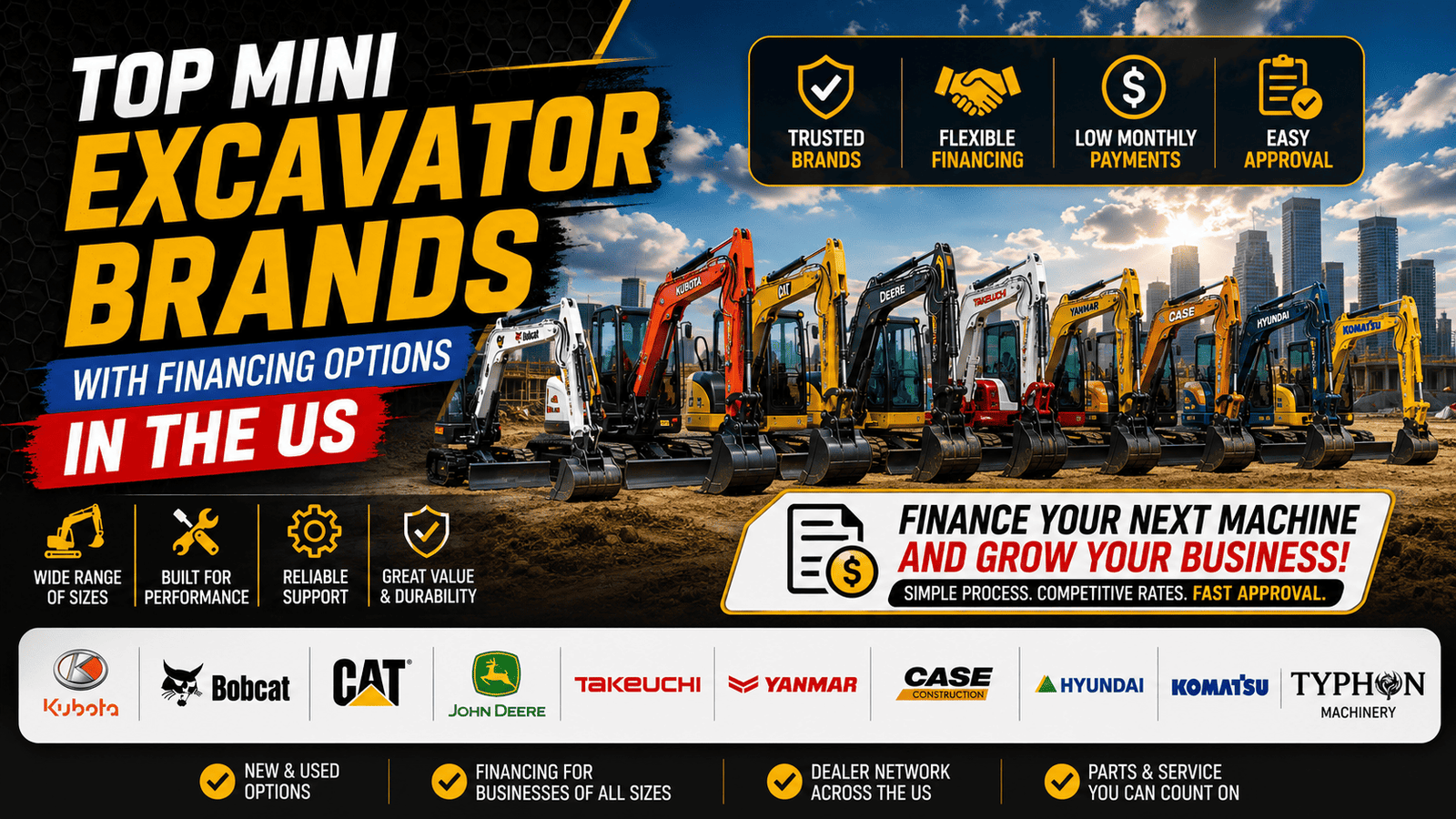
Top Mini Excavator Brands With Financing Options in the US
If you’re shopping for a mini excavator right now, the brand name on the hood matters less than most buyers assume — what actually decides whether you’re happy three years from now is dealer support, parts availability, and whether you can structure a payment that doesn’t choke your cash flow.
That last piece is where a lot of contractors get stuck, because not every manufacturer finances equipment the same way, and some of the loudest marketing claims about financing don’t hold up once you’re actually filling out an application.
This guide walks through the top mini excavator brands with financing options in the US, what each one is genuinely good at, and how financing actually works so you’re not guessing when you sit down with a dealer or a lender.
The right brand for you depends on machine size, application, dealer proximity, warranty coverage, attachment compatibility, and — increasingly — how accessible the financing actually is for a small operation. A brand can build a great machine and still be the wrong choice if the nearest dealer is three states away or the financing terms only work for large fleets.
One important note before we get into brands: financing availability changes by dealer, location, and promotional period, and not every manufacturer finances machines the same way some buyers expect. Where we mention a financing program below, we’re describing how it’s structured, not guaranteeing approval or terms — those depend on the lender, your qualifications, and the equipment itself.
What Are the Best Mini Excavator Brands in the US?
Contractors, landscapers, and property owners tend to gravitate toward a handful of brands for practical reasons: parts show up fast, dealers answer the phone, and resale value holds up when it’s time to trade in. Established brands like Kubota, Bobcat, and CAT built that reputation over decades through dense dealer networks.
Meanwhile, newer direct-to-consumer sellers like TYPHON Machinery have built a different kind of trust — competitive pricing and fast fulfillment backed by the same engine suppliers (Kubota, Yanmar, Briggs & Stratton, Honda) that power the legacy brands.
Neither approach is automatically “better.” A rental fleet running 300 days a year cares about a different set of things than a landscaper who needs a machine three days a week. What matters is matching the brand’s strengths — machine range, service network, financing structure — to how you’ll actually use the equipment.
Top Mini Excavator Brands With Financing Options in the US
TYPHON Machinery
Overview: TYPHON Machinery has become one of the fastest-growing names in the compact equipment space, built around a direct-to-consumer sales model that cuts out the overhead of traditional brick-and-mortar dealership networks. That structure lets TYPHON price machines noticeably below comparable units from legacy brands while still building on proven engine platforms.
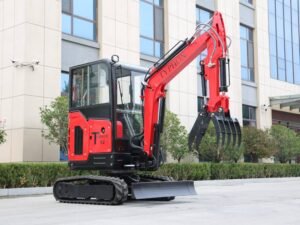
Mini Excavator Range: The TERROR lineup spans from sub-1.5-ton compact units like the TERROR XIII up through mid-size 2.7-ton and 3-ton machines, giving buyers a genuine range from backyard-gate-width machines to units capable of heavier residential and utility work.
Key Strengths: TYPHON machines are built around well-known, field-proven engines — Kubota D902, Briggs & Stratton, Yanmar, and Honda depending on model — which means service technicians outside the TYPHON network can still diagnose and repair the core powertrain. Buyers also get pilot controls, retractable tracks on several models, and cabin options with A/C and heat on higher trims, features that are often reserved for pricier machines from legacy brands.
Financing: TYPHON works with a financing partner, Paramount Financial, offering bundled financing that can cover the machine, shipping, and taxes together, along with a soft-credit-pull prequalification step so buyers can check eligibility before it affects their credit score. TYPHON also offers financing programs aimed at newer businesses, which is a meaningful difference for buyers who don’t have years of established business credit. As with any lender, actual rates, terms, and approval depend on the applicant’s credit profile and the financing partner’s current programs.
In July 2026, TYPHON Machinery signed a Memorandum of Understanding with Priority Capital Partners, a commercial equipment finance company established in 1997, naming Priority Capital as TYPHON’s preferred strategic financing partner. The partnership is aimed at giving small and medium-sized businesses faster financing decisions and more flexible repayment structures across TYPHON’s equipment lineup — including mini excavators, skid steers, forklifts, wheel loaders, road rollers, and scissor lifts — while helping buyers preserve working capital rather than tying up cash in an outright purchase.
Best For: Small contractors, landscapers, and property owners who want a capable machine without the dealership markup, and who are comfortable ordering equipment online rather than walking a physical lot.
Potential Limitation: Because TYPHON doesn’t operate a traditional in-person dealer network, buyers who strongly prefer face-to-face negotiation or same-day, walk-in service will want to confirm shipping timelines and regional parts support before ordering.
Kubota
Overview: Kubota is one of the most trusted names in compact equipment, largely because its diesel engines show up under the hood of machines from other brands too — including some TYPHON models.
Mini Excavator Range: Kubota’s KX and U-series span from under 2 tons to over 5 tons, covering nearly every mini excavator use case.
Key Strengths: Strong hydraulic performance, excellent fuel efficiency, and a dealer network with deep parts inventory.
Financing: Kubota Credit Corporation USA offers manufacturer-affiliated financing through Kubota dealers; specific promotional rates and terms vary by dealer and season.
Best For: Buyers who prioritize dealer proximity and long-term parts support over the lowest sticker price.
Potential Limitation: Generally priced at a premium compared to direct-to-consumer alternatives.
Bobcat
Overview: Bobcat is nearly synonymous with compact equipment in the US, with one of the largest dealer footprints in the country.
Mini Excavator Range: The E-series covers roughly 1-ton to 10-ton machines.
Key Strengths: Excellent operator comfort, strong resale value, and wide attachment compatibility across its own product ecosystem.
Financing: Bobcat Financial Services and CNH Industrial Capital typically offer financing and leasing through authorized Bobcat dealers; verify current programs with your local dealer.
Best For: Rental fleets and contractors who need nationwide service coverage.
Potential Limitation: Higher upfront cost relative to newer market entrants.
Caterpillar (CAT)
Overview: CAT’s reputation for durability and heavy-duty construction carries over into its compact line.
Mini Excavator Range: The 300 series covers roughly 1-ton to 10-ton mini and compact excavators.
Key Strengths: Rugged undercarriage design, strong resale value, and CAT’s extensive telematics system for fleet tracking.
Financing: Cat Financial offers manufacturer-affiliated loans and leases through CAT dealers; approval and terms depend on the buyer’s qualifications.
Best For: Contractors already invested in the CAT ecosystem who want cross-compatible attachments and consistent telematics.
Potential Limitation: Among the pricier options in the category, with premium parts pricing to match.
John Deere
Overview: John Deere pairs a strong agricultural heritage with a growing compact construction lineup.
Mini Excavator Range: The D-series and G-series span roughly 1.7 to 8 tons.
Key Strengths: Strong dealer network in rural and agricultural regions, solid hydraulic performance.
Financing: John Deere Financial provides manufacturer-affiliated financing and leasing options through Deere dealers.
Best For: Farmers and property owners who already work with John Deere equipment and dealers.
Potential Limitation: Dealer density can be thinner in dense urban markets compared to rural areas.
Takeuchi
Overview: Takeuchi is credited with building the first mini excavator and remains an engineering-focused brand favored by operators.
Mini Excavator Range: The TB series spans roughly 1.7 to 8.6 tons.
Key Strengths: Precise hydraulics and strong digging force relative to machine weight.
Financing: Dealer and third-party financing is typically available through Takeuchi’s dealer network; specific programs vary by dealer.
Best For: Excavation specialists who prioritize hydraulic precision over brand recognition.
Potential Limitation: Smaller dealer footprint than Kubota, Bobcat, or CAT in some regions.
Yanmar
Overview: Yanmar is a Japanese manufacturer known for compact, fuel-efficient diesel engines — the same engine family used in several TYPHON models.
Mini Excavator Range: The ViO and SV series cover roughly 1.7 to 8 tons, with a reputation for tight, zero-tail-swing designs.
Key Strengths: Excellent maneuverability in confined spaces and strong fuel economy.
Financing: Dealer and third-party equipment financing is generally available; verify current terms locally.
Best For: Landscapers and utility contractors working in tight residential lots.
Potential Limitation: Smaller dealer network in some parts of the US compared to legacy competitors.
CASE
Overview: CASE Construction Equipment has a long history in the compact equipment space with a focus on operator ergonomics.
Mini Excavator Range: The CX series spans roughly 1.7 to 6 tons.
Key Strengths: Strong operator visibility and comfortable cab layouts.
Financing: CNH Industrial Capital provides manufacturer-affiliated financing through CASE dealers.
Best For: Contractors who prioritize operator comfort on long shifts.
Potential Limitation: Attachment ecosystem is smaller than some competitors.
JCB
Overview: JCB, a UK-based manufacturer, brings a distinct engineering approach with a strong presence in utility and construction segments.
Mini Excavator Range: The 8-series spans roughly 1 to 10 tons.
Key Strengths: Durable build quality and strong lifting capacity relative to machine size.
Financing: JCB Finance offers manufacturer-affiliated programs through JCB dealers.
Best For: Utility contractors who need strong lift capacity in a compact footprint.
Potential Limitation: Parts lead times can be longer outside major metro dealer hubs.
Which Mini Excavator Brand Is Best for Small Contractors?
Small contractors juggle uptime, dealer support, and cash flow simultaneously, so the “best” brand depends on how those priorities rank for your business. If minimizing monthly payments and total purchase price is the priority, TYPHON’s direct-to-consumer pricing and bundled financing through Paramount Financial are worth serious consideration — especially for newer businesses that haven’t built up years of credit history.
If having a dealer down the road for same-day parts matters more than price, Kubota or Bobcat’s dense networks are hard to beat. Attachment versatility and resale value should factor in too, since a machine that’s easy to sell later effectively lowers your total cost of ownership.
Which Mini Excavator Brand Is Best for Landscaping?
Landscapers need compact dimensions, short or zero tail swing, and rubber tracks that won’t tear up a finished lawn. TYPHON’s smaller TERROR models and Yanmar’s ViO series both fit this profile well, with retractable tracks on select TYPHON trims making it easier to squeeze through a standard backyard gate. Hydraulic thumbs, augers, and trenchers are common landscaping attachments, and most brands in this list support them through standard auxiliary hydraulic lines.
Which Mini Excavator Brand Is Best for Residential Construction?
Residential jobs reward machines that balance digging depth and lifting capability against a narrow footprint that fits through gates and tight driveways. CAT and JCB’s mid-size compact models offer strong lifting capacity, while TYPHON’s 2.7- and 3-ton TERROR machines hit a similar sweet spot at a lower price point, which matters if you’re financing the purchase and want to keep monthly payments proportional to job revenue.
How Does Mini Excavator Financing Work?
Step 1: Choose the Equipment. Settle on the machine size, engine, and attachments you actually need for your typical job.
Step 2: Get the Total Purchase Price. This includes the machine, attachments, freight, setup, and any applicable taxes and fees — not just the sticker price.
Step 3: Compare Financing Offers. Look at APR, loan term, down payment, total interest paid, and the resulting monthly payment across at least two or three lenders.
Step 4: Submit Financial Information. Lenders may evaluate credit history, business history, income, financial statements, and the equipment’s value as collateral. Requirements vary by lender, so there’s no universal approval standard.
Step 5: Review the Agreement. Read the full financing agreement before signing, including any fees for early payoff, and confirm you understand the total cost over the life of the loan — not just the monthly number.
What Financing Options Are Available for Mini Excavators?
Manufacturer Financing: Offered through a manufacturer’s captive finance arm (Kubota Credit Corporation, Cat Financial, John Deere Financial, CNH Industrial Capital, JCB Finance) or an affiliated partner like TYPHON’s arrangement with Paramount Financial. Promotional programs may be available seasonally.
Dealer Financing: Arranged directly through the equipment dealer, often bundling the purchase and financing into a single transaction.
Bank Equipment Loans: Traditional lending from a bank, typically requiring established business credit.
Equipment Finance Companies: Specialized lenders focused specifically on equipment purchases, sometimes more flexible with newer businesses.
Leasing: Lower upfront commitment, but the ownership structure differs from a purchase — you may not own the machine outright at the end of the term unless there’s a buyout option.
Cash Purchase: No financing interest at all, but it ties up capital that could otherwise support operations.
| Financing Option | Main Advantage | Potential Drawback | Best For |
|---|---|---|---|
| Manufacturer / Affiliated Partner | Promotional programs may be available | Eligibility varies by lender and applicant | New equipment buyers |
| Dealer | Convenient, one-stop purchasing | Terms vary by dealer | Buyers wanting simplicity |
| Bank Loan | Established lending relationship | Stricter approval requirements | Qualified businesses with credit history |
| Equipment Finance Company | Equipment-focused underwriting | Rates and terms vary widely | Businesses without long credit history |
| Lease | Lower upfront cost | Ownership structure differs | Certain short-term business needs |
| Cash | No financing interest | Ties up available capital | Buyers with capital on hand |
What Determines Mini Excavator Financing Costs?
Purchase price, down payment, interest rate, and loan duration all factor in directly, but so do less obvious variables: your credit profile, business history, whether the machine is new or used, the lender’s risk assessment of the equipment as collateral, and any promotional financing currently running. None of these guarantee a specific outcome — they’re simply the levers that move your monthly payment up or down.
New vs. Used Mini Excavator Financing
New Equipment typically comes with manufacturer or manufacturer-affiliated financing, full warranty coverage, and no uncertainty about prior operating hours — all of which can make approval and terms more straightforward.
Used Equipment usually costs less upfront, but lenders often factor in the machine’s age, hours, and condition, which can affect available terms. Financing for used equipment is still widely available; it just depends more heavily on the specific machine’s history.
What Should You Look for Besides Financing?
The lowest monthly payment isn’t automatically the best deal. Warranty coverage, parts availability, dealer proximity, and resale value all affect what you actually pay over the life of the machine — a concept worth thinking about as total cost of ownership rather than just the purchase price or payment.
A machine with a slightly higher payment but a stronger warranty and faster parts turnaround can easily cost less over five years than a cheaper machine that sits idle waiting on parts.
How Much Should You Spend on a Mini Excavator?
Budget should reflect machine capability, expected utilization, ownership cost, and financing cost together — not just what fits your monthly cash flow today. Avoid buying too small a machine and grinding through jobs it wasn’t built for, and avoid buying too large a machine and paying for capacity you’ll rarely use.
Factor in attachments, service costs, and transportation requirements before locking in a budget, since those add-ons can meaningfully shift your total spend.
Questions to Ask a Mini Excavator Dealer
- What is the complete out-the-door price?
- What financing programs are currently available?
- What is the APR?
- What is the total financing cost over the full term?
- What down payment is required?
- What warranty is included?
- Are attachments included in the price?
- Are auxiliary hydraulics included?
- How quickly are replacement parts available?
- Where is the nearest service center?
- What are the recommended maintenance intervals?
- What is the machine’s operating weight?
- What transportation equipment is required to move it?
How to Choose the Right Mini Excavator Brand
- Define the job you need the machine for.
- Choose the required size class.
- Determine the attachments you’ll actually use.
- Check local dealer or shipping support.
- Compare warranty coverage across brands.
- Compare financing options and structures.
- Calculate total ownership cost, not just purchase price.
- Consider resale value if you plan to trade in later.
Frequently Asked Questions
What are the best mini excavator brands in the US? Kubota, Bobcat, CAT, John Deere, Takeuchi, Yanmar, CASE, JCB, and TYPHON Machinery are among the most commonly considered brands. Each has different strengths — legacy brands lead on dealer density and resale value, while TYPHON stands out for competitive pricing and accessible financing through its partner lender.
Which mini excavator brands offer financing? Most major brands offer some form of financing, either through a manufacturer-affiliated finance arm, an authorized dealer, or a financing partner. TYPHON Machinery, for example, offers bundled financing through Paramount Financial, including a soft-credit-pull prequalification option.
Can I finance a mini excavator with bad credit? It’s possible, but terms and approval depend entirely on the specific lender’s underwriting criteria. Some financing partners, including TYPHON’s, offer programs aimed at newer or less-established businesses, though outcomes still vary by applicant.
How does mini excavator financing work? You choose the equipment, get the total purchase price including taxes and fees, compare financing offers, submit financial information for review, and then review the agreement before signing. The process is similar across brands, though the underwriting lender differs.
Can I finance a used mini excavator? Yes, financing for used equipment is common, though lenders typically factor in the machine’s age, hours, and condition when setting terms.
How much does a mini excavator cost? Prices vary widely by size and brand, generally ranging from the low $20,000s for compact new units up toward $65,000 or more for larger, feature-rich machines. Direct-to-consumer brands like TYPHON tend to price lower than comparable dealer-network brands.
What credit score is needed to finance a mini excavator? There’s no universal minimum — requirements vary by lender, loan structure, and whether it’s a soft or hard credit check. It’s worth checking prequalification options, like a soft-pull program, before applying formally.
Is dealer financing better than a bank loan? Neither is automatically better; dealer financing is often more convenient and bundled into the purchase, while a bank loan may offer different terms if you already have an established relationship. Comparing offers side by side is the only reliable way to know which is cheaper for you.
Should I buy or finance a mini excavator? Financing is the norm for most contractors because it preserves cash flow for other business needs, while cash purchases avoid interest entirely. The right choice depends on your available capital and how quickly the machine will generate revenue.
Which mini excavator brand is best for contractors? It depends on whether price, dealer support, or attachment ecosystem matters most. TYPHON Machinery is a strong fit for contractors prioritizing lower cost and accessible financing, while Kubota or Bobcat suit those who want a dense local dealer network.