How to Compare Mini Excavator Specs Before Buying
If you’re staring at two spec sheets side by side and trying to figure out which mini excavator actually fits your work, you’re asking the right question. Knowing how to compare mini excavator specs before buying isn’t about finding the machine with the biggest number in any single column — it’s about matching operating weight, digging performance, hydraulics, dimensions, and attachment capability to the jobs you actually do.
A lot of buyers get this backwards. They shop by horsepower, or they chase the deepest digging depth on the page, and end up with a machine that’s either too big for their gate or too underpowered for the attachments they wanted to run. The right way to compare mini excavators is to look at size, operating weight, digging performance, hydraulics, attachment compatibility, site access, transportation, and total ownership cost together — not one spec in isolation.
This guide walks through every specification that matters, explains what each number actually means on a job site, and gives you a practical framework for comparing machines fairly.
What Mini Excavator Specs Should You Compare?
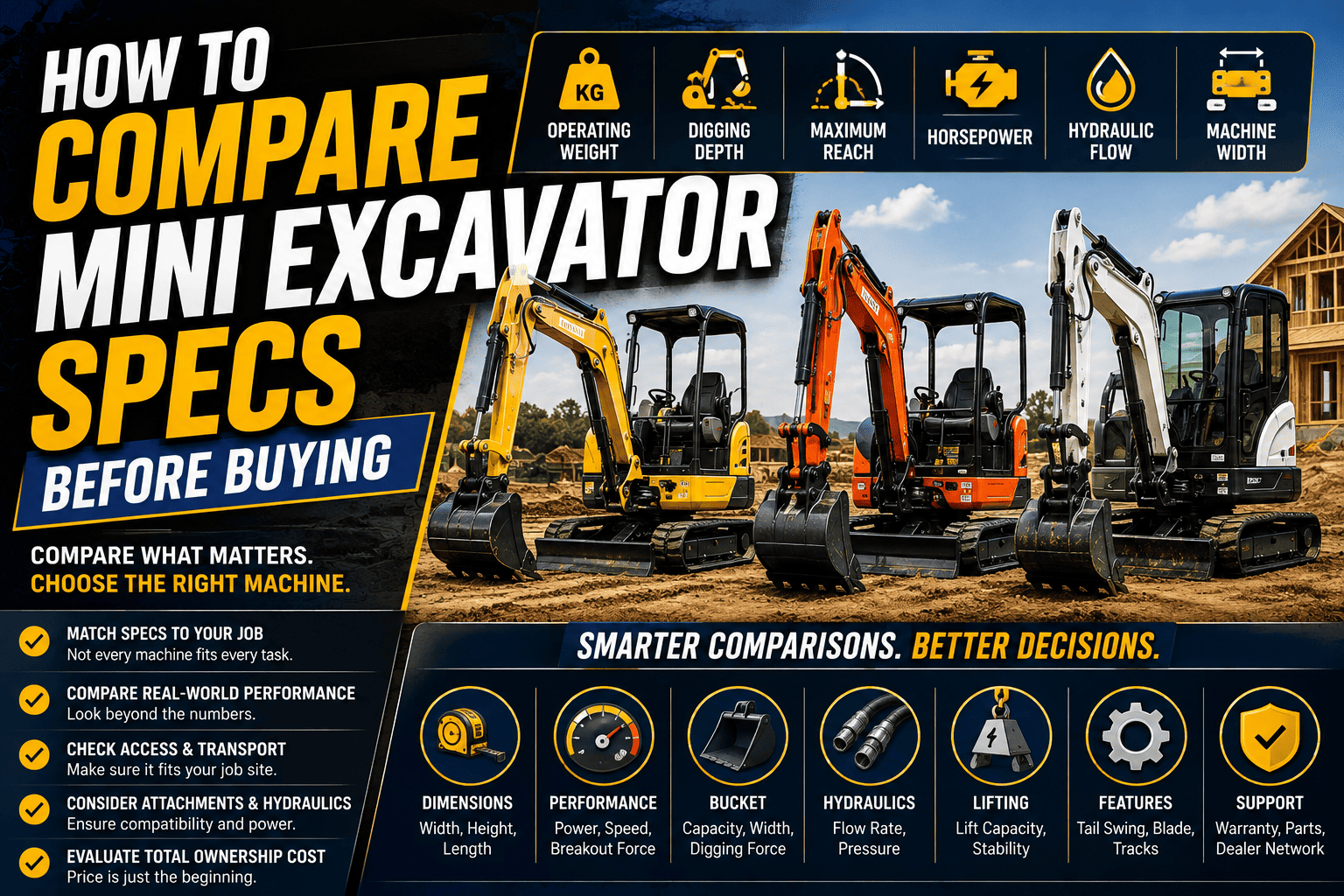
At minimum, line up these specifications before you make a decision:
- Operating weight
- Engine horsepower
- Digging depth
- Maximum reach
- Machine width
- Overall height
- Tail swing
- Hydraulic flow
- Lifting capacity
- Bucket capacity
- Travel speed
- Ground clearance
- Attachment compatibility
Not every spec carries equal weight for every buyer. A landscaper working in fenced backyards cares far more about width and tail swing than a contractor digging deep utility trenches in open lots. Knowing which specs matter most for your specific work is the real skill here — the rest of this article breaks each one down so you can weigh them properly.
Operating Weight — One of the Most Important Specs
Operating weight is the total weight of the machine in working condition — typically including a full fuel tank, hydraulic fluid, operator, standard bucket, and (on some spec sheets) a cab or canopy. It’s arguably the single most influential number on the page because it touches nearly everything else the machine does.
Heavier machines generally offer better stability, more digging force, and higher lifting capacity. But that weight has to go somewhere — it affects ground pressure (how much a machine sinks into soft or landscaped ground), how easily it can be transported, and whether it fits on the trailer or truck you already own.
Here’s where buyers get tripped up: manufacturers don’t always use “operating weight” and “machine weight” the same way. Some published figures include a cab, others a canopy only. Some include a specific bucket, others don’t. Before you compare two machines on weight alone, check exactly what configuration that number represents. A ten percent difference in operating weight might just be a difference in how the two manufacturers measured it, not a real capability gap.
Horsepower — How Much Power Do You Actually Need?
Horsepower gets a lot of attention because it’s an easy number to compare, but it tells you less than most buyers assume. Engine horsepower drives the hydraulic pump, which in turn powers digging, lifting, swinging, and travel — but the relationship between horsepower and actual performance depends on the hydraulic system design, pump output, machine weight, and how the boom and arm are engineered.
Two machines with identical horsepower ratings can dig, lift, and cycle very differently depending on how well the hydraulic system is matched to the engine. A higher horsepower rating also doesn’t automatically mean better digging performance if the machine’s weight or hydraulic flow can’t back it up.
What horsepower does affect directly is fuel consumption and, on many machines, travel performance. If you’re comparing horsepower between two excavators, use it as one data point among several — not the deciding factor.
Digging Depth and Maximum Reach
This is where a lot of spec-sheet confusion happens, because manufacturers publish several related but different measurements:
- Maximum digging depth — the deepest point the bucket can reach below the machine’s tracks
- Maximum vertical digging depth — how deep the machine can dig while keeping the wall of the excavation vertical, which is usually shallower than maximum digging depth
- Maximum reach — how far the arm and boom extend horizontally at ground level
- Maximum dumping height — how high the bucket can lift material for loading a truck or pile
- Maximum digging height — the highest point the bucket can reach
These numbers are usually tested with a specific boom, arm, and bucket configuration, so compare machines that are measured the same way whenever the manufacturer specifies it. A machine with an extendable arm, for example, may post a much deeper “maximum” figure that isn’t achievable with a standard arm.
In practical terms: trenching and utility work lean heavily on digging depth and reach, drainage and foundation work need enough vertical depth to keep excavation walls stable, and landscaping or pond work often needs generous reach more than raw depth.
Machine Width and Overall Dimensions
Physical size decides whether a machine can even get to the work — before performance matters at all.
Width is the number that eliminates machines fastest. Residential gates commonly run 36 to 42 inches, and a mini excavator that’s a few inches too wide simply won’t fit through, no matter how capable it is otherwise. Narrow driveways, fence lines, and tight backyard access all hinge on this one measurement.
Height matters for garages, sheds, low tree canopies, and overhead utility lines. A machine that transports easily but can’t clear a garage door opening creates problems you won’t discover until it’s already on site.
Length affects maneuverability in confined spaces, how the machine sits on a trailer, and how much room you need to turn or reposition it in a tight yard.
One caution worth repeating: published dimensions describe the machine itself, not its full working envelope. The boom, arm, and counterweight can extend beyond the resting footprint during operation, so leave margin beyond the base measurements when planning access.
Tail Swing and Maneuverability
Tail swing describes how far the rear of the machine’s upper structure extends beyond the tracks when the excavator rotates. There are three general categories:
- Conventional tail swing — the rear counterweight extends noticeably past the tracks during rotation
- Reduced tail swing — a smaller overhang, offering a middle ground between compactness and stability
- Zero tail swing — the upper structure rotates fully within the width of the tracks
Tail swing matters most when you’re working close to buildings, fences, parked vehicles, retaining walls, or anything else the counterweight could strike during a full rotation. Zero tail swing machines are popular for tight residential and urban jobs for exactly this reason.
The tradeoff is that reduced and zero tail swing designs sometimes carry smaller counterweights, which can affect lifting capacity and stability compared to a similarly sized conventional machine. Compact maneuverability and maximum stability aren’t always the same design goal.
Hydraulic Flow — A Specification Buyers Often Miss
Hydraulic flow, usually listed in gallons per minute, determines how much hydraulic power is available to run attachments through the auxiliary circuit. Machines are often available with standard flow and high-flow configurations, and pressure ratings matter alongside flow rate.
This spec becomes critical the moment you start looking at attachments like hydraulic breakers, augers, trenchers, brush cutters, grapples, or compactors. Each of these has a manufacturer-specified flow and pressure range it needs to operate correctly. Run an attachment with too little flow and it performs sluggishly or not at all. Run one with too much flow and pressure, and you risk damaging the attachment or the excavator’s hydraulic system.
Higher hydraulic flow isn’t automatically better — it’s only valuable if it matches what your attachments actually require. Before comparing two excavators on hydraulic flow, know which attachments you plan to run and check their required specifications against each machine’s rating.
Bucket Capacity and Digging Force
Bucket capacity, breakout force, and arm crowd force work together to determine how a machine actually moves material.
Bucket capacity is the volume the bucket holds, but the largest bucket isn’t automatically the best choice. Bucket width needs to match trench width requirements, and bucket size needs to be appropriate for the soil type and material density you’re digging in — an oversized bucket in dense clay can overload the hydraulic system, while an undersized bucket in loose soil wastes cycles.
Breakout force measures how much force the bucket can exert when curling into material, while arm crowd force measures the digging force generated by the arm cylinder. Both are more telling of real digging performance than bucket size alone, especially in hard-packed or rocky ground.
Bucket selection should shift based on soil type, trench width, material handled, machine size, and the hydraulic capability available to power the digging motion.
Lifting Capacity and Stability
Lifting capacity is a different measurement from operating weight, and the two shouldn’t be confused. A heavier machine tends to lift more, but actual rated lifting capacity depends on boom position, load radius (how far out the load is from the machine), overall configuration, ground conditions, counterweight, and any attachments in use.
Manufacturers publish rated capacity charts that show exactly how much a machine can lift at specific boom positions and radii — always at reduced percentages of the theoretical tipping load, for safety. Never estimate a machine’s lifting capability based on its operating weight alone, and always consult the manufacturer’s official capacity chart for the specific configuration you’re using before lifting any load.
Compare Mini Excavator Specs in a Table
A side-by-side table makes differences easier to see than reading two spec sheets separately. Use verified manufacturer figures only — never estimated or assumed values.
| Specification | Excavator A | Excavator B | What It Tells You |
|---|---|---|---|
| Operating Weight | — | — | Stability/transport |
| Horsepower | — | — | Engine power |
| Digging Depth | — | — | Excavation capability |
| Maximum Reach | — | — | Working envelope |
| Width | — | — | Site access |
| Hydraulic Flow | — | — | Attachment capability |
| Bucket Capacity | — | — | Material volume |
| Tail Swing | — | — | Maneuverability |
Pull every figure directly from the manufacturer’s official spec sheet, and note the configuration (cab vs. canopy, standard vs. extendable arm, standard vs. high-flow) each number represents.
Why You Should Compare Specs From the Same Configuration
This is where a lot of “apples to oranges” comparisons happen. A single model can post different specs depending on:
- Counterweight option
- Boom type (standard vs. extendable/telescoping)
- Arm length
- Track configuration (steel vs. rubber, width)
- Cab vs. open canopy
- Bucket fitted for testing
- Hydraulic package (standard vs. high-flow)
If you’re comparing a canopy machine with a standard arm against a cab machine with an extendable arm, the numbers won’t reflect a fair comparison — even if it’s the same base model. Whenever possible, request specs for the exact configuration you’d actually be buying, not the base trim used for marketing material.
Which Mini Excavator Specs Matter Most for Different Jobs?
Priorities shift depending on what you’re actually doing with the machine.
| Application | Most Important Specs |
|---|---|
| Landscaping | Width, weight, digging depth |
| Trenching | Digging depth, reach, hydraulic performance |
| Stump removal | Operating weight, breakout force, hydraulics |
| Drainage | Digging depth, reach, width |
| Residential work | Width, tail swing, weight |
| Heavy excavation | Weight, hydraulic performance, digging force |
| Attachment work | Auxiliary hydraulic flow, pressure |
| Transportation | Operating weight, dimensions |
If you do a mix of these jobs, prioritize the specs tied to your most frequent or most access-restricted work, and treat the rest as secondary considerations.
Don’t Compare Mini Excavator Specs Without Checking Attachments
Attachment compatibility deserves its own line item in any comparison, not an afterthought. Consider what you’ll actually run on the machine: buckets in different widths, a hydraulic thumb, an auger, a breaker, a trencher, a grapple, a compactor, a grading bucket, or a brush cutter.
A machine with impressive base specifications may still be a poor choice if it cannot properly power the [mini excavator attachments] you need. Check the auxiliary hydraulic flow and pressure range against each attachment’s requirements, confirm the quick-coupler system is compatible, and verify the boom and arm can handle the added weight and reach of larger attachments like breakers.
Mini Excavator Specs vs. Real-World Performance
Spec sheets describe a machine’s capability under controlled test conditions — they don’t fully describe how it will perform on your job site. Soil conditions, operator experience, machine setup, attachment choice, maintenance history, hydraulic system condition, track condition, and terrain all influence real-world output.
Two machines with nearly identical published specifications can feel noticeably different in daily use, especially once wear, maintenance quality, and setup differences come into play. Specs are a starting point for comparison, not a guarantee of performance — factor in machine condition and support when it’s a used purchase.
Transportation Specs You Should Check Before Buying
Before you buy, confirm you can actually move the machine. Check:
- Operating weight (with attachments and fuel, not just base weight)
- Machine width
- Machine height
- Overall length
- Trailer weight capacity
- Towing vehicle rating
- Attachment weight added to the total load
Compare the complete transport weight — machine plus attachments plus any accessories — against your trailer and towing vehicle’s rated capacity, not just the base machine specification. Towing regulations and weight ratings vary by location and vehicle, so verify manufacturer ratings and check applicable local requirements before hauling.
How to Compare Mini Excavator Prices With Specifications
Price only means something in context of capability. Weigh purchase price against useful specifications and ownership cost together, not price alone.
Factors that affect real value over time include warranty length and coverage, dealer support and proximity, parts availability, routine maintenance costs, attachment availability and pricing, financing terms, fuel consumption, and expected resale value. A lower purchase price can be offset — sometimes significantly — by weaker dealer support or harder-to-source parts down the road. The cheapest machine on paper isn’t always the best value once ownership costs are factored in.
A Simple Mini Excavator Buying Checklist
Step 1 — Define the job. Be specific about the type of work, not just “excavation.”
Step 2 — Determine the digging depth you actually need, with some margin.
Step 3 — Measure your site access: gate width, driveway width, overhead clearance.
Step 4 — Choose the operating-weight class that fits your stability and access needs.
Step 5 — Check hydraulic flow and pressure requirements for your planned attachments.
Step 6 — Choose the attachments you’ll need now and likely need later.
Step 7 — Compare transportation requirements against your trailer and tow vehicle.
Step 8 — Compare warranty terms and dealer/service support in your area.
Step 9 — Calculate total ownership cost, not just sticker price.
Step 10 — Compare verified specifications side by side, using the same configuration for each machine.
Common Mistakes When Comparing Mini Excavator Specs
- Choosing based only on horsepower — check hydraulics, weight, and digging force too.
- Ignoring machine width — the single most common reason a machine doesn’t fit the job site.
- Ignoring operating weight — it affects stability, transport, and lifting capacity together.
- Comparing different configurations — match cab-to-cab, arm-to-arm, flow package to flow package.
- Ignoring hydraulic flow — attachments won’t perform correctly without matched flow and pressure.
- Assuming digging depth equals overall performance — reach, width, and hydraulics matter just as much.
- Ignoring attachment compatibility — confirm the machine can actually power what you plan to run.
- Ignoring transportation — verify total transport weight fits your trailer and tow vehicle.
- Looking only at purchase price — factor in warranty, parts, and service support.
- Ignoring dealer and service support — this affects downtime and long-term ownership cost.
Avoiding these mistakes usually comes down to one habit: compare complete pictures, not single numbers.
Frequently Asked Questions
What specs should I compare when buying a mini excavator?
Compare operating weight, horsepower, digging depth, maximum reach, width, height, tail swing, hydraulic flow, bucket capacity, lifting capacity, travel speed, and attachment compatibility. Weigh these against your specific jobs and site access rather than picking the machine with the single highest number in any one category.
What is the most important mini excavator specification?
There isn’t one universal answer — it depends on the work. For access-restricted residential jobs, width and tail swing matter most. For deep trenching or utility work, digging depth and reach take priority. Operating weight affects nearly every other spec, which is why many buyers start there.
Is horsepower important when comparing mini excavators?
Horsepower matters, but it’s only one part of the picture. Actual digging and lifting performance also depend on hydraulic pump output, machine weight, and boom design. Two machines with identical horsepower can perform very differently depending on how well the hydraulic system is matched to the engine.
What does operating weight mean on a mini excavator?
Operating weight is the machine’s total weight in working condition, typically including fuel, hydraulic fluid, the operator, and a standard bucket. It directly affects stability, ground pressure, lifting capacity, and transportation requirements, so it’s one of the first specs to compare.
Why does mini excavator hydraulic flow matter?
Hydraulic flow determines how much power is available to run attachments like breakers, augers, trenchers, and grapples. An attachment needs flow and pressure within its specified range to perform correctly — mismatched flow can mean poor performance or damage to the attachment or hydraulic system.
How important is digging depth?
Digging depth determines whether a machine can reach the excavation depth your project requires, such as utility trenches or foundation work. It’s critical for depth-driven projects but less important for surface-level landscaping, where reach and width often matter more.
Should I compare mini excavator width?
Yes — width is often the deciding factor for residential and access-restricted jobs. A machine that’s a few inches too wide won’t fit through a standard gate, regardless of how capable it is otherwise. Measure your site access before comparing any other specification.
What does tail swing mean?
Tail swing describes how far the rear counterweight extends beyond the tracks when the machine rotates. Reduced and zero tail swing designs keep the upper structure within or close to the track width, which matters when working near buildings, fences, or other obstacles.
How do I compare mini excavator lifting capacity?
Use the manufacturer’s rated lifting capacity chart, which shows safe lifting limits at specific boom positions and load radii. Never estimate lifting capability from operating weight alone — actual capacity depends on configuration, counterweight, ground conditions, and attachments in use.
What should I check before buying a used mini excavator?
Beyond the published specs, check hydraulic system condition, track and undercarriage wear, engine hours, maintenance records, and attachment compatibility. A used machine’s real-world performance depends heavily on condition and upkeep, not just its original spec sheet.