Top 5 Scissor Lift Uses for Indoor and Outdoor Construction
Let’s be honest. Trying to haul heavy tools, bulky building materials, and your crew thirty feet into the air using shaky scaffolding is a massive headache. It eats up your clock, drains your budget, and puts your workers at serious risk. That’s exactly where mobile elevating work platforms step in to save the day by understanding the scissor lift uses.
If you’ve spent any time on a modern job site, you already know that understanding the absolute best scissor lift uses can completely change how you bid and execute a project. These machines use a remarkably simple but tough crisscross mechanism to push a wide, flat work area straight up into the air.
They give your team a rock-solid foundation to work from, allowing them to focus entirely on the job rather than worrying about losing their balance. When you dig into the most practical scissor lift uses, it becomes incredibly clear why project managers and contractors consider these lifts the undisputed backbone of their equipment fleet. They drastically cut down setup time, keep you compliant with strict safety regulations, and just make the hard work a whole lot easier.
Why Getting Off the Ladder Changes Everything
Transitioning away from old-school ladders and temporary scaffolding isn’t just about fancy new tech; it’s about sheer survival on tight project deadlines. When you bring a scissor lift onto a site, you are instantly upgrading your team’s capability to move both personnel and heavy gear in one smooth ride.
The economic upside is massive because you aren’t paying guys by the hour just to build and tear down scaffolding every time they need to move ten feet to the left.
- Stopping Falls Before They Happen: You get solid steel guardrails, secure harness tie-offs, and a flat deck that practically eliminates the scary slip-and-fall hazards we all hate dealing with on standard A-frame ladders.
- Carrying the Heavy Load: Instead of making ten trips up and down to grab tools, an industrial lift lets two or three guys ride up together with all their gear, saving hours of wasted energy.
- Driving While Elevated: The best part? You can literally drive the machine to the next work zone while the platform is still up in the air (at safe heights, of course), which speeds up continuous jobs like painting or wiring.
Top 5 Scissor Lift Uses:
1. Knocking Out High Ceilings and Overhead Fixtures
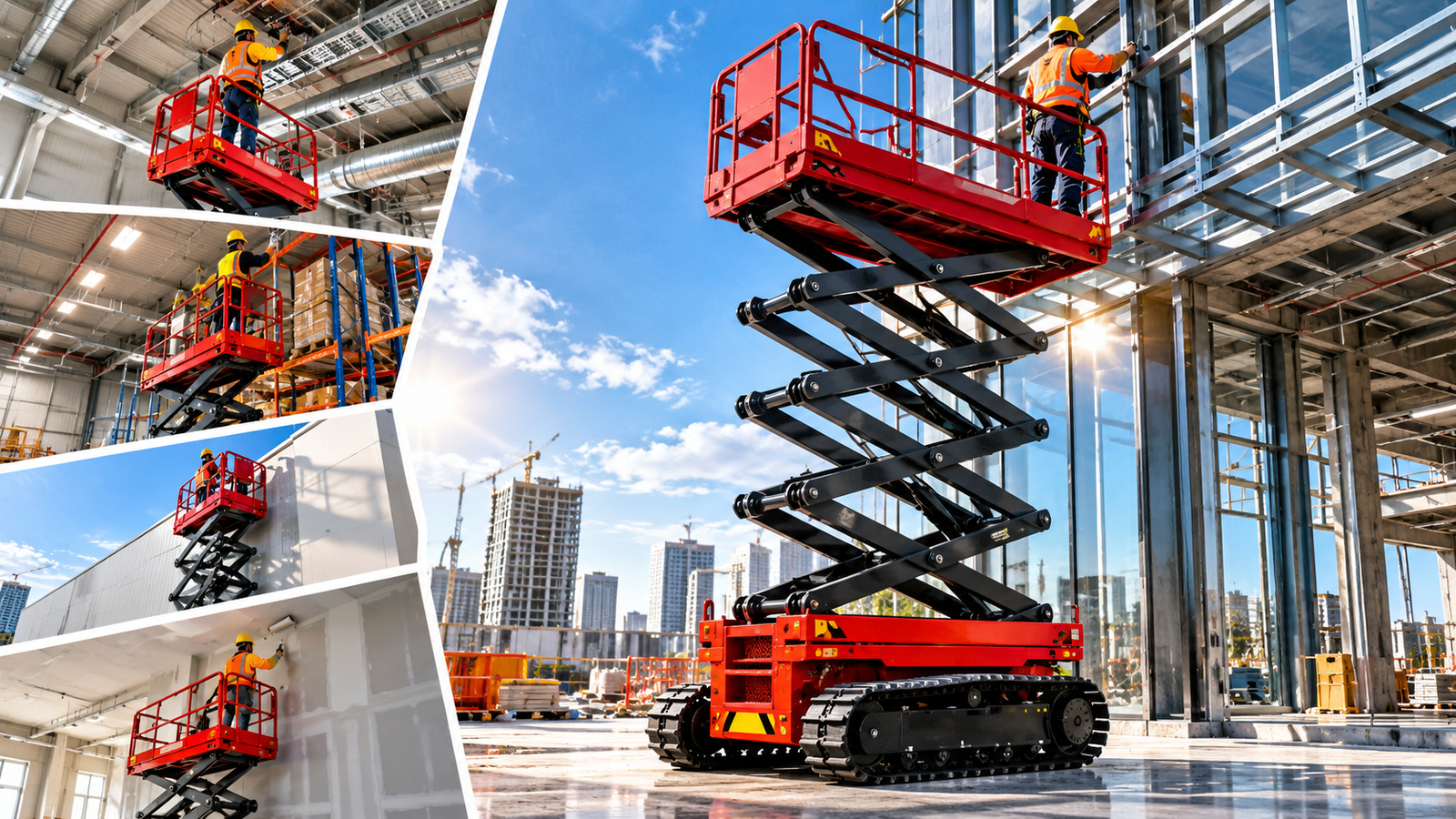
Think about outfitting a massive new commercial space, like a hospital wing or a retail store. You are dealing with dropped ceilings, miles of wiring, and heavy fixtures. One of the most common and practical scissor lift uses happens right here.
Nobody wants to hold a heavy piece of drywall over their head while balancing on the top rung of a ladder. The wide deck of a scissor lift creates a portable staging area where a crew can comfortably maneuver large ceiling components into perfect alignment without busting their backs.
- Hanging Drywall Without the Backache: Your drywall crew can stack their heavy gypsum boards right on the platform, lift it to the exact inch they need, and screw it in perfectly level without straining.
- Wiring Up Commercial Lighting: Electricians finally get a comfortable, stable floor to stand on while they carefully wire up complex grid lighting, heavy chandeliers, or security cameras in building lobbies.
- Installing Life-Saving Fire Systems: Pipefitters use the wide platform to line up, connect, and test overhead fire sprinkler lines and smoke detection grids across massive ceiling expanses.
2. Making Life Easier for HVAC, Plumbing, and Electrical Crews
The MEP trades (Mechanical, Electrical, and Plumbing) arguably have the toughest physical jobs on any site because they constantly wrestle with awkward, heavy metal components.
When you look at how these guys operate, their specific scissor lift uses usually revolve +around getting a stable base directly under heavy infrastructure. Ductwork, commercial water pipes, and thick bundles of copper wire weigh a ton. A solid lift lets a technician securely raise these structural pieces right up to the rafters, giving them both hands free to bolt, weld, and secure everything tightly.
- Routing Massive HVAC Ducts: Technicians can easily hoist huge sheet metal ducts into the air, perfectly aligning the seams and bolting them to the ceiling joists without needing a secondary material lift.
- Running Overhead Plumbing Lines: Commercial plumbers use these platforms daily to run thick cast iron drainage pipes and pressurized water lines through the upper skeletons of newly framed buildings.
- Pulling Heavy Electrical Cable: Instead of fighting gravity, electrical contractors can smoothly pull thick, heavy industrial cable trays across steel roof beams while slowly driving the lift down the hallway.
3. Taking on the Rough Terrain: Masonry and Exterior Finishing
Now, let’s step outside. Dirt, deep mud, gravel, and uneven slopes are an absolute nightmare for standard warehouse equipment. But outdoor scissor lift uses are incredibly vital, which is exactly why rough-terrain models exist. These beasts are built with heavy-duty tracks or deep-tread tires and massive engines.
Bricklayers, masons, and exterior crews rely on them heavily to keep their heavy materials directly at waist height as they build up a building’s exterior wall, completely bypassing the need to construct perimeter scaffolding.
- Laying Bricks and Block: Masons can load up a skid of heavy bricks and a tub of wet mortar, raising the platform foot by foot as the wall gets higher, which keeps them working at a comfortable, fast pace.
- Spraying and Rolling Exterior Paint: Painting crews can cover a massive exterior wall in a fraction of the time. They just set their height and drive smoothly alongside the building, laying down an even coat the whole way.
- Setting Heavy Commercial Windows: Glaziers use the rock-solid stability of the lift to carefully maneuver, align, and seal heavy, expensive glass panels into high-rise commercial framing without risking a shatter.
4. Conquering the Modern Mega-Warehouse
E-commerce has absolutely exploded, and as a result, warehouses are getting built taller than ever before to maximize storage space. You just can’t manage 40-foot-tall inventory racks with a forklift cage.
In the logistics world, daily scissor lift uses are all about building the racks safely and then maintaining the massive automated systems that run near the roof. Maintenance teams love these zero-emission electric machines because they can zip down narrow aisles silently and safely lift a guy up to fix a jammed conveyor belt.
- Building the Racking Systems: When a warehouse is first built, crews use lifts to bolt the towering metal storage racks into the concrete and tie them together securely at the top for earthquake safety.
- Doing the High-Tier Inventory Checks: Warehouse managers can pop up to the very top shelves to do manual inventory audits or check on damaged pallets without disrupting the forklifts working below.
- Fixing Overhead Conveyor Belts: When the automated sorting belts jam up near the ceiling, maintenance guys can safely get up there with their toolboxes to swap out motors, grease bearings, and get things running again.
5. Handling the Heavy Structural Steel and Big Signs
Sometimes you just need raw lifting capacity for the seriously heavy stuff. When you look at heavy-duty construction, the most critical scissor lift uses involve structural integrity and massive exterior installations.
Ironworkers who need to weld thick steel beams together prefer scissor lifts over boom lifts because the platform doesn’t bounce or sway in the wind. That stability is exactly what you need when you are running a hot welding torch forty feet in the air or trying to bolt a massive billboard to the side of a highway structure.
- Hanging Giant Billboards and Signs: Sign companies use the massive deck space to safely lift large, awkward illuminated signs and digital billboards, giving them room to bolt them securely into the concrete.
- Welding the Structural Steel: Ironworkers get an unshakeable, level floor to stand on while they perform high-precision welds on the main steel framing of a new building.
- Fixing Rooflines and Commercial Gutters: Exterior roofing crews can comfortably access the very edge of a commercial roof to replace heavy box gutters, fix damaged fascia boards, or inspect for storm damage.
The Right Tool for the Job: The TYPHON xFlex 4068ET
If you are currently bidding on jobs and figuring out your own scissor lift uses, you need to make sure you actually have the right iron in your fleet. Finding a machine that can handle both the mud outside and the tight corners inside is tough, but it’s not impossible.
Over at Machinery.online, the TYPHON xFlex 4068ET Electric Rubber Track Scissor Lift is turning heads for exactly this reason. It’s a monster of a machine that gives you a 40-foot platform height (meaning you can comfortably reach about 46 feet).
It’s built on aggressive 13-inch rubber tracks, so it eats up 30-degree muddy slopes for breakfast, but because it runs on a completely silent, zero-emission 48V battery system, you can drive it right indoors without choking out your crew.
- Serious Height and Capacity: It pushes you up to a 40-foot platform height with a heavy 705 lb payload, meaning you can easily take yourself, your buddy, and a bunch of heavy gear straight to the roofline.
- Tracks That Actually Grip: Forget getting stuck in the mud. The heavy-duty rubber tracks and hydraulic drive let you crawl over terrible outdoor terrain that would instantly sink a wheeled lift.
- Clean, Quiet Electric Power: You get a solid 6 to 8 hours of work on a single charge. No diesel fumes, no engine noise, making it absolutely perfect for indoor facility work and strict green-energy job sites.
Breaking Down Indoor vs. Outdoor Lifts
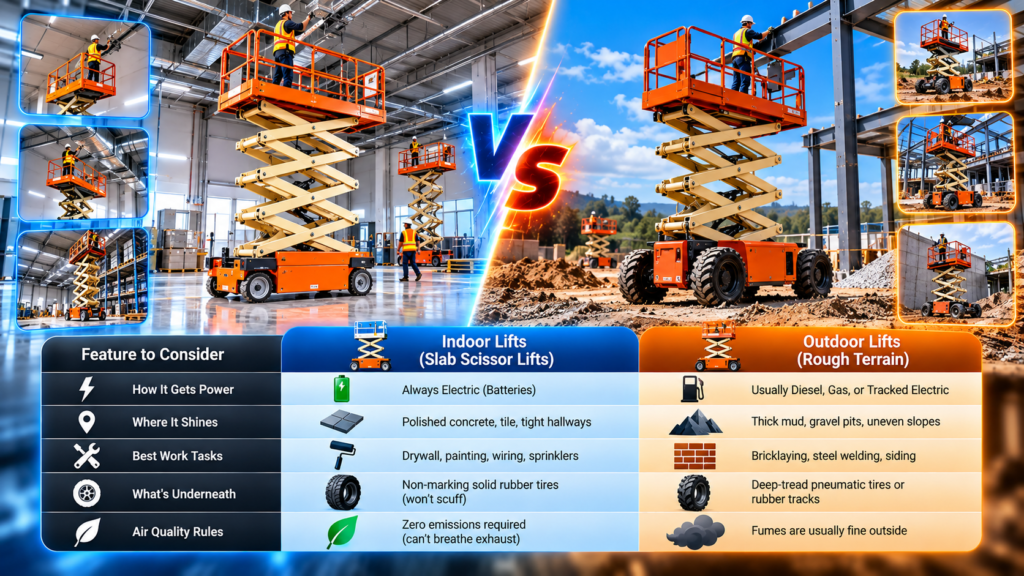
You really can’t treat all lifts the same. Taking a smooth-tire indoor lift out into the mud is a guaranteed way to get a heavy machine stuck, and bringing a loud, diesel-belching outdoor lift into a finished warehouse is a great way to ruin the floors and violate air quality laws.
Table: Scissor Lift Uses
| Feature to Consider | Indoor Lifts (Slab Scissor Lifts) | Outdoor Lifts (Rough Terrain) |
| How It Gets Power | Always Electric (Batteries) | Usually Diesel, Gas, or Tracked Electric |
| Where It Shines | Polished concrete, tile, tight hallways | Thick mud, gravel pits, uneven slopes |
| Best Work Tasks | Drywall, painting, wiring, sprinklers | Bricklaying, steel welding, siding |
| What’s Underneath | Non-marking solid rubber tires (won’t scuff) | Deep-tread pneumatic tires or rubber tracks |
| Air Quality Rules | Zero emissions required (can’t breathe exhaust) | Fumes are usually fine outside |
FAQs About Scissor Lift Uses
What is a scissor lift used for in construction?
Basically, it’s used anytime you need a flat, safe floor raised high into the air. Crews use them daily for installing overhead drywall, running HVAC ducts, pulling electrical wires, painting high walls, and laying brick. It completely replaces the need to build dangerous, time-consuming scaffolding.
Can you safely use a scissor lift outdoors?
Absolutely, but you have to use the right kind. You can’t take an indoor slab lift on the grass. You need a “rough-terrain” scissor lift. These models come with aggressive tires or heavy rubber tracks (like the TYPHON xFlex) that are specifically built to drive through mud, rocks, and uneven job site dirt.
What is the real difference between a boom lift and a scissor lift?
It comes down to how they move. A scissor lift only goes straight up and down, but it gives you a huge platform and can lift a lot of weight. A boom lift has a long arm that can reach up and over obstacles (like reaching over a ditch to touch a wall), but the bucket is small and usually only holds one person.
Do you need a special license or OSHA certification to drive one?
Yes, 100%. OSHA requires that anyone operating a mobile elevating work platform (MEWP) must go through formal, documented training. You need to know how to inspect it, how to read the load charts, and how to use your safety harness correctly before you ever touch the controls.
How high can a standard construction scissor lift actually go?
It varies widely. The small electric ones you see in retail stores usually max out around 19 to 32 feet. But the big, rough-terrain construction models can push a platform up to 40, 50, or even 60 feet in the air, allowing a worker to comfortably reach areas nearly 70 feet high.
Are these things safe to use on a sloped hill?
Operating a standard lift sideways on a hill is a massive tip-over risk. However, rough terrain lifts are built to handle mild slopes (usually up to 30 degrees). They often have heavy tracks to grip the hill, and many come with automatic leveling outrigger legs that punch into the dirt to make the machine perfectly level before you go up.
Should my business rent or buy a scissor lift?
If you only need it for a two-week roofing job once a year, just rent it. But if your crews are constantly doing ceiling work, electrical, or structural framing, renting will bleed your profits dry. Buying a reliable unit from a trusted source like Machinery.online ends up paying for itself in saved rental fees and zero downtime.