skid steer vs mini excavator: Which is Better for Landscaping Projects?
If you’ve ever stared down a massive outdoor renovation, you know exactly how daunting it feels. You’re looking at piles of dirt, overgrown brush, or maybe a backyard that needs a complete overhaul, and you realize pretty quickly that a couple of shovels and a wheelbarrow just aren’t going to cut it. You need heavy equipment. This is exactly where property owners and landscape contractors hit the classic roadblock: figuring out whether skid steer vs mini excavator is the right tool for the job.
Both machines pack a massive amount of hydraulic power into surprisingly compact frames, letting you knock out weeks of back-breaking manual labor in a single afternoon. But here’s the catch—they aren’t interchangeable.
Even though they show up on the same job sites, they are built with entirely different engineering mindsets and tackle completely different types of work. Picking the wrong machine usually means you end up burning through your rental budget, wasting daylight, and worst of all, accidentally trashing parts of the property you meant to save.
If you want to keep costs down and get the project done right, you need to understand exactly how the skid steer vs mini excavator dynamic plays out in real-world landscaping scenarios.
- Figure out the fundamental mechanical design differences that dictate what each piece of equipment actually does best.
- Assess your specific property layout and project goals to pinpoint the exact machine that will speed up your workflow.
- Look at the long-term rental and ownership costs, along with how different attachments can change the game.
Understanding the Core Differences: Skid Steer vs Mini Excavator
To make the best call for your site, you really need to look at how these two machines were meant to be used from the factory floor. Think of skid steer loaders as your ultimate heavy-lifting transports.
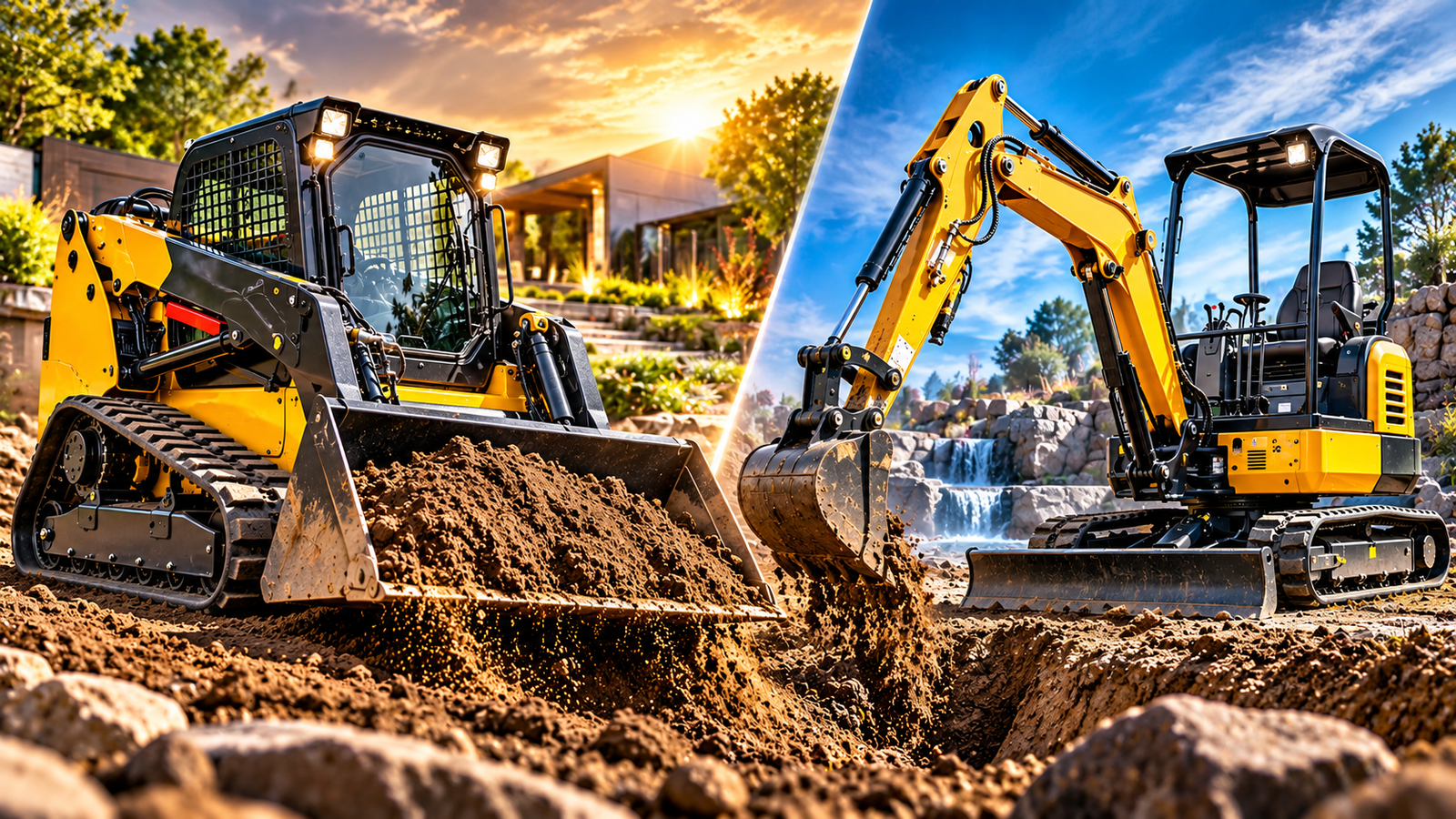
They are essentially compact tractors that steer by braking the wheels on one side, allowing them to pivot in their own tracks. That makes them incredibly fast and agile when darting around an open lot. They are built for scooping up a massive bucket of material, lifting it high, and hauling it across the yard in record time.
On the flip side, the mini excavator is a born digger. It sits on a set of continuous tracks with a cab—or “house”—that spins a full 360 degrees. That means the operator can dig a deep trench, spin around, and drop the dirt into a dump truck without the tracks ever moving an inch.
It’s a stationary precision tool compared to a skid steer’s high-speed shuttle run. When you’re standing in your yard trying to make a choice between different excavators and loaders, just ask yourself if you need to carry things around or dig deep holes. That one simple question usually points you straight to the right rental.
- Skid steer loaders are designed for high-speed material handling, aggressive pushing, and ferrying heavy loads across wide open spaces.
- Mini excavators specialize in stationary, high-power precision digging below the surface using a rotating cab.
- Your choice basically boils down to whether the core of your work involves running material across the site or digging down into the earth.
When to Use a Mini Excavator for Landscaping?
There are times when a landscaping job requires surgical precision below the dirt, and that’s exactly when the mini excavator becomes the hero of the site. A lot of professional landscaping goes way beyond just spreading mulch. We’re talking about carving out deep, complex trenches for irrigation systems, burying electrical lines for outdoor patios, or digging solid footings for heavy block retaining walls.
Any standard excavator is great for digging, but a compact model is perfect for these residential environments because its long, articulated boom arm can reach way down and rip through compacted clay, massive tree roots, and buried rocks with serious breakout force. Plus, because the machine itself stays put while the cab does all the rotating, you can work in ridiculously tight backyard corners.
If you’ve ever tried to operate heavy machinery right up against a vinyl fence or a delicate flower bed, you know how stressful it can be. A compact excavator for landscaping takes that stress away. You don’t have to keep driving back and forth to reposition, which drastically lowers the chances of accidentally smashing into existing structures. For deep earth extraction and working safely in confined zones, nothing beats it.
- Makes quick work of deep utility trenching for complex irrigation setups, drainage pipes, and outdoor electrical runs.
- Provides the focused breakout force needed to rip out old tree stumps and heavy boulders without destroying the whole yard.
- Allows you to work safely in super tight residential spaces thanks to a compact footprint and zero-tail-swing designs.
When to Use a Skid Steer for Landscaping?
If your game plan is less about digging deep trenches and more about completely leveling or reshaping the surface of a property, skid steer loaders are your go-to beasts. They are the undisputed kings of grading and material moving. Say you just had twenty yards of topsoil dumped in your driveway, and you need it spread evenly across the backyard before the sod arrives.
A skid steer will blast through that pile in a fraction of the time it would take an excavator. They are designed to aggressively push dirt, scoop up heavy loads, and zip across a sprawling job site without breaking a sweat. Because they can travel at much higher speeds than tracked excavators, they are the hands-down most efficient choice for large acreage jobs where you need to constantly shuttle stuff from point A to point B.
In the endless debate over skid steer vs mini excavator landscaping, the skid steer takes the crown any time you are dealing with widespread surface clearing, leveling out uneven terrain, or moving massive amounts of heavy bulk materials like crushed stone, sand, and mulch.
- Unbeatable for rough grading, surface leveling, and prepping massive areas of uneven ground before laying sod.
- The absolute fastest way to shuttle bulk materials like gravel, dirt, and heavy mulch across a large job site.
- Perfect for safely carrying heavy pallets of hardscaping stones or pavers when outfitted with fork attachments.
Comparing Attachments and Versatility
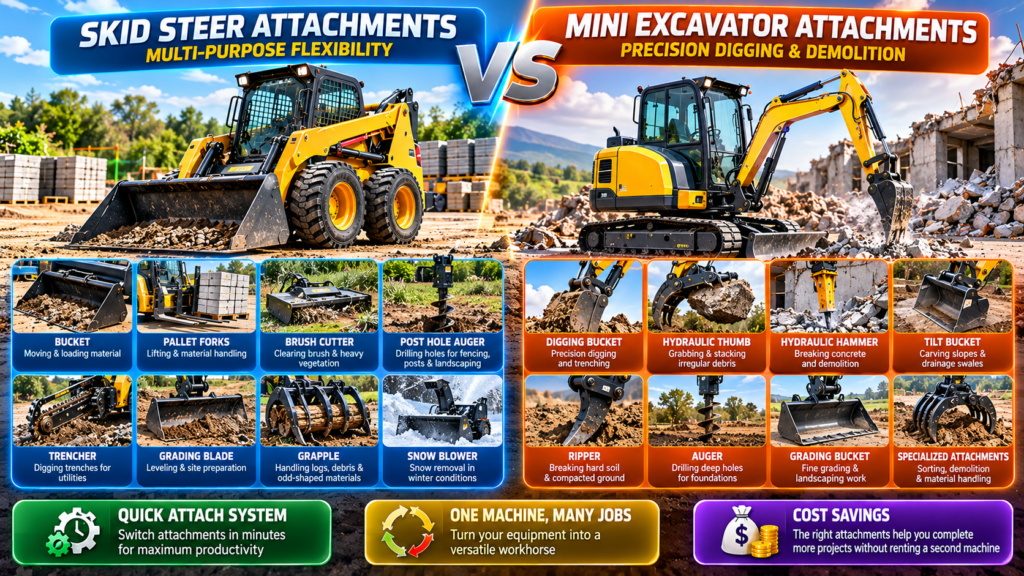
What really makes modern earthmoving equipment so amazing is the massive lineup of hydraulic attachments you can hook up to them. Both machines are versatile, but they tackle jobs in very different ways. Skid steer attachments are famous in the industry for basically turning the base machine into a giant Swiss Army Knife on wheels.
With a universal quick-attach system, you can drop a dirt bucket and hook up any skid steer loaders attachment imaginable—like a hydraulic post hole auger, a heavy-duty brush cutter, or even a trencher—in literally a couple of minutes. That crazy flexibility is exactly why landscaping crews usually buy a skid steer before anything else.
On the other hand, you also have an incredible lineup of mini excavator attachments to choose from, though they are hyper-focused on precision digging and demolition. You can throw a hydraulic thumb on an excavator to easily grab and stack weirdly shaped debris, attach a hydraulic hammer to bust up an old concrete driveway, or use a tilt bucket to carve out perfect drainage swales.
Getting a grip on the skid steer vs mini excavator landscaping matchup really comes down to looking at what specific tools you need for the different phases of your build.
- Skid steer loaders deliver unmatched multi-purpose flexibility with fast-swap tools like brush hogs, augers, forks, and grading blades.
- Mini excavator attachments utilize high-powered, precision-based functionality—think hydraulic thumbs, concrete breakers, and specialized grading buckets.
- Picking the right attachments can often save you from blowing your budget on a second heavy equipment rental.
Impact on Terrain and Confined Spaces
Anyone who has ever done a residential backyard overhaul knows that protecting the existing lawn is half the battle. If you drive a massive piece of machinery across wet grass without thinking it through, you’re going to be spending a fortune on turf repair when the job is over.
Wheeled skid steer loaders turn by locking up one side of the wheels and violently skidding the tires across the dirt. On a delicate, soft lawn, that skidding action will tear the grass to shreds and dig deep, nasty ruts in a matter of minutes.
Mini excavators, on the other hand, roll on continuous rubber tracks that spread the heavy weight of the machine out over a much wider area. That lower ground pressure, combined with the fact that the excavator just sits in one spot and spins to do its work, means it barely leaves a mark compared to a wheeled loader.
Plus, if you are dealing with a classic suburban backyard where the only access point is a tiny wooden fence gate, many compact excavators have retractable tracks. They can literally suck their tracks in, squeeze through a standard gate, and widen back out once inside.
- Wheeled loaders will aggressively tear up soft turf because of their skidding turn style and higher ground pressure.
- Mini excavators use rubber tracks to evenly spread weight, heavily reducing soil compaction and saving delicate lawns.
- Retractable undercarriages on smaller excavators allow them to slip easily through tight residential gates and narrow pathways.
Cost Considerations: Buying and Renting
Whether you are a weekend DIY warrior trying to figure out a weekend rental or a business owner looking to expand your fleet, you have to look at the numbers. If you find yourself constantly searching online for a mini excavator for sale, keep in mind that tracked machines always cost more in upkeep over the long haul. Replacing steel undercarriage parts and heavy rubber tracks is pricey.
Generally, skid steer loaders are going to hit your wallet a bit softer on the initial purchase price, and they are notoriously cheaper to maintain because dealing with wheels and tires is a lot less complicated. But if you are just heading to the rental yard for a few days, the daily rates between the two are actually pretty close.
The real hidden cost comes down to workflow. If you rent a skid steer to try and dig a 100-foot trench, you are going to be out there for days struggling with it, blowing your budget on extra rental days and wasted labor. The same goes for trying to move mountains of gravel with a slow excavator.
- Skid steer loaders generally have a more approachable upfront price tag and far simpler, cheaper long-term maintenance costs.
- Browsing for a mini excavator for sale? Remember they hold incredible resale value on the used market because they are constantly in high demand.
- Renting the wrong machine for the job is a guaranteed way to waste time, extend rental fees, and blow up your labor budget.
The Final Verdict on Skid Steer vs Mini Excavator Landscaping
At the end of the day, trying to crown one machine as the undisputed champion of the yard is pointless because it’s all about what the job actually demands. If your project involves pushing dirt around, spreading gravel, hauling heavy pallets of pavers, and doing it all as fast as possible across a big open space, you need a skid steer.
It’s the ultimate high-speed surface workhorse. But if you are looking at pulling out massive stumps, digging deep trenches for pipes, or working inside a cramped, fenced-in backyard where you can’t afford to trash the grass, a mini excavator is going to save your life. Honestly, on big professional hardscaping jobs, you’ll almost always see both machines working together.
The excavator handles all the heavy surgical digging, and the loader runs back and forth clearing the dirt away and bringing in the fresh gravel. By taking a hard look at your site access, ground conditions, and exactly what needs to be moved or dug, you’ll know exactly which piece of heavy iron to fire up.
- Go with skid steer loaders if you need fast material transport, serious surface grading, and a ton of different fast-swap tools.
- Grab a mini excavator when your focus is on deep below-ground digging, working in tight spaces, and keeping turf damage to a minimum.
- For massive outdoor renovations, running both machines in tandem is easily the fastest, most cost-effective way to knock the job out.
FAQs: Skid Steer vs Mini Excavator
Can a skid steer dig as well as a mini excavator?
Not even close. You can definitely slap a digging bucket on a loader, but it just doesn’t have the geometry to match a mini excavator. Skid steers are built to push forward and lift up. Excavators are literally engineered to pull down and rip into the earth with massive breakout force. If you try to dig a serious trench with a skid steer, you’re going to be fighting the machine the whole time.
- Loaders totally lack the deep downward reach that comes naturally to an excavator’s boom.
- Mini excavators give the operator a perfect line of sight into the hole, making it way safer around buried pipes.
- Forcing a loader to dig deep is a slow, frustrating process that burns up fuel.
Which machine causes less damage to residential lawns?
A mini excavator is much easier on the grass. Wheeled skid steer loaders are notorious lawn wreckers. Because they have to lock up their wheels and skid to turn around, they rip the top layer of turf right off the dirt. A compact excavator spreads its weight out over long rubber tracks, keeping ground pressure incredibly low.
- Rubber tracks distribute heavy weight evenly, stopping the machine from sinking in.
- The spinning cab means the tracks stay perfectly still while working, completely eliminating destructive turn maneuvers.
- Wheeled loaders will almost always leave deep, expensive-to-fix mud ruts in a residential yard.
Is a mini excavator easier to operate for beginners than a skid steer?
For someone jumping into the seat for the very first time, a skid steer usually feels a lot more natural. You just push the joysticks forward to go forward and pull back to stop. A mini excavator takes a bit more brain power at first. You have to use the joysticks to independently control the boom, the stick, the bucket curl, and the cab swing all at the same time.
- Skid steer loaders have super intuitive drive controls that most rookies pick up almost instantly.
- Excavators require you to blend multiple joystick movements together to get a smooth, clean dig.
- You can get the hang of safely operating either machine with about half an hour of good practice.
Which equipment is better for land clearing?
It really depends on what kind of mess you are cleaning up. If you are dealing with acres of thick brush, you want a skid steer loaders attachment like a brush hog or a grapple bucket. But if that land is full of massive, deep-rooted tree stumps or giant boulders, you absolutely need a mini excavator to rip them right out of the ground.
- Loaders dominate when it comes to mowing down surface brush and moving large piles of loose debris.
- Mini excavators are mandatory if you need to perform surgical strikes on deep tree stumps and massive rocks.
- Most contractors use a combo of both to get the site completely stripped and leveled.
Can a mini excavator lift heavy pallets of material?
While mini excavators are incredibly strong for their size, they aren’t meant to act like forklifts. If you need to unload pallets of brick pavers or sod, a skid steer is what you want. You can easily hook up skid steer attachments like pallet forks, and the machine’s lift arms are structurally built to keep that heavy, awkward weight perfectly balanced while you drive.
- Excavators are built to hoist and pivot materials in a stationary spot, not transport them long distances.
- Skid steer loaders are engineered with heavy-duty lift arms specifically made for carrying massive, bulky loads safely.
- Pallet forks are one of the most common attachments for loaders, but you’ll rarely see them on an excavator.
What is the primary difference in travel speed between the two machines?
If it were a foot race, the loader would completely leave the mini excavator in the dust. Standard skid steer loaders can cruise around a job site at anywhere from 7 to 10 miles per hour. Mini excavators are built to crawl, usually topping out around 2 or 3 miles per hour to maintain stability.
- Wheeled loaders save a massive amount of time when you have to ferry materials across a large property.
- The slow, creeping speed of an excavator ensures maximum stability and safety when digging deep.
- Because of the speed difference, loaders are vastly superior for constant loading and unloading tasks.
Is renting a skid steer cheaper than a mini excavator rental?
When you look at the daily rental sheet, the base prices for both machines are usually pretty close. But looking at the daily rate is a rookie mistake. If you rent a cheaper loader to dig a long utility trench, you’ll probably end up keeping it for an extra two days because it’s the wrong tool for the job. Getting the machine that actually matches your workflow is always the cheapest route.
- Base rental rates at most equipment yards are highly competitive between the two platforms.
- Your actual out-of-pocket cost depends entirely on picking the machine that lets you finish the job faster.
- Don’t forget to factor in the extra daily fees for any specialized mini excavator attachments or skid steer attachments you might need to rent.