Get Rid of Tree Roots Quickly: The TYPHON Skid Steer Stump Grinder is a Power and Efficiency Leader
Landscaping, construction site preparation, and property development projects usually result in the need for quick and comprehensive clearing of the elements. Tree stumps are a constant cause of delaying the time of productions; they can damage the undercarriages of vehicles and destroy the pretty layout of the newly cleared areas which can be easily and effortlessly cleared using the most powerful machine, The TYPHON Skid Steer Stump Grinder.
The TYPHON Skid Steer Stump Grinder attachment is, without a doubt, an industry revolutionary tool by the way it is able to eliminate these issues at once. Besides being efficient, it is the only one in the market that can be compatible with the machinery platforms of top quality that you will find in premium marketplaces. It is a heavy-duty power house that can upgrade your daily operations efficiency.
Thanks to the fact that the engineering team has brought in to practice the latest engineering technologies, this small attachment can break even the densest root networks without much affecting the output power of the main machine.
Excavators, farmers lying in efforts to remove root systems manually or with traditional buckets have been facing huge delays. Changing to a high-tech attachment design will physically transform field operations. It is a mechanical solution whereby maximizing the high-speed cutting wheels that results in cutting stumps powerfully”.
Features of TYPHON Skid Steer Stump Grinder
The performance aspect of the operation for TYPHON STOMP is mainly associated with its finely engineered parts. It has a design that enables it to work on hardwood or softwood, it can reduce a large stump to typical organic mulch almost instantly. Operators will notice a few of these engineering have brought about a significant improvement in the stability and control of the equipment during grinding of stumps deep underground:
- High-Speed Cutting Wheel: The high-speed cutting wheel has a 410mm diameter and a 40mm thickness. It can deliver high inertia and reach cutting speed of upto 780rpm.
- Precision Carbide Blades: These blades feature 16 strategically placed, highly durable blades which cut through even deeply embedded roots very efficiently without getting caught or binding.
- Compact Physical Footprint: Overall length of a TYPHON is 896mm, 20mm width, and a total weight of 110kg. This helps optimize balance and weight distribution of the machine.
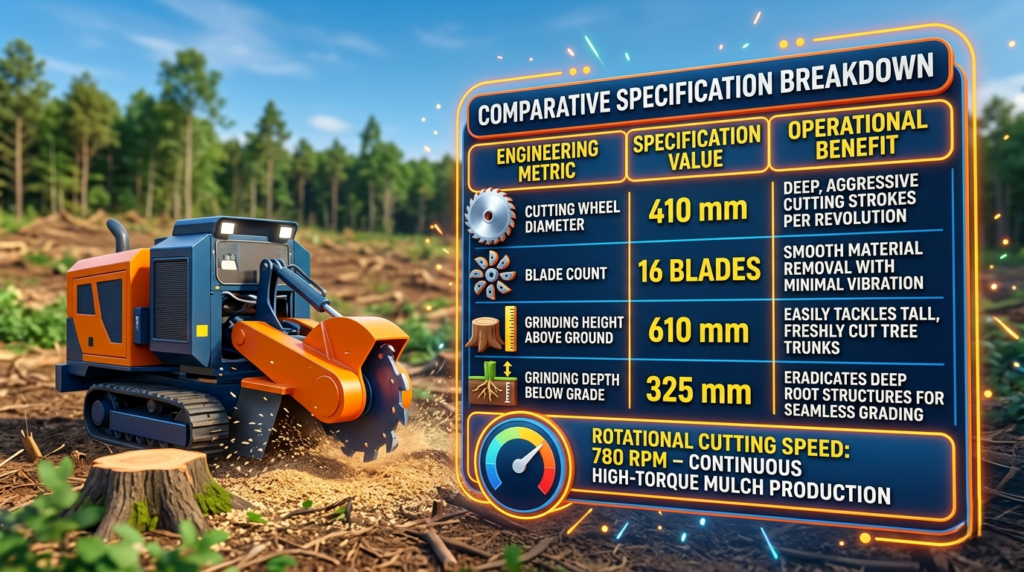
Table: Comparative Specification Breakdown
| Engineering Metric | Specification Value | Operational Benefit |
| Cutting Wheel Diameter | 410 mm | Deep, aggressive cutting strokes per revolution |
| Blade Count | 16 Blades | Smooth material removal with minimal vibration |
| Grinding Height Above Ground | 610 mm | Easily tackles tall, freshly cut tree trunks |
| Grinding Depth Below Grade | 325 mm | Eradicates deep root structures for seamless grading |
| Rotational Cutting Speed | 780 rpm | Continuous high-torque mulch production |
Benefits of the TYPHON system in landscaping and site preparation
Using the TYPHON system at different sites causes instant rise in the production and safety level of the sites. Most of the root extraction methods lead to creation of the huge holes that require a lot of backfilling and leveling. With a dedicated cutting attachment, you can avoid these material handling steps completely thus enhancing the operational workflow in the following fields:
- Land repurposing on the spot: It is possible to grind roots far below the surface line, which means one can lay topsoil, turf or concrete right away.
- Use of attachment: A hydraulic system has been especially designed to work with main loader.
- Labor reduction: By getting rid of multi-man manual digging crews, this comes with one machine operating from a cab lower overhead costs.
Hydraulic systems in heavy machinery: How to fix the most common problems
Even the best working heavy equipment attachments depend on the host vehicle’s fluid dynamics. For the high performance of attachments like the TYPHON Skid Steer Stump Grinder, the main loader’s fluid loop must be well maintained. Heavy equipment operators needs to know how hydraulic systems work and how to get rid of the problems when the pressure in the system drops at the time of the job.
The fluid system relies on flow rates that are constant, pressure seals that are tight and temperatures which are optimized for working, to be able to deliver force mechanically to the attachments. When a machine has a hard time lifting a heavy bucket or running a high-output attachment, the cause is most probably a fluid or structural failure. Proper diagnosis is what helps keep small issues from turning ones that not only require high costs but result in the stoppage of your job site.
How to recognize slow running systems and loss of power
A reduced system pressure or a loss in speed of the entire machine is a clear indication that fluid contamination and/or an internal flow restriction are involved. Hydraulic cylinders taking longer to respond is an indication that the power loop cannot supply the volume required for mechanical work. Troubleshooting should be focused around the three main components:
- Amount of fluid viscosity: Make sure the oil viscosity corresponds with the location. If it is too thick because of cold weather or too thin as a result of the overheating, it will cause slow operations.
- Clogged filtration in the system: Check for all the inline hydraulic filters, as the clogged filtration media when restricts flow will cause a drop in pressure across the circuit.
- Internal component wear: There may be internal leaks in the pumps, motors, or directional control valves where oil bypasses seals and not drive the attachment.
Getting rid of Mechanical Noise and Cavitation
The hydraulic loop in good condition usually makes a rhythmic hum that is consistent; any sharp banging, clicking or high-pitched whine indicates the presence of internal stress. These noises most of the time result from aeration, which happens when outside air enters the closed loop or cavitation when the fluid supply is not enough for the pump demands. To avoid major component damage, the inspection should focus on the main points:
- Suction line integrity: Look for any tiny air leaks that bring atmosphere air into the fluid by checking the inlet hose connections and pump suction line seals.
- Inlet screen cleanliness: Remove any internal reservoir inlet screen blockage that may cause fluid starvation and vapor cavity formation in the pump gear housings.
- Fluid quality and foaming: A milky appearance of the fluid in the reservoir can be a sign of water contamination, while aeration is characterized by foam on the surface.
Tackling Hydraulic Fluid Overheating
Extremely high operating temperatures cause quick destruction of internal system components, degradation of fluid lubrication properties, and warping of important rubber seals. After hydraulic oil reaches a temperature of 180°F (82°C), its protective film becomes so thin that it causes friction wear on the costly parts such as pumps. To be able to halt overheating problems before they lead to complete system failure, you should concentrate on the following main system elements:
- Heat exchanger blockages: Rinse off dirt, wood chips and organic debris from the outer cooling fins of the hydraulic oil cooler assembly.
- Relief valve calibration: Make sure that the main system relief valve is not stuck in an open position or adjusted too low, resulting in the fluid being dumped back into the reservoir continuously.
- Reservoir fluid capacity: At all times, the hydraulic fluid tank should be at the specified fill line as low fluid levels mean that there is less oil to help absorb and dissipate heat during operation.
Table: Hydraulic System Troubleshooting Tips and Tricks
| Observed System Symptom | Potential Root Cause | Recommended Corrective Action |
| Erratic Attachment Movement | Trapped air pockets in lines | Bleed the air from the system lines and tighten the fittings |
| High Whining Noise at Pump | Pump cavitation / Fluid starvation | Clear the intake line blockages and check the inlet strainers |
| Rapid Loss of Circuit Pressure | Worn internal cylinder seals | Disassemble the actuator cylinder and replace all internal packings |
| Milky Colored Hydraulic Oil | Water intrusion into the loop | Drain the fluid reservoir entirely, flush the lines, and refill with fresh oil |
| Control Valve Lever Binding | Mechanical linkage misalignment | Clean the exterior control linkages and realign the valve spools |
FAQ’s – TYPHON Skid Steer Stump Grinder
What is the hydraulic flow requirement for the TYPHON Skid Steer Stump Grinder?
The hydraulic flow rate required for operating the TYPHON STOMP Skid Steer Stump Grinder Attachment efficiently is 40 Liters per minute (40L) with a working pressure of 17 Mega Pascals (17Mpa). This means that the unit can deliver good performance on regular-flow auxiliary hydraulic circuits without the need for costly high-flow loader upgrades.
What should I consider do if the TYPHON stump grinder seems to be making abnormal noises?
When hydraulic systems operate normally, they produce a steady, rhythmic hum. Any sudden banging, clicking, or high-pitched whines should alert you to possible internal issues. These noisy symptoms can frequently be traced back to aeration, which is the introduction of outside air into the closed loop, or to cavitation, which happens when the fluid supply can’t meet the demand of the pump. Early symptom identification can prevent major component failure by allowing you to focus on primary inspection areas such as suction line integrity, the cleanliness of the inlet screen, and fluid quality/foaming.
Where can I get the replacement blades and parts for heavy machinery attachments?
Authorized heavy machinery online stores like machinery.online and certified brand distributors sell verified replacement parts, attachments, and provide support information. Use genuine components to maximize attachment lifetime and safeguard your machinery investment.
How can I tell if my hydraulic fluid is contaminated with water or air?
Visual check: Water contamination causes the hydraulic oil to have a cloudy or milky appearance. Presence of air results in the reservoir fluid to have foam on the surface.
What do I do if My skid steer loader is losing hydraulic power after running for about one hour?
Thinning hydraulic oil as system temperatures rise is the common reason for power loss after a machine heats up. Seals of internal components such as pumps or control valves will leak thin oil if worn, leading to a drop in overall operating pressure.
Is it safe to check for high-pressure hydraulic leaks with my bare hands?
The use of bare hands to check for hydraulic leaks of a pressurized machinery loop is highly discouraged. Pressurized fluid can easily penetrate human skin causing an injection injury which is quite dangerous and requires emergency medical operations. Cardboard or wood is always better.
How is the TYPHON Skid Steer Stump Grinder operational?
The TYPHON Skid Steer Stump Grinder uses an excelling 410mm cutting wheel with the 40mm wheel thickness which provides high inertia and the cutting speed of up to 780 rpm.