
Things to Consider When Buying Backhoe Loaders for Your Project
Buying the right heavy equipment for a construction, agricultural, or industrial project is a key step that will directly impact your work schedule, profit, and final project success. Of the many flexible machines on the market today, the backhoe loader is one of the most multi-purpose and workhorse types of equipment available.
According to the combination of features, the backhoe loader merges the digging capability of an excavator with the loading possibility of the front-end wheel loader, which usually require two or three separate machines. Notwithstanding, as there is a great variety of sizes, power configurations, and feature sets of backhoe loaders, understanding how to pick a backhoe loader for your next project is a matter of finding a good balance between the construction site specifications, performance features, and technology requirements.
Purchasing without considering all aspects may result in expensive operational inefficiencies such as providing less power than required to your crew or excessively spending your capital on a too large machine that is not able to get around your job site.
With a thorough examination of the main engineering features – such as engine horsepower, maximum digging depth, specific hydraulic pump performance – you will make a data-based purchase that results in top machinery ROI.
This detailed article gives you the exact factors that you need to consider while selecting the perfect backhoe loader that meets the mechanical, geographical, and financial aspects of your project.
Getting to Know the Machine Structure and Functional Center
Purchasing wise decision parameters aside, knowing the basic structure of a backhoe loader and working principle of its various structural components is a must. In simple terms, a backhoe loader is a heavy-tracked vehicle on which a loader is attached in the front and an excavator arm in the back.
Given the nature of their use, the operator faces forward to manipulate the large front bucket for material handling and, inside the cab, executes a 180-degree pivot in order to operate the digging boom and, arm assemblies, respectively.
The smooth running of these parts is fully dependent on very sophisticated hydraulic systems. The new machines are fitted with high-pressure hydraulic systems that power the hydraulics cylinders thereby converting the engine performance to breakout force at the bucket.
Understanding if the intended operation involves simple cyclic use or requires high pressure, multi-lever hydraulic capability will definitely directly impact the purchasing decision of the machine.
- Front Loader Frame: Equipped with heavy lifting arms and wide buckets for handling loose soil, debris loading, and surface leveling on even grounds.
- Rear Backhoe Section: Made of a boom, an arm (dipperstick) and a bucket placed together and specifically used for trench digging, utility laying and foundation digging below surface level.
- Operator Cabin: Contains a revolving operator seat coupled with a dual-direction control system which enables quick swapping between loader and excavator operations.
Defining Project Boundaries and Essential Performance Parameters
The number one guidance while deciding how to pick backhoe loaders for your next project is to make the machine’s structural ability match closely with the physical limitations in your workplace. Determine the deepest point the project will reach, the weight of the materials to be handled, and the overall hardness of the materials before looking at machine specifications.
Besides damaging fragile sub-surfaces, a large-sized unit may not even be able to maneuver in narrow urban corridors, while a small unit will suffer from component fatigue and longer cycle times. Project managers should especially evaluate the target operating weight and engine power to set a performance standard.
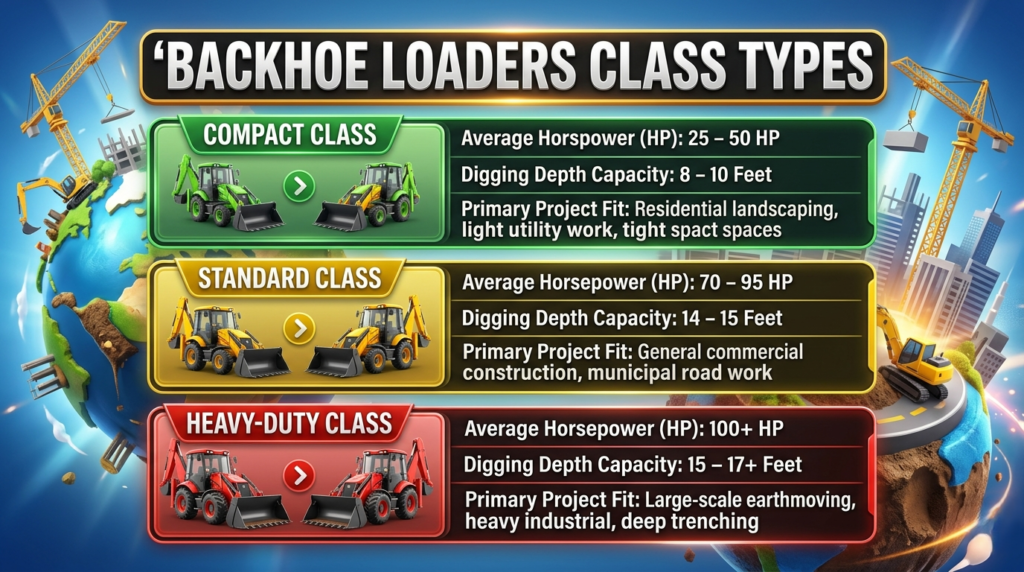
Table: Backhoe Loaders Class Types
| Backhoe Loaders Class | Average Horsepower (HP) | Digging Depth Capacity | Primary Project Fit |
| Compact Class | 25 – 50 HP | 8 – 10 Feet | Residential landscaping, light utility work, tight spaces |
| Standard Class | 70 – 95 HP | 14 – 15 Feet | General commercial construction, municipal road work |
| Heavy-Duty Class | 100+ HP | 15 – 17+ Feet | Large-scale earthmoving, heavy industrial, deep trenching |
- Largest Digging Depth: It is best to confirm that the backhoe loader’s rear boom is even capable of reaching 12 to 24 inches deeper than the depth of your deepest trenching line without laboring.
- Engine Horsepower (HP): A high horsepower engine is the one that will be able to achieve shorter cycle times, give a strong tractive effort and be able to handle heavy, tightly packed soils without engine lugging.
- Machine Weight: The total weight has repercussions on ground pressure and stability; heavier machines give better stability during deep digging but they also need heavy-duty transport trailers.
Considering Hydraulic System Capabilities and Breakout Force
There is no denying the fact that, engine horsepower is the only factor that limits the mechanical productivity of a backhoe loader; efficiency of the hydraulics is the other major factor. The hydraulic pump turns engine energy into fluid power which is, through control valves, ultimately transferred to the cylinders.
When deciding how to pick backhoe loaders for your next project, first of all, evaluate the hydraulic flow rate (gallons or liters per minute) and the resulting breakout force. The maximum structural power that a bucket tip can exert when breaking through hard, compact clay, rocky soils or frozen ground is referred to as breakout force.
- Piston Pumps vs. Gear Pumps: Compared to fixed-displacement gear pumps, piston pumps are not only more efficient but also can adequately adjust their output to different load pressures and handle system spikes.
- Load-Sensing Hydraulics: This type of hydraulic system automatically adjusts the volumes of oil to each circuit in proportion to the degree of valve opening.
- Bucket Breakout Force: It is wise to consider the highest breakout force possible when you will be working with non-fragmented soils, old asphalt, or rocky aggregates.
Considering Construction Site Accessibility and Undercarriage Options
A piece of equipment can only be productive if it can safely and efficiently navigate the site. Backhoe loaders girded with wheeled-tractor chassis provide a significant mobility advantage over track-bound excavators.
Wheeled versions permit the equipment to move on finished asphalt, road networks, and concrete without destroying the surface. However, conditions on the terrain decide the type of steering and drivetrain configurations that are required. For mud-soiled landscapes or tight urban spaces, steer modes and 4WD systems become key factors in project timeline protection.
- Four-Wheel Steering (4WS): The front as well as rear wheels can be independently steered with this capability, which means that very small turning radii can be achieved in constrained working areas.
- Four-Wheel Drive (4WD) Systems: For steep inclines, slick mud, or loose sand, high levels of tractive effort can be maintained only with a 4WD system.
- Ride Control Technology: Suspension technology that is a great benefit to operators as it dampens loader arm bounce during transport of materials, thereby not only preventing material spillage but also reducing operator fatigue.
Attachment Selection and Multi-Tool Functionality
The biggest reason so many project managers realize that learning about how to pick backhoe loaders for your next project is necessary stems from the fact that a single piece of machinery is just not enough for all kinds of work. Once you have a hydraulic quick-coupler installed on a backhoe loader, the machine is converted from an earthmover to an all-rounder utility tool.
You also need to decide whether your next project will require specialized capabilities such as post-hole drilling, concrete demolition, or heavy lifting. Check the backhoe models you are considering to be sure that they come equipped with auxiliary hydraulic lines and that running these tools will be effortless.
- Front Loader Attachments: These include multi-purpose 4-in-1 buckets, pallet forks for material handling, snow plows and sweepers.
- Rear Boom Attachments: Concrete demolition hydraulic breakers, augers for fence posting, and also various trenching or grading buckets.
- Hydraulic Quick-Couplers: Operators can quickly and safely swap complex attachments right from inside the cab with this device, dramatically reducing down-time.
Making Operator Comfort, Safety, and Cabin Ergonomics Your Top Priority
Research shows that comfortable operators deliver better results and are less prone to accidents. Since backhoe loader operators must frequently change their positions from looking forward to looking backward, the ergonomic layout of the cabin is therefore very important.
Look for operator-friendly features when you are buying or leasing backhoe loaders. Great cabins almost eliminate physical discomfort, thereby preserving the mental agility and efficiency of the operator.
- Pilot Joystick Controls: Compared to classic mechanical levers, ergonomic joysticks require less physical effort, allow the operator very precise and smooth control of the motion, and also make the control very responsive.
- 360° Visibility: Large, curved glass panels with a minimum number of structural pillars give the operator excellent views of both frontend and rear-end operations as well as of the areas around the personnel.
- Climate Control (HVAC): When the project requires extreme summer or winter conditions, fully enclosed cabins with very strong heating and air conditioning are essential for maintaining a high level of operator concentration.
Estimating Capital, Maintenance, and Ownership Costs for the Long Term
Knowing how to pick backhoe loaders for your next project cannot be considered complete until you have worked out the financial aspects. The initial purchase or rental price is only a very small part of the machine’s lifetime cost.
Project managers should get on with working out fuel consumption effectiveness, ease of routine maintenance, and parts availability in detail. You can save a lot of money on unexpected downtime if the machine you choose is from a well-known manufacturer and has diagnostic points easily accessible.
- Fuel Consumption: Study the engine’s fuel usage rate while operating at different RPMs to assess daily, weekly and monthly operating costs.
- Maintenance at Ground Level: For quick daily inspections, the equipment should have easily accessible oil filters, fluid checkpoints and grease zerks at ground level.
- Residual and Liquidation Value: When it comes to upgrading your fleet, high-tier brand names usually have very good residual market value which allows you to recoup a major chunk of your capital.
FAQs: Backhoe Loader Selection
How is a backhoe loader different from an excavator?
The two machines have some similar purposes, but a backhoe loader is a highly mobile machine on wheels, the front of which features a loader bucket and the back a backhoe arm. Excavators are specially designed for digging and are usually fitted with continuous tracks and a cab that can rotate 360 degrees.
How to decide the size of backhoe loader required for my project?
Your project is the ultimate decider of the backhoe loader size in terms of the maximum digging depth and weight-lifting. For example, if you plan only landscaping your home or small utility work, you should get a compact model (that is below 50 HP). If you often carry out standard commercial construction and trenching up to 14 feet, the norm in the industry is a standard 70-95 HP model.
What does bucket breakout force mean?
It is the highest amount of force that the cylinder can produce upward at the tip of the bucket blade. The value of the breakout force reflects the machine’s ability to cut through hard, compacted surfaces; therefore, the higher the breakout force, the greater will be the capability of the machine to deal with rock or highly compressed earth without stalling.
Can a backhoe loader be driven on public paved roads?
Yes, indeed one of the biggest advantages of a wheeled backhoe loader is that it is roadable. Unlike tracked excavators that have to be transported by trailer, backhoe loaders can move on public roads at speeds up to 25 mph.
What hydraulic features are necessary for a backhoe?
To be safe, it is better to get a variable-displacement piston pump-equipped machine and one with a load-sensing hydraulic system. The first feature will allow the hydraulic oil to be properly flowed while attracting the least amount of loss. Also, the backhoe should be equipped with auxiliary hydraulic lines for running tools like breakers or augers.
Is it really necessary to have a four-wheel drive (4WD) for a backhoe loader?
Though two-wheel drive options are sufficient for flat, dry concrete or firm clay, 4WD is strongly recommended in the context of construction sites. 4WD delivers improved traction on deep mud, wet terrain, loose gravel, or steep slopes thus preventing the machine from being stuck.
Which is the better backhoe loader – one with joystick controls or one with mechanical levers?
Pilot joystick controls are highly recommended over old mechanical levers. Joysticks provide ergonomic comfort, reduce operator fatigue during long shifts, and are more responsive to control movements.