Financing Heavy Machinery: Finding a Mini Excavator for Sale, Loans, Leases & ROI Explained
Walking onto a busy job site without the proper equipment is a lot like trying to build an entire house using nothing but a pocket knife. Sure, you might eventually get the job done, but you are going to waste an incredible amount of time, energy, and money in the process. Learn how mini excavator for sale can improvise the ROI when opting for sale, loans, and leases.
When growing contractors finally decide it is time to scale up their day-to-day operations, they usually slam right into a massive roadblock: the sheer, intimidating cost of heavy machinery. If your crews are out there digging narrow trenches, grading tight residential backyards, or doing detailed utility pipe work, you already know from hard experience that a standard, full-sized machine is simply too bulky and destructive for the job.
You need something highly compact and maneuverable. But figuring out exactly how to pay for it? That is an entirely different beast to tackle. Financing construction equipment is not something most business owners want to spend their late evenings doing, but genuinely understanding the underlying financial mechanics of equipment acquisition is exactly what separates the highly profitable outfits from the ones that are barely scraping by month to month.
Whether you are currently hunting down a pristine, low-hour mini excavator for sale or simply trying to figure out if your current business cash flow can handle yet another monthly payment, getting the financing structure right is absolutely crucial. You have to sit down, crunch the hard numbers, look objectively at your long-term business goals, and decide if you want to own the iron outright or just pay for its useful life over a few short years.
Finding the right mini excavator for sale is only half the battle; financing it intelligently is how you actually win the war and keep your margins healthy.
- Evaluating your monthly cash flow is the absolute first mandatory step before you even think about looking at dealer lots or browsing online marketplaces for a mini excavator for sale.
- Consulting directly with a certified tax professional can reveal hidden equipment depreciation benefits that will dramatically alter your total cost of ownership over the machine’s lifespan.
- Factoring in the specific timelines and payouts of your upcoming contracted jobs ensures the new machine will actually pay for itself right out of the gate instead of sitting idle.
Navigating the Core Differences Between Loans and Leases
When you finally spot the perfect mini excavator for sale and decide to pull the trigger to add it to your growing fleet, you are generally staring down two main paths at the dealer’s financing desk. You can take out a traditional equipment loan, or you can sign a structured equipment lease.
They might sound remarkably similar to an outsider, but they treat your business bank account and tax obligations very differently. Taking out a loan means you are stepping directly onto the path to total ownership.
The bank fronts the cash to buy the mini excavator for sale, you pay them back with interest over a set term—usually three to five years—and at the end of that period, that machine belongs to your business free and clear. It becomes a hard asset on your company balance sheet that you can eventually sell, use as trade-in collateral, or just run into the ground on messy jobs.
On the flip side, leasing a machine is a lot like renting a commercial property. You get to use the equipment every day, but you never actually own it. The monthly payments on a lease are almost always significantly lower than loan payments because you are only paying for the rapid depreciation of the equipment during the specific term of the lease, not the entire retail purchase price.
This setup is incredibly attractive for younger, fast-growing companies that desperately need to keep their cash reserves high for payroll and unexpected material costs. But you have to be careful reading the fine print. When a standard operating lease ends, you usually have to hand the keys back to the dealer, or pay a hefty, predetermined buyout price to keep the machine in your yard.
- Traditional equipment loans allow your business to build real equity in the machine, giving you tangible financial collateral for future business ventures and expansions.
- Equipment leases actively preserve your daily working capital by requiring much lower initial down payments and significantly smaller monthly financial obligations.
- Fair Market Value (FMV) leases give you the ultimate flexibility to simply walk away and upgrade to newer, more efficient technology every few years without the exhausting hassle of trying to sell old, worn-out equipment yourself.
Why Sourcing the Right Mini Excavator for Sale Matters
There is a strange, well-documented psychological trap that eager buyers fall into the moment they secure their equipment financing: they suddenly feel like they have blank-check money to spend on whatever catches their eye.
Just because your business got approved for a massive equipment loan does not mean you should immediately go buy the most expensive, tricked-out model sitting on the showroom floor.
Successfully finding the right mini excavator for sale requires patiently matching the machine’s exact technical specifications directly to your most common, everyday job requirements. If ninety percent of your crew’s work involves digging shallow irrigation trenches in tight suburban yards, you absolutely do not need a heavy-duty model with a complex auxiliary hydraulic setup meant for heavy concrete demolition.
You need a zero-tail-swing machine that won’t accidentally smash into a client’s expensive vinyl fence when the operator spins the cab. Taking the time to diligently hunt down equipment through reputable, industry-specific platforms like machinery.online ensures you are looking at properly vetted machines that won’t suddenly turn into massive maintenance nightmares just a month after you sign the binding paperwork.
When evaluating a used mini excavator for sale, you have to carefully consider the machine’s operating weight, maximum dig depth, and safe dump height. Buying a machine that is too small means you are constantly working the equipment past its safe limits, rapidly accelerating mechanical wear and tear. Buying a machine that is too big means you are paying high interest rates on horsepower and breakout force that you never actually use on the job site.
- Always accurately match the specific maximum dig depth and dump height of the machine to the physical requirements of your average daily contract work.
- Zero-tail-swing models often cost a slight premium upfront but are absolutely essential for preventing property damage if your crews frequently work in confined residential spaces.
- Buying through verified, reputable online heavy machinery marketplaces significantly reduces the terrifying risk of accidentally inheriting someone else’s neglected mechanical problems.
Maximizing ROI with the Right Mini Excavator Attachments
If you are only using your newly purchased machine to dig basic dirt holes with a standard factory bucket, you are leaving an absurd amount of money on the table every single day. The true, undeniable beauty of modern compact equipment lies entirely in its extreme versatility.
By investing in the right auxiliary tools after finding a solid mini excavator for sale, you effectively transform a single, one-dimensional machine into a powerful multi-tool capable of tackling half a dozen different specialized contractor roles.
This is precisely where your Return on Investment (ROI) skyrockets off the charts. Let’s say you drop the extra money on a heavy-duty hydraulic thumb and a planetary earth auger. Suddenly, that exact same piece of iron isn’t just digging trenches anymore; it’s effortlessly lifting heavy demolition debris, placing large landscaping retaining wall rocks with pinpoint precision, and drilling deep fence posts in a mere fraction of the time it would take an exhausted manual labor crew.
When you sit down to accurately calculate your ROI on a mini excavator for sale, you have to factor in the massive manual labor costs you are permanently saving. A specialized attachment might cost a few thousand dollars upfront, but if it successfully saves you the hourly wages of two laborers over a three-month commercial project, it has already completely paid for itself. Smart, highly profitable operators never view attachments as optional luxury accessories; they view them as essential revenue multipliers.
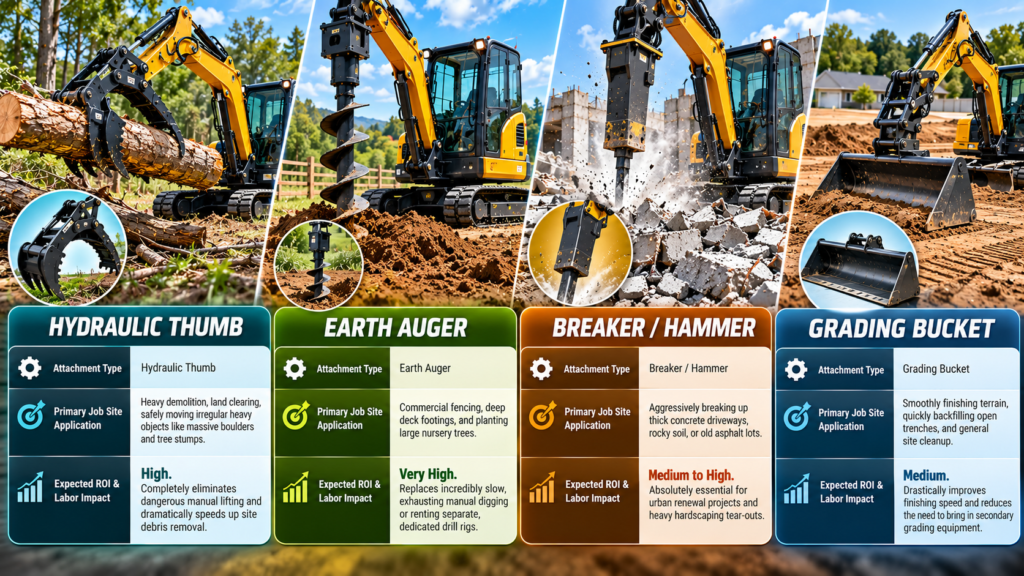
Table: Attachment Types and ROI – Mini Excavator for Sale
| Attachment Type | Primary Job Site Application | Expected ROI & Labor Impact |
| Hydraulic Thumb | Heavy demolition, land clearing, safely moving irregular heavy objects like massive boulders and tree stumps. | High. Completely eliminates dangerous manual lifting and dramatically speeds up site debris removal. |
| Earth Auger | Commercial fencing, deep deck footings, and planting large nursery trees. | Very High. Replaces incredibly slow, exhausting manual digging or renting separate, dedicated drill rigs. |
| Breaker / Hammer | Aggressively breaking up thick concrete driveways, rocky soil, or old asphalt lots. | Medium to High. Absolutely essential for urban renewal projects and heavy hardscaping tear-outs. |
| Grading Bucket | Smoothly finishing terrain, quickly backfilling open trenches, and general site cleanup. | Medium. Drastically improves finishing speed and reduces the need to bring in secondary grading equipment. |
- Hydraulic thumbs are widely considered the absolute most essential add-on, instantly turning a basic digging machine into a heavy-lifting multi-tool.
- Purchasing these crucial attachments bundled with the initial machine purchase often allows you to conveniently roll their total cost directly into your main financing package.
- Regularly cleaning and maintaining the machine’s hydraulic quick-couplers ensures your operators can swap attachments on the fly without leaking expensive hydraulic fluid all over the client’s site.
The Hidden Costs of Owning Excavators
Nobody really likes talking about routine maintenance, but it is undeniably the silent, creeping killer of equipment ROI. When you compare massive, full-sized excavators to their compact counterparts, it is incredibly easy to assume the smaller machines are universally cheaper to run across the board.
While it is true that a mini excavator for sale generally burns significantly less diesel fuel and has much lower daily transport costs—you don’t need to hire a specialized lowboy semi-trailer to move them—they still require rigorous, unforgiving mechanical upkeep.
If you take out a five-year commercial loan on a machine, you have to accurately budget for the inevitable, expensive breakdowns that will happen in year three. Rubber tracks wear out and snap.
High-pressure hydraulic hoses eventually chafe and burst under heavy loads. Expensive undercarriages get packed with abrasive dirt and start grinding their own gears away. When you are financially projecting whether a mini excavator for sale will actually be profitable for your company, you must calculate the Total Cost of Ownership (TCO), not just the low monthly bank payment.
This true cost includes high commercial insurance premiums, strict preventative maintenance schedules, and the terrifying opportunity cost of sudden downtime. If your company’s only excavator goes down for two weeks while you desperately wait for a proprietary manufacturer part to ship, your entire paid crew might be sitting on their hands doing nothing.
- Establishing a strict, daily walk-around visual inspection routine prevents minor wear issues from quietly turning into catastrophic mechanical failures.
- Actively budgeting roughly five to ten percent of the machine’s monthly financing cost for routine maintenance creates a highly secure financial buffer for unexpected repairs.
- Keeping incredibly detailed service logs not only fully protects your factory warranty status but dramatically increases the machine’s overall resale value when it is finally time to upgrade.
Comparing Mini Excavators Against the Heavyweights
There is undeniably a time and a specific place for massive, earth-moving machinery. If your company is contracted to build a major state highway or dig a massive, deep foundation for a downtown skyscraper, you obviously need the biggest, most powerful equipment you can possibly find.
But for the vast, overwhelming majority of independent contractors, residential landscapers, and local utility workers, bigger isn’t just unnecessary; it is a massive, stressful liability.
Large equipment completely destroys residential lawns, requires expensive commercial driver’s licenses (CDLs) and massive haul trucks to legally transport, and burns diesel fuel at a truly terrifying daily rate. This is exactly why the secondary market for a reliable mini excavator for sale has absolutely exploded over the last decade.
A compact machine can easily squeeze right through a standard backyard wooden gate, tread incredibly lightly on established green turf with its wide rubber tracks, and still deliver more than enough hydraulic breakout force to violently tear through stubborn clay soil and thick tree roots.
When you look closely at the core financials, the barrier to entry is just so much lower for compact gear. Before you pull the trigger on a massive piece of iron, remember that you can usually finance two or even three compact machines for the exact same price as one massive excavator, allowing your business to run multiple profitable crews on completely different sites simultaneously.
Rubber tracks on compact machines actively prevent the highly costly property damage that steel-tracked heavy equipment routinely causes on delicate residential jobs.
- The unique ability to legally tow compact equipment behind a standard heavy-duty pickup truck completely eliminates the need to constantly hire expensive third-party logistics companies.
- Deploying multiple compact machines across several different job sites consistently generates a much more diversified and highly stable revenue stream than relying entirely on one massive, expensive machine.
Heavy Machinery Financing – Mini Excavator for Sale FAQs
Is it harder to get a business loan for a used mini excavator for sale compared to a brand new one?
Generally speaking, yes. Traditional banks and lenders view used equipment as a slightly higher financial risk because the exact mechanical history and maintenance record are often unknown. You might face slightly higher interest rates and shorter repayment terms when financing a used mini excavator for sale, but the significantly lower initial purchase price often balances out the overall financial burden on your business.
What personal or business credit score do I actually need to finance construction equipment?
While it heavily varies by the specific lender, most heavy equipment financing companies look for a personal or business credit score of at least 650. If your score is currently lower than that, you can still secure equipment funding, but you should definitely expect to pay a significantly higher upfront down payment and a steeper interest rate to properly offset the lender’s perceived risk.
Can I legally write off the entire cost of a mini excavator for sale on my business taxes? In many cases, yes. Under Section 179 of the IRS tax code (for US-based businesses), companies can often deduct the full purchase price of qualifying equipment during the exact tax year they put it into service, up to a certain financial limit. You should absolutely consult a certified CPA to ensure you maximize this massive tax benefit.
Does leasing a mini excavator for sale negatively affect my company’s business credit? No, in fact, it can actively help build it. As long as you make your monthly equipment lease payments on time every single month, it clearly demonstrates reliable financial behavior to future lenders. Furthermore, operating leases sometimes don’t show up as traditional debt on your business balance sheet in the exact same way a massive bank loan does, which can keep your overall debt-to-equity ratio looking incredibly healthy for future borrowing.
How much of a down payment is typically required for a heavy machinery equipment loan?
Most traditional lenders require an upfront down payment ranging anywhere between 10% and 20% of the equipment’s total retail purchase price. However, if your business has truly stellar credit and a long, documented track record of high profitability, some specialized equipment financiers will occasionally offer 100% financing with zero money down.
Are auxiliary attachments included in the main financing agreement when buying a mini excavator for sale?
Yes, they usually can be included quite easily. If you buy the main machine and the extra mini excavator attachments from the exact same dealer at the exact same time, most lenders are typically more than happy to bundle the total combined cost into a single, manageable loan or lease package, making it much easier to manage your monthly operational budget.
What actually happens if my business outgrows a leased mini excavator for sale before the contract term is up?
This is an incredibly common issue for rapidly growing contracting companies. Many modern equipment leasing companies offer flexible contract terms that actively allow you to upgrade to a larger, more powerful machine mid-lease. You will have to renegotiate the new contract, and there might be minor early-termination fees involved, but it is generally much easier than trying to privately sell a machine you bought with a loan that is currently sitting underwater.

