Selling Used Construction Machinery? Find the best Dealership vs. Online Marketplace
Walk onto almost any contractor’s yard across the country, and you will likely spot a piece of equipment sitting quietly off to the side. Maybe it wrapped up a multi-year road project three months ago, or perhaps you bought it for a specific utility excavation contract that is now in the rearview mirror by choosing the best ways of selling used construction machinery in the most profitable way.
The Realities of Liquidating Heavy Iron Today
Keeping that iron parked on gravel drains cash every single week in depreciation, storage, and insurance. The heavy equipment market has undergone a dramatic transformation, and holding onto idle machines is no longer an option if you want to keep your cash flow healthy.
Contractors and fleet operators everywhere face the exact same fork in the road: do you haul the machine over to a local brick-and-mortar dealer, or do you take control and list it across an active online equipment marketplace? Deciding where to handle selling used construction machinery is not just a routine chore—it directly dictates whether you pocket thousands of dollars in hard-earned equity or leave that money on someone else’s showroom desk.
- Sitting equipment is depreciating capital, making timely asset disposition essential for protecting your bottom line.
- The route you pick to sell your machinery determines whether you walk away with true market value or take a steep wholesale discount.
- Modern contractors need fast turnaround times, transparent payouts, and direct access to buyers who are actively bidding on working iron.
The Local Dealership Route: Fast Cash with a Heavy Price Tag
There is an undeniable comfort in driving an old machine straight to a dealer you have known for a decade. The appeal of the traditional dealership comes down to raw convenience: you drop off the keys, hand over the title, and walk out with either a company check or a trade-in credit toward a brand-new unit.
The dealer takes on the headache of power washing the chassis, touching up scratches, tracking down prospective retail buyers, and dealing with freight logistics. For large-scale construction outfits that cannot spare an extra hour of labor to manage calls or show a machine, this route feels effortless. However, that effortless transaction carries a hidden penalty that many owners only realize after the check clears.
When you sell to an equipment dealership, you are strictly selling at wholesale value. Dealerships operate massive physical facilities with service bays, lot rent, sales commissions, and holding insurance to cover.
Because they must clean up the machine, absorb depreciation risks, and still flip it for a profit, their initial buyout offer has to sit well below market value. You are essentially paying them thousands of dollars in forfeited equity simply to act as your middleman. If your goal is to extract maximum financial recovery out of every hour logged on that engine, a standard trade-in will rarely leave you satisfied.
- Dealerships deliver almost instant liquidity and handle every scrap of transfer paperwork, freeing up your internal crew immediately.
- The trade-in credit can be applied directly against a new purchase on the spot, lowering immediate sales tax liabilities in several states.
- You swallow a painful wholesale discount because the dealer has to protect their own resale margins, carrying costs, and overhead.
The Online Marketplace: Why Digital Platforms Win on Margin
The equipment industry runs on digital connectivity now, and contractors are sourcing backhoes, skid steers, and mini excavators on their laptops and phones between job site walkthroughs.
Digital platforms remove the middleman completely. Instead of being stuck with whatever one local dealer feels like offering you on a Tuesday morning, an online equipment platform puts your machinery in front of thousands of active buyers nationwide who are searching specifically for your exact make and model. That sheer volume of visibility sparks genuine bidding and direct negotiation.
When selling used construction machinery through a dedicated digital platform, you set your own asking price based on actual market demand rather than an arbitrary dealer trade-in chart. You keep the equity you built up maintaining that machine over the years.
Modern digital platforms have eliminated the sketchy wild-west nature of old classified boards by baking in verified dealer profiles, dedicated buyer filtering, and secure payment processing. You no longer have to worry about whether a buyer’s funds are legitimate or how you will coordinate cross-country logistics. Everything is built directly into the sales flow, giving private sellers and fleet owners the leverage they deserve.
- Putting your equipment on a nationwide digital marketplace unlocks competitive bids from thousands of contractors instead of one local shop.
- You maintain absolute authority over your pricing strategy, letting you capture full retail market value instead of wholesale scrap.
- Integrated digital features—like verified profiles, real-time inventory tracking, and payment security—take the guesswork out of private sales.
Side-by-Side Breakdown: Dealership vs. Online Marketplace
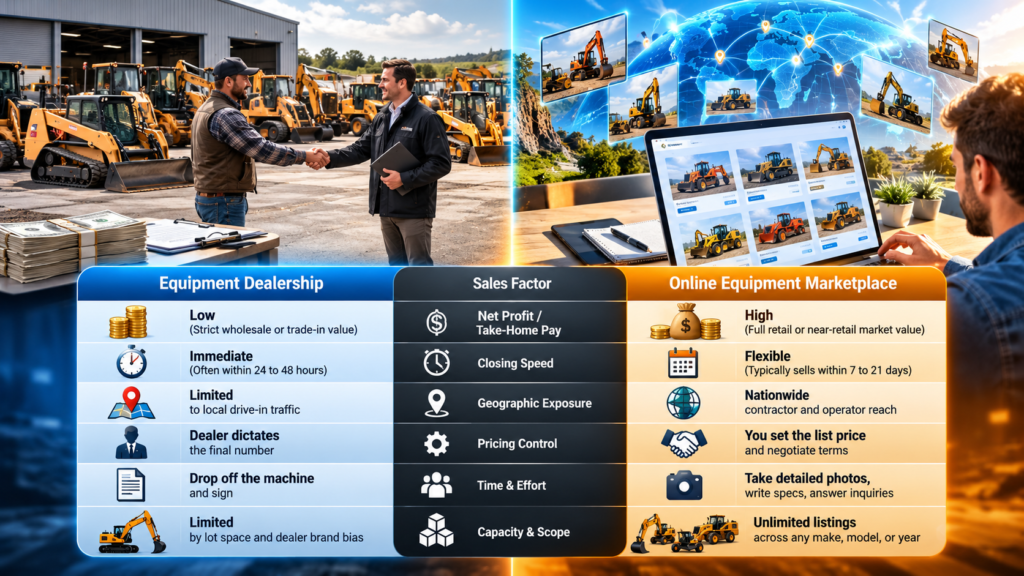
Choosing between these two routes comes down to balancing how fast you need capital against how much profit you are willing to leave behind. If an unexpected cash crunch hits and you need that loader off your books before Friday, a dealer will buy it today—for a price.
If you want to fund your next major fleet upgrade without bleeding equity, listing it online is virtually unbeatable. The table below lays out the raw realities of both options so you can plan your next move with total clarity.
- Your operational timeline and target margins are the two deciding factors when selecting where to list.
- While physical dealers dominate in terms of sheer turnaround speed, digital marketplaces win hands down on profitability and geographic reach.
- Direct digital sales give fleet managers the flexibility to offload single attachments, specialized tools, or dozens of units simultaneously.
Table: Selling Used Construction Machinery
| Sales Factor | Equipment Dealership | Online Equipment Marketplace |
| Net Profit / Take-Home Pay | Low (Strict wholesale or trade-in value) | High (Full retail or near-retail market value) |
| Closing Speed | Immediate (Often within 24 to 48 hours) | Flexible (Typically sells within 7 to 21 days) |
| Geographic Exposure | Limited to local drive-in traffic | Nationwide contractor and operator reach |
| Pricing Control | Dealer dictates the final number | You set the list price and negotiate terms |
| Time & Effort | Drop off the machine and sign | Take detailed photos, write specs, answer inquiries |
| Capacity & Scope | Limited by lot space and dealer brand bias | Unlimited listings across any make, model, or year |
Why Machinery Online Is the Smartest Home for Your Heavy Equipment
If you decide that cutting out the middleman makes the most financial sense, picking the right platform matters just as much as setting the right price. That is where Machinery Online (https://machinery.online/) comes in. Built from the ground up for the construction, mining, and material handling sectors, Machinery Online is not a generic listing board cluttering your equipment alongside used cars and power tools. It is an industry-focused hub connecting verified sellers with serious buyers across the country.
Whether you are looking to list a low-hour mini excavator—like a Kubota-powered Typhon Terror unit—or you are rotating an entire lineup of telehandlers, scissor lifts, and wheel loaders, Machinery Online gives your iron the presentation it warrants.
With over 2,400 active listings, a network of more than 850 verified dealers, and an impressive 98% customer satisfaction rate, the platform has proven its worth to working contractors.
Every listing is reviewed for accuracy, buyers can filter straight to your exact machine specifications, and escrow-backed transaction support guarantees that your payout arrives safely. When selling used construction machinery, Machinery Online offers the rare sweet spot: the wide reach of an open digital marketplace matched with the security and professionalism of a top-tier industrial dealership.
- Connect directly with thousands of verified contractors and over 850 industry dealers looking for job-ready iron right now.
- Enjoy 18+ dedicated equipment categories, ensuring your excavators, loaders, or attachments show up directly in front of targeted buyers.
- Protected by verified listing reviews, nationwide shipping coordination, and secure payment setups that eliminate transaction risk.
Prepping Your Machine for a Quick, Profitable Sale
You can pick the best platform in the world, but if your machine looks neglected, buyers will scroll right past it or throw lowball bids at your inbox. Heavy equipment buyers are analytical; they want to know whether a machine has been greased every morning or run ragged on a demolition site without fluid changes.
Taking a few dedicated days to prepare your equipment before taking photos pays off dramatically in the final sale price.
Start by giving the machine a complete pressure wash, removing years of accumulated grease, mud, and debris from the undercarriage, stick, and engine bay. Address the minor annoyances that signal poor upkeep: replace leaking hydraulic o-rings, fix broken cab glass, touch up peeling paint, and replace blown fuses or work lights.
Once the machine looks sharp, track down the maintenance logs. Having records that prove regular oil sampling, scheduled hydraulic filter replacements, and track tension adjustments builds immediate trust with a buyer who might be ordering the machine from three states away. When taking listing photos, capture crisp, well-lit images of the hour meter, the serial number plate, track tread depth, and bucket teeth wear.
- A clean machine with fresh fluids and small cosmetic fixes consistently commands a higher asking price than work-dirty equipment.
- Documented maintenance history, including oil changes and component rebuilds, gives buyers the confidence to pay top dollar.
- Detailed, honest photos—especially of wear parts like tracks, tires, pins, and bushings—drastically reduce haggling and tire-kicking.
FAQs About Selling Used Construction Machinery
What is the best website to sell used construction machinery?
Dedicated industrial marketplaces like Machinery Online are widely considered the best choice. Unlike general classifieds, Machinery Online focuses purely on heavy equipment, offering verified seller badges, 18+ specific machinery categories, and an active nationwide audience of contractors and equipment dealers.
How do I figure out what my used equipment is actually worth?
The most accurate method is checking current, live listings for machines with similar operating hours, model years, and mechanical conditions. Browsing platforms like Machinery Online lets you see what comparable excavators or loaders are commanding in real-time, helping you price yours competitively without undercutting your margin.
Do I have to fix every mechanical problem before listing my machine?
Not necessarily. While fixing cheap issues like leaky fittings, blown lights, or worn belts gives an immediate boost to your sale price, major rebuilds might not return their cost. The key is transparency: clearly disclose known issues, adjust your asking price accordingly, and market the machine as a solid, running workhorse that needs minor TLC.
What paperwork do I need ready to sell construction machinery?
You need clean proof of ownership, such as the original bill of sale or manufacturer’s statement of origin (MSO), along with lien release documentation if the machine was previously financed. Having complete service logbooks, engine spec sheets, and warranty transfer papers ready will speed up the sale significantly.
How are shipping and freight handled when selling online?
In most marketplace transactions, the buyer arranges and pays for freight transport. However, reputable platforms partner with nationwide equipment haulers to make coordination simple. As the seller, your primary responsibility is ensuring the equipment is clean, running, and accessible for a lowboy or flatbed truck pickup.
Is it safe to take payments for heavy machinery over the internet?
Yes, provided you use an escrow-backed service or a direct verified bank-to-bank wire transfer. Top platforms incorporate escrow protection where the buyer deposits funds into a neutral account before transport, releasing the money directly to you once delivery terms are met. Never release a machine based on a personal check or unverified payment slip.
Can I sell attachments separately, or should I bundle them?
Both strategies work well. Bundling attachments—such as extra digging buckets, hydraulic thumbs, or augers—often helps a mini excavator or skid steer sell much faster because the buyer gets a turnkey package. However, if you have high-value, specialized attachments like hydraulic breakers or forestry mulchers, selling them as standalone listings frequently brings in higher total profit.
Final Word: Taking Charge of Your Fleet’s Value
There is no reason to take an automatic haircut on your equipment’s value just to move it off your lot. Dealerships will always have their place for emergency turnarounds and rapid trade-ins, but contractors who plan ahead are increasingly turning to online equipment marketplaces to capture the real market value of their assets.
With digital platforms like Machinery Online handling verification, logistics support, and secure payments, selling used construction machinery has never been more straightforward or more profitable. Clean up the iron, gather your paperwork, set your price, and let the market pay you what your equipment is actually worth.
- Dealership trade-ins offer speed at the cost of your hard-earned equity.
- Online marketplaces put the power back in your hands, offering full retail exposure and verified safety.
- Thorough maintenance prep, honest listing specs, and smart platform selection guarantee the best return on your investment.