Tracked vs Wheeled Skid Steers: Making the Right Choice for Your Terrain
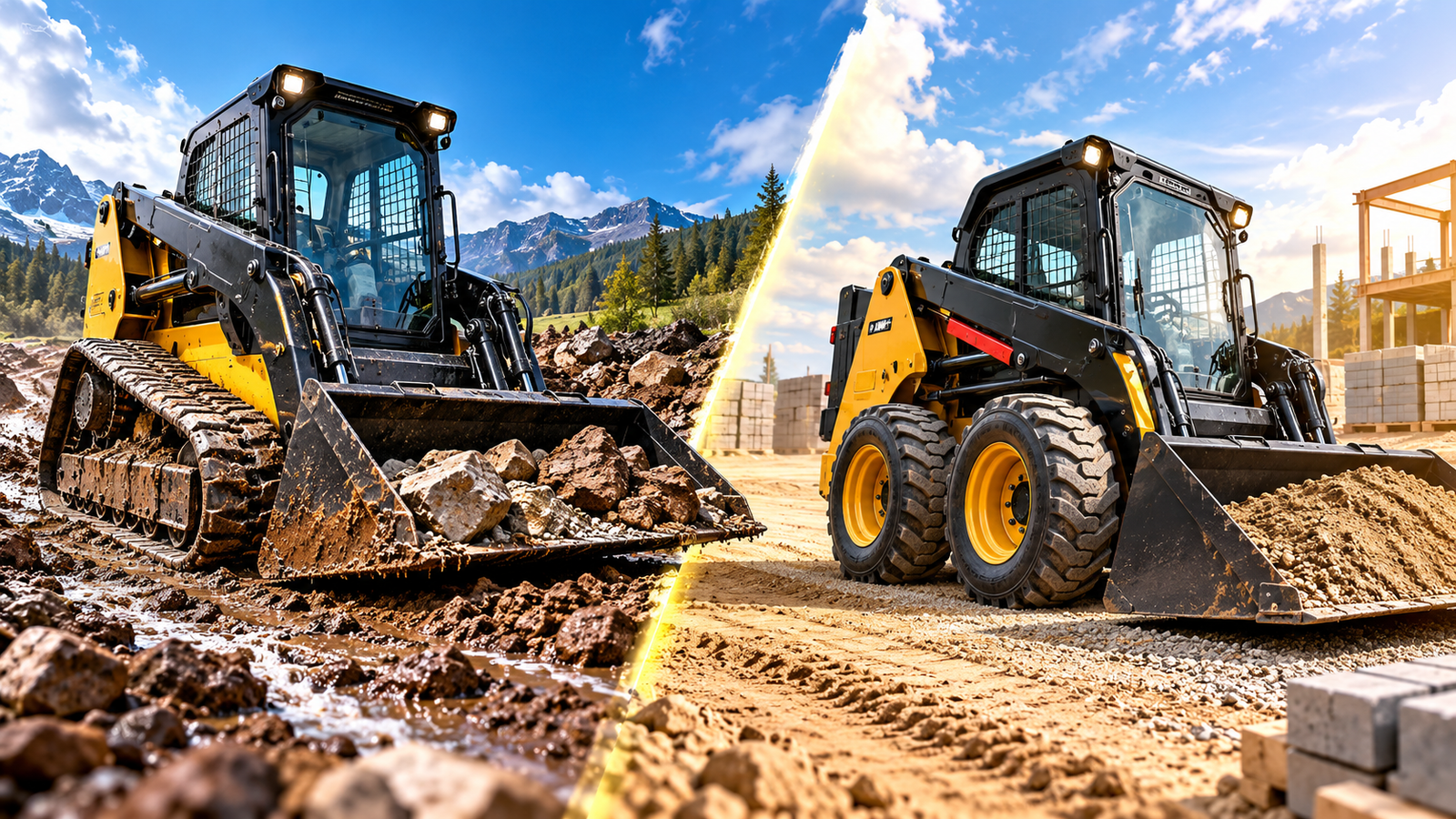
Walk onto any active earthmoving site after three days of steady rain, and you will immediately spot who made the right equipment call. One operator is cutting grade without breaking a sweat, while another is sitting cab-deep in sloppy clay, spinning four bald tires and waiting for an excavator to sling an extraction strap. Hence, choosing between tracked vs wheeled skid steers is very important for every operator.
Finding the Ground Truth on Skid Steers
Choosing between a tracked vs wheeled skid steers is never just a matter of personal preference or brand loyalty; it is a fundamental mechanical calculation based entirely on what is underneath your machine.
At Machinery Online, contractors and operators frequently browse our marketplace weighing these two configurations, and the hesitation is completely understandable. Both machines share similar cab layouts, common hydraulic hookups, and the muscle to carry heavy buckets, but the way they transfer horsepower to the dirt is worlds apart.
If you mismatch the undercarriage to your primary job site ground conditions, you will burn through fuel, chew through wear parts, and sacrifice billable hours to unnecessary downtime. Getting clear on your everyday surface conditions before you pull the trigger on a purchase is the smartest way to protect your operating margins.
- Choosing between a tracked vs wheeled skid steers directly impacts your machine’s cycle times, fuel burn, and ground clearance.
- Soil moisture, aggregate hardness, and job site grades dictate whether tires or continuous rubber tracks will perform efficiently.
- Equipment marketplaces like Machinery Online give buyers the flexibility to source either configuration based on realistic fleet demands.
Wheeled Skid Steers: Speed, Hard Surfaces, and Yard Agility
The traditional wheeled skid steer loader has held down real estate on construction sites for well over half a century, and there are solid mechanical reasons it refuses to disappear. When you are operating on cured concrete, packed asphalt, recycled crushed concrete, or firm gravel, a wheeled model runs circles around a tracked unit.
It boils down to simple physics: rolling resistance is significantly lower on four pneumatic or solid tires than on a continuous rubber track assembly. That lower resistance translates directly into noticeable travel speed—often reaching 10 to 12 miles per hour in two-speed models—which cuts transit time dramatically across large commercial yards, municipal road projects, or expansive supply depots.
Steering is handled by counter-rotating or braking the wheels on one side, allowing the machine to spin inside its own physical radius. On solid ground, this agility makes loading haul trucks and darting between building footings remarkably quick.
As an added operational bonus, because the engine is not working against the heavy friction of track guides and rollers, you will burn noticeably less diesel throughout a standard ten-hour shift on flat, hard footing.
- Travel speeds on wheeled units allow operators to move material across vast paved jobsites in a fraction of the time.
- Lower rolling friction on dry, compacted surfaces yields better hourly fuel economy and less drivetrain stress.
- Zero-radius pirouette turns on solid ground provide unmatched maneuverability when working inside confined building slabs.
Tracked Skid Steers: Flotation, Slopes, and Brutal Mud
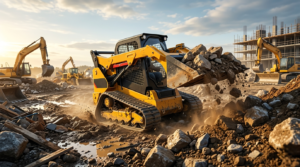
The moment your job moves off paved pads and into virgin topsoil, deep sand, or bottomless muck, the tracked vs wheeled skid steers conversation shifts decisively toward tracks. Compact track loaders (CTLs) replace four tires with wide, continuous rubber tracks that wrap around a dedicated system of drive sprockets, idler wheels, and mid-rollers.
This design radically alters ground pressure. Where a standard wheeled loader might exert 35 to 45 pounds per square inch (PSI) through four tiny contact patches, a tracked machine spreads that identical weight over hundreds of square inches, dropping the ground pressure down to roughly 4 to 5 PSI—often less pressure than an adult human boot print. You stay on top of the slop instead of trenching into it. That massive footprint also gives you raw, dependable tractive effort.
When pushing a dozer blade through stubborn clay or cutting into an undisturbed hill, tracks grip the earth and drive forward where wheels simply break traction and spin. Furthermore, tracks broaden your machine’s baseline and drop its center of mass, making side-slope grading, pond excavation, and ditch maintenance significantly safer for the operator.
- Ground pressure drops to a mere 4 to 5 PSI, allowing tracked units to stay aloft on mud, loose sand, and deep snow.
- Enhanced tractive surface area delivers massive forward pushing force for grading, heavy cut-and-fill, and root-ripping work.
- The wide, grounded track footprint provides stability and roll-over resistance on steep banks, uneven grades, and rough hillsides.
The Balance Sheet: Undercarriage Wear vs. Tire Replacements
Your balance sheet has to be the final judge when weighing a tracked vs wheeled skid steers. Upfront, a wheeled machine is almost always easier on your acquisition budget. When looking through machinery listings, you will consistently find that new and used wheeled loaders run anywhere from 15% to 25% cheaper than tracked units of identical horsepower and hydraulic output.
But the purchase price is only your opening ante; the true financial divide shows up on your monthly maintenance logs. Tires are straightforward: if you run over rebar and puncture a tire, you can plug it, foam-fill it, or replace it for a couple hundred dollars in under an hour.
In stark contrast, a track undercarriage is an intricate mechanical assembly packed with internal bearings, tensioning grease cylinders, idlers, rollers, and heavy rubber belts lined with steel cables.
If an operator develops a habit of spinning tracks on sharp crushed granite or grinding against concrete curbs, you can easily destroy a $3,500 set of tracks in under 800 hours. Keeping tracks alive also requires non-negotiable daily maintenance; operators must dig out dried mud and trapped stones before they harden overnight and freeze up rotating rollers.
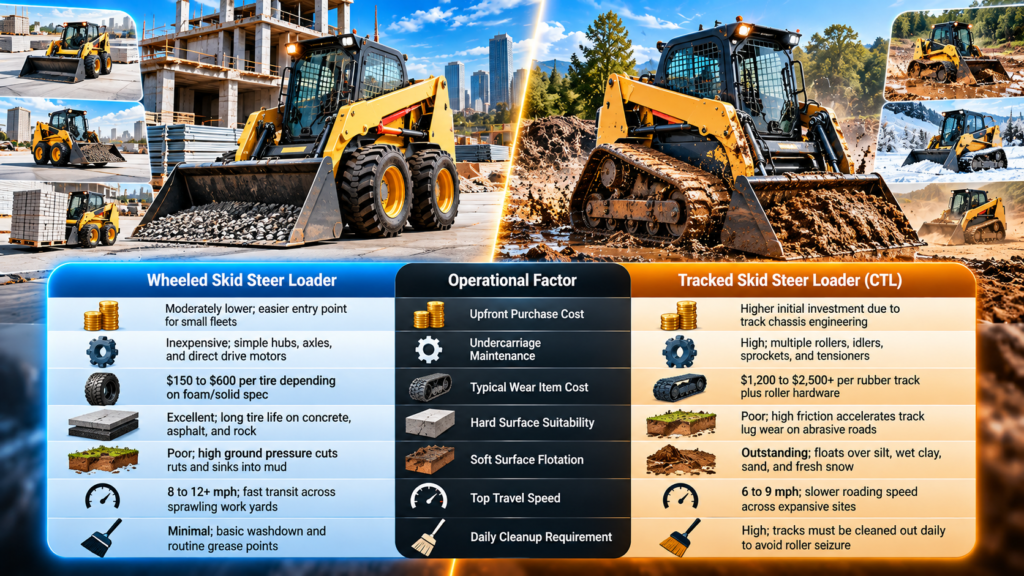
Table: Tracked vs Wheeled Skid Steers
| Operational Factor | Wheeled Skid Steer Loader | Tracked Skid Steer Loader (CTL) |
| Upfront Purchase Cost | Moderately lower; easier entry point for small fleets | Higher initial investment due to track chassis engineering |
| Undercarriage Maintenance | Inexpensive; simple hubs, axles, and direct drive motors | High; multiple rollers, idlers, sprockets, and tensioners |
| Typical Wear Item Cost | $150 to $600 per tire depending on foam/solid spec | $1,200 to $2,500+ per rubber track plus roller hardware |
| Hard Surface Suitability | Excellent; long tire life on concrete, asphalt, and rock | Poor; high friction accelerates track lug wear on abrasive roads |
| Soft Surface Flotation | Poor; high ground pressure cuts ruts and sinks into mud | Outstanding; floats over silt, wet clay, sand, and fresh snow |
| Top Travel Speed | 8 to 12+ mph; fast transit across sprawling work yards | 6 to 9 mph; slower roading speed across expansive sites |
| Daily Cleanup Requirement | Minimal; basic washdown and routine grease points | High; tracks must be cleaned out daily to avoid roller seizure |
- Undercarriage replacement on a tracked unit is one of the most substantial ongoing maintenance expenses in compact equipment.
- Wheeled machines use simple, rugged hubs that require far fewer labor hours to service, grease, and maintain week to week.
- Scrap yards, demo contractors, and recycling facilities favor wheels fitted with solid or foam-filled rubber to prevent job delays.
Matching Your Workload: Attachments, Ground Disturbance, and Jobsites
Your industry and your daily attachment lineup should immediately steer your decision in the tracked vs wheeled skid steers debate. If you run a high-end residential landscaping or turf management company, taking a wheeled machine onto an established lawn is an absolute recipe for angry homeowners; the sharp pivots will tear established grass to shreds and leave compaction tracks that take months to recover.
Tracked loaders distribute weight smoothly, allowing you to glide across delicate grass without leaving rut marks. On the flip side, if you spend your weeks handling asphalt millings, concrete demolition, or loading salt into municipal spreader trucks, running rubber tracks will wear them down prematurely while shaking the operator to pieces.
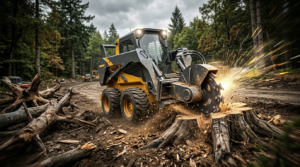
You also have to think about the hydraulic attachments you hook to the front plate. Tools that demand immense pushing power—like tree pullers, forestry mulchers, brush cutters, and dozer blades—perform best on tracks because the machine can lean all its engine torque into the dirt without losing grip.
For attachments like cold planers, sweepers, and hydraulic hammers on road repairs, the steady, shock-absorbing nature of heavy rubber tires on pavement makes wheels the logical platform.
- Turf-focused contractors prioritize tracked machines to eliminate soil rutting and prevent damage to residential root structures.
- High-traction forestry mulching and land clearing require the uninterrupted ground grip that only continuous tracks provide.
- Urban utility and road-paving contractors rely on wheeled machines to navigate abrasive surfaces without melting track tread.
FAQs – Tracked vs Wheeled Skid Steers
Why do skid steers with wheels work best on even ground?
Wheeled skid steers rely on small, concentrated contact points to transfer horsepower into forward motion. On firm, uniform ground like concrete, asphalt, or hard-packed clay, those rubber patches generate excellent traction while encountering almost zero rolling resistance. This allows the machine to accelerate quickly, execute tight spins, and move materials at high speeds without the excessive friction and wear that continuous track systems suffer on solid surfaces.
What are the disadvantages of a crawler (tracked) skid steer loader?
The main drawbacks are high acquisition cost and steep maintenance overhead. A tracked loader usually costs thousands of dollars more upfront than an equivalent wheeled model. Moreover, continuous rubber tracks, idlers, sprockets, and mid-rollers wear down rapidly on abrasive hard surfaces like asphalt and crushed stone. Replacing an entire undercarriage is an expensive, labor-intensive job that demands regular budget allowances.
What are the advantages of a crawler skid steer loader?
Tracked loaders excel in soft, uneven, and low-traction conditions because they spread machine weight over wide rubber tracks, dropping ground pressure down to roughly 4 to 5 PSI. This flotation prevents the machine from sinking into deep mud, sand, or snow. Tracks also offer a lower center of gravity, delivering greater stability on steep hillsides and producing significantly more pushing power during heavy excavation work.
Can you put tracks on a wheeled skid steer?
Yes, you can install over-the-tire (OTT) tracks on a standard wheeled skid steer. These track assemblies—made from steel links or reinforced rubber sections—wrap directly over the existing pneumatic tires to provide temporary flotation and traction in wet conditions. While they do not completely replicate the low center of gravity of a true dedicated compact track loader, they offer an economical, modular bridge for seasonal mud.
What are the disadvantages of a wheeled skid steer loader?
The single biggest drawback of a wheeled skid steer is its tendency to sink, rut, and get stranded in soft, wet, or uncompacted ground. Because the entire operating weight rests on four compact tire footprints, the machine exerts high ground pressure (often exceeding 35 PSI). In muddy trenches or loose sand, the tires quickly dig ruts, spin uncontrollably, lose pushing power, and risk tipping on loose side slopes.
How do I calculate a skid steer lift capacity?
Safe lift capacity is formally designated as the Rated Operating Capacity (ROC). By SAE standards, a wheeled skid steer’s ROC is calculated at 50% of its tipping load (the weight required to lift the rear wheels off the ground). For tracked machines, the ROC is calculated at 35% of the tipping load due to track geometry. Always consult the official manufacturer specification plate located inside the cab door before handling heavy pallets.
Does skid steer lift capacity affect attachment compatibility?
Yes, lift capacity directly determines which attachments you can safely run. Operating heavy tools like high-flow forestry mulchers, large hydraulic concrete breakers, or heavy augers requires both sufficient auxiliary hydraulic horsepower and enough counterbalanced chassis weight to keep the rear end grounded. Running an oversized attachment on an undersized loader creates severe hydraulic overheating and presents a dangerous tipping hazard.