What Can You Do With a Mini Excavator?
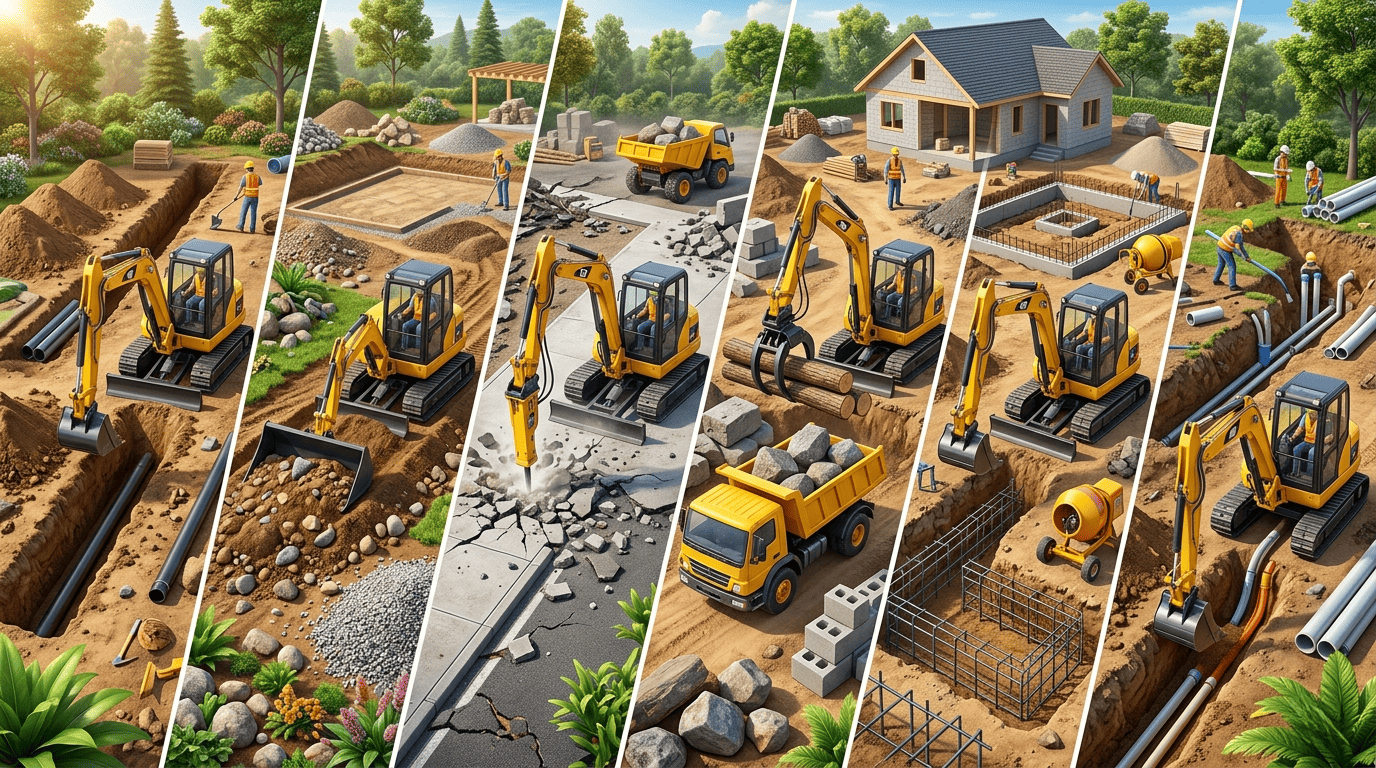
Mini excavators are workhorses in the construction and landscaping industry, particularly where space is limited. If the question What can you do with a mini excavator is on your mind, know that its usage is quite versatile and it is actually capable of performing tasks that require a high level of accuracy and less space as compared to other heavy machinery. Some of the things you can achieve with the help of a mini excavator include:
Utilities line installation- Mini excavators are perfect for the trenching required to install utilities. Precise foundation footings- An advantage with this piece of machinery is made footing realization for structures without going beyond the need of excavation. Septic tank installation- Due to their small footprint identifying and planning a yard around the septic system installation is possible.
The mini excavator is a machine of less than 7 metric tons that maximizes space rental and simultaneously shows a strong hydraulic ability. This mini beast can easily walk through the narrow gates, work in between the buildings, or even operate on delicate surfaces such as turf. Having a mini excavator in your hands, whether you are a pro worker or a home makeover enthusiast, will show you the huge advantages with which this one-man machine can change your work effectiveness.
What Can You Do With a Mini Excavator? Popular 4 Uses
1. Precision Digging and Trenching
The answer to the question what can you do with a mini excavator is basically digging. Still, the mini excavator is not only smaller in size as compared to his bigger brothers but also outperforms them in accuracy.
Due to the fact that the machine is very small and has the extended boom capability, it is able to dig trenches in places where a standard crawler just wouldn’t fit.
- Utility Line Installation: Mini excavators are usually the best option for digging very narrow trenches when installing underground water piping, electrical conduits, or fiber optic cables.
- Foundation Footings: They can be used to find the exact location and dig for the footings of small buildings like sheds, garages, or home extensions.
- Septic Tank Excavation: Even though the machine can be big enough (usually around 10-15 feet) for installing the septic systems, it keeps its footprint small enough so that the whole lawn does not get destroyed.
2. Professional Landscaping and Site Prep
Landscape contractors often query about the uses of a mini excavator when thinking about timesaving on labor through manual work. These machines are specifically made to be “turf-friendly”, meaning that they normally have rubber tracks that will not only minimize the downward pressure on the ground but at the same time will not damage the existing grass or pavements.
- Planting and Removing Trees: Normally it won’t be a problem for you to make holes for planting large trees or removing stumps and root balls with the help of the bucket or auger attachment.
- Hardscaping Preparation: A mini excavator can efficiently remove the ground cover and level the surface in case drainage improvement needs to be ensured before the patio or sidewalk installation.
- Construction of Ponds and Pools: You can use mini excavators for work on small garden ponds and medium-sized hot tubs and “spools” (spa/pools) by handling the digging and contouring of the ground accurately.
3. Efficient Demolition in Tight Spaces
Even if it is a mini one, the machine can still be quite powerful. When a mini excavator is fitted with a hydraulic breaker (hammer), it becomes a very effective demolition tool that can allow you to pull down the buildings selectively so that the structure of other nearby buildings does not get damaged.
- Concrete and Asphalt Breaking: Letting loose on the old driveway, sidewalk, or retaining wall in a renovation project will be greatly facilitated by a mini excavator.
- Interior Demolition: A few ultra-compact models make this ultra-compact model is even capable of fitting through the doorway of a standard house so that they can be used for interior gutting of commercial spaces.
- Debris Removal: After tearing down the walls, the “thumb” attachment enables the operator to pick up and load debris directly into a dump truck or trailer.
4. Agricultural and Farm Maintenance
For a question like what can you do with a mini excavator, farmers will usually expect answer related to farm works and chores. You can consider it as a versatile “multi-tool” which performs the work of several smaller pieces of equipment.
- Fence Post Installation: You can, with the help of auger attachment, drill fence post holes by the hundreds in a lot less time than if doing it manually.
- Drainage and Irrigation: Be it clearing out the old ditch or digging a new irrigation channel, you have to ensure that the land remains productive and as water-managed as possible.
- Material Handling: Mini excavators equipped with grapple attachments can be used to move hay bales, large logs, or stones around the farmstead.
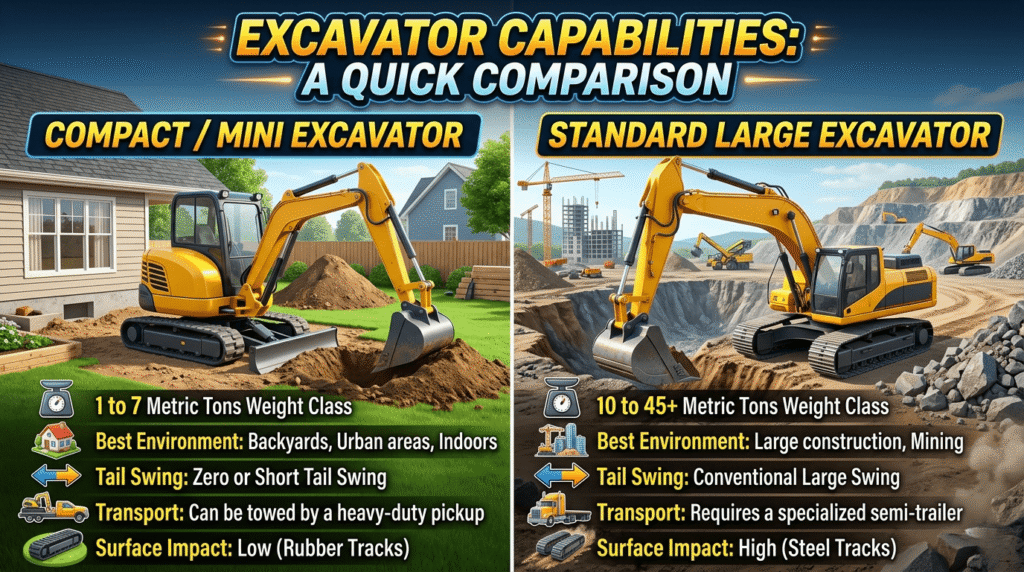
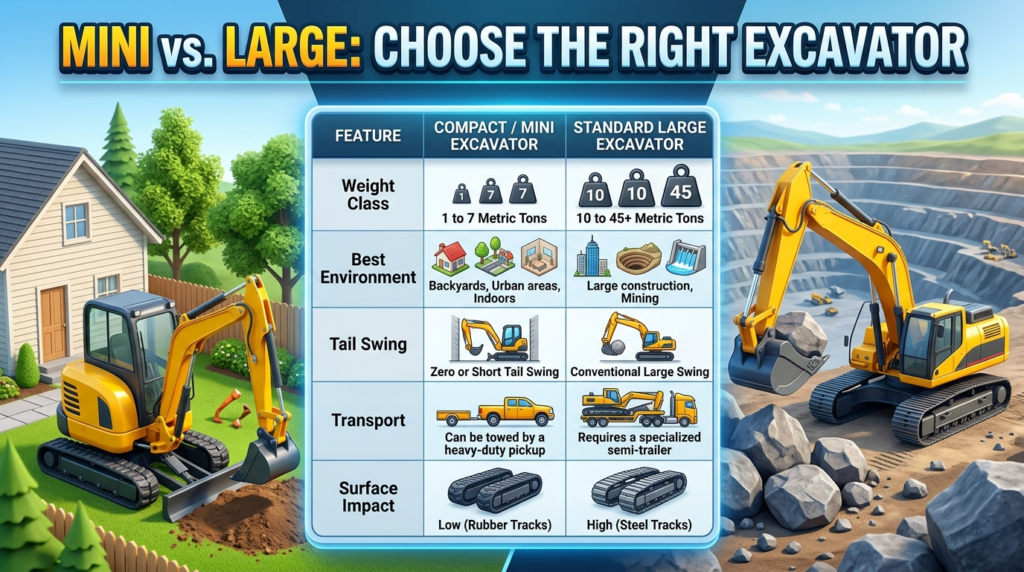
Mini Excavator Capabilities: A Quick Comparison
| Feature | Compact/Mini Excavator | Standard Large Excavator |
| Weight Class | 1 to 7 Metric Tons | 10 to 45+ Metric Tons |
| Best Environment | Backyards, Urban areas, Indoors | Large construction, Mining |
| Tail Swing | Zero or Short Tail Swing | Conventional Large Swing |
| Transport | Can be towed by a heavy-duty pickup | Requires a specialized semi-trailer |
| Surface Impact | Low (Rubber Tracks) | High (Steel Tracks) |
FAQ’s: What can you do with a Mini Excavator?
What is the most common use of a mini excavator?
The main purpose of a mini excavator is trenching for utilities as their slim profile helps them make the precise paths for pipes and wires in residential areas where the space is tight.
How deep can a mini excavator dig?
Mini excavators are capable of digging 5-15 feet in depth depending on their size. 1-toners generally have a limit of 5-7 feet while the 5-6 tonners can accommodate much more forward.
Do I need a special license to operate a mini excavator?
Generally, you won’t need a commercial driver’s license (CDL) for operating a mini excavator on private property. But if this is for professional use, then in most cases you will require worksite safety certification.
Can a mini excavator lift a car?
Most of the mini excavators have a lifting capacity of 1,000-4,000 lbs. As an average car weight is approx. 4,000 lbs, it could only be lifted by the larger “mini” at the absolute limit and it would be unsafe for a smaller one.
Are rubber tracks or steel tracks better?
Rubber tracks are the best for landscaping and urban work as these will not damage the pavement or grass. Steel tracks on the other hand are better for harsh, rocky terrain where the priority is on durability.
Can I use a mini excavator for snow removal?
Absolutely! After you have installed a snow blade or a specialized bucket, an excavator will be quite effective at clearing walkways and narrow parking lots where plow trucks cannot penetrate.
Is it better to rent or buy a mini excavator?
Projects lasting more than 6 months will, in most of the cases, justify buying from a reputable source like Machinery Online. Renting would be the recommended option for the occasional or weekend project.
Conclusion – What can you do with a Mini Excavator
There is not a lot what can you do with a mini excavator. The things which you round limit in fact your choice of the attachments for it. This one machine can dig a pool as well as demolish a garage but with much more efficiency at the same time it is the large excavator.
It also has the finesse of a small one and hence, it is a smaller consumer of fuel and when brought and transported over the roads it is easier. The mini excavator is one of the smartest investments of modern construction and landscaping business.
At Machinery Online, our mission is to provide you with relevant options that would suit your different needs. Feel free to check out our collection and see what a mini excavator can mean for the improvement of your workflow.