
Ultimate Guide to Compare Mini Excavators: Find the Perfect Compact Machine for Your Project
Handling construction, landscaping, or farming the right equipment is a must to accomplish your job. Compare mini excavators suggests several technical aspects should be considered to guarantee that your investment will give you the maximum of the returns.
Compact machines amaze with their high degree of versatility, enabling crews to work in tight spaces while at the same time providing a big force for breaking out. On Machinery Online, you can find not only a complete range of listings, affordable prices, and a contact with the dealers but also the knowledge necessary for successful heavy equipment trading and procurement.
Working on machines of different weight classes and with different hydraulic power must be taken into account if you want to change your project with a new machine.
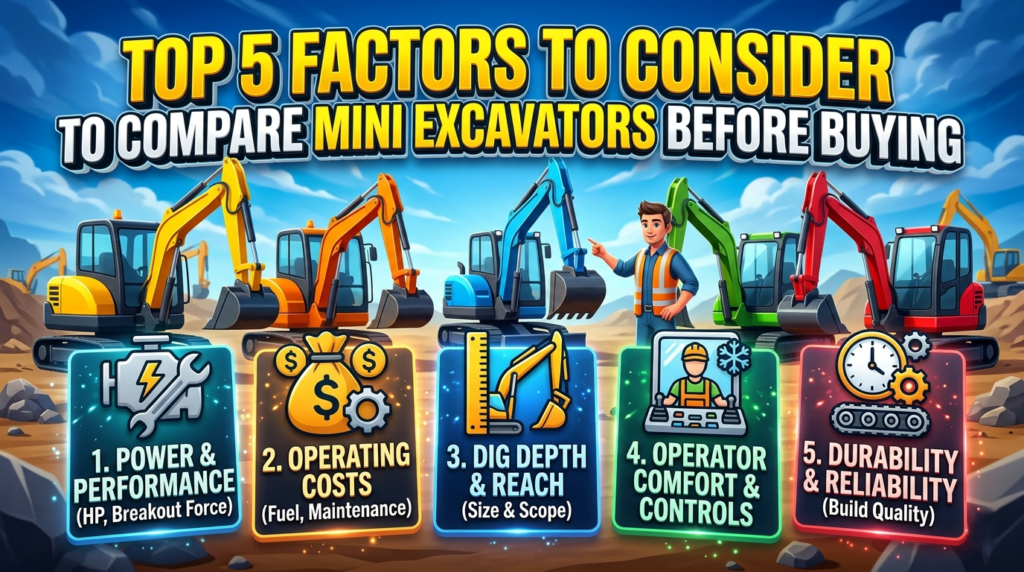
Top 5 Factors to Consider to compare mini excavators before buying
1. Understanding Operating Weight and Machine Classifications
Unfolded data representation into markdown style form:
| Weight Classification | Common Horsepower Range | Best Practical Applications |
| Micro (Under 1-Ton) | 10 HP – 15 HP | Indoor trenching, residential gates |
| Mini (1 to 3 Tons) | 15 HP – 25 HP | Urban utilities, standard landscaping |
| Midi (3 to 8 Tons) | 25 HP – 60 HP | Civil works, major road pipe laying |
Weight is one of the main points influencing the stability and transportation of a construction site when Compare mini excavators for sale or hire.
- Mini Excavators: between 1 and 3 tons, the balance of transportability and a high level of hydraulic power enables carrying out municipal operations.
- Micro Excavators: built for demolition and spots so narrow that only a human can fit the machine under one ton; it’s also allowing going through standard building doors.
- Midi Excavators: intensively capable machines that stand between small scale equipment and full-sized machines and are used for example for big pipe work through the use of excavators.
2. Comparing Tail Swing Configurations for Tight Workspaces
| Swing Profile Configuration | Clearance Needed | Primary Strategic Advantage |
| Conventional Tail Swing | 10 – 20 Inches | Higher lifting capacities over sides |
| Zero-Tail Swing (ZTS) | 0 Inches | Zero risk of striking adjacent walls |
When choosing mini excavators for sale or hire, check the profile of the counterweight to see what is the optimal option from the point of view of the rotary profile. The cords of the work space might be so tight that you will have to decide whether a zero tail swing machine or a normal type will be better for the job at hand.
- Zero-Tail Swing Safety: ZTS profiles allow for the rear housing not to extend past the width of the track, enabling an operator to focus solely on the task of digging without worrying about collisions when working in reverse.
- Conventional Lifting Stability: Conventional versions keep a small rear overhang which gives a lower center of gravity and better side-to-side load lifting stability.
- Reduced Job Site Liability: Using ZTS models minimizes the risk of damaging properties when working next to busy streets, utility poles, or buildings.
3. Evaluating Hydraulic Flow and Auxiliary Attachment Options
| Attachment Type | Required Hydraulic Flow | Ideal Industry Sector |
| Standard Digging Bucket | Low Continuous Flow | General Contracting & Trenching |
| Hydraulic Earth Auger | Medium Dynamic Flow | Solar Panel Farm & Fencing Layouts |
| Heavy Demolition Breaker | High Variable Flow | Concrete Roadway Rehabilitation |
When you compare mini excavators for multi-tasking functionalities make sure that your need for the attachment is adequately supported by the auxiliary hydraulic flow.
Reviewing gallons per minute (GPM) will help to ensure the continuance of the comfortable and safe running of your hydraulics such as the breaker, auger, and thumb.
Using multi-path function joysticks gives the operator minute control of the hydraulic auxiliary system for perfect precision of the tool. New quick coupler setups make it possible for a worker to change out a tool in no time at all.
4. Analyzing Operator Comfort and Cabin Configurations
| Enclosure Style | Climate Protections | Best Geographical Regions |
| Open ROPS/TOPS Canopy | Basic Sun / Rain Roof | Temperate Climates, Short Operations |
| Closed Cab with HVAC | Dust & Climate Control | Extreme Heat, High Dust Mining Zones |
When you compare mini excavators do not forget that an operator cab configuration plays a very important role in a job being safer and efficient.
Working in severe weather can be made more bearable for the operator by the use of enclosed cabs fitted with heating and air conditioning which lead to better productivity throughout the year.
Having seats that can be adjusted, joysticks with a wrist rest and a smooth operation and digital dashboards esthetics will help a worker to last a workday without losing focus. ROPS and TOPS are safety features that protect the operator in case the machine overturns or tips over.
5. Track Options: Rubber vs. Steel Ground Engagement
| Track Material Types | Average Operating Life | Recommended Work Surfaces |
| Industrial Rubber Tracks | 1,200 – 1,800 Hours | Urban asphalt, lawns, concrete paths |
| Heavy Duty Steel Tracks | 2,500 – 4,000 Hours | Jagged rock quarries, demolition sites |
To avoid unnecessarily costly ground damage and premature wear of the tracks choosing the right undercarriage design is very important.
First you need to find out what type of work environment a certain track is built for. This is a prerequisite to compare mini excavators properly.
Choose rubber tracks if your job site is an urban one and the ground noticeably consists of concrete/asphalt sidewalks and well-maintained turf.
Tracks made of steel are right for very demanding situations such as rocky terrain, gravel pits, and demolition debris. Hybrid Track Pads are bolts on rubber cushioned over steel chains and they give you good traction and surface protection.
FAQs – Compare Mini Excavators
How much does a mini excavator cost to buy or rent?
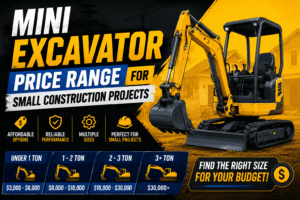
Purchasing a brand-new mini excavator usually costs from $25,000 to $95,000 depending on the model, size, and the features of the cabin. Renting will cost you on the average market the sum from $250 to $600 per day. The wise option is to buy second-hand, and a great place to do that is Machinery Online with its thousands of dealers’ listings and very good quality used equipment options.
What is the difference between a mini excavator and a backhoe loader?
The structure and mobility of these two are quite different. Mini excavators consist of a rotation unit and tracks, which are used for digging in tight spaces with precision all around. Backhoe loaders include a tractor with wheels, a loader in front, and a backhoe at the back; they require more space but are faster at moving between places.
What size mini excavator do I need for standard trenching?
Mini excavators weighing between 1.5 and 3.5 tons are perfect for utility trenching down to 5-8 feet since such construction models supply enough bucket breakout force even while thin enough to be towed on a trailer behind a heavy-duty pickup truck.
Can a mini excavator clear land and remove mature tree stumps?
Yes, when equipped with the right tools, a mini excavator is a great helper in land clearing. The use of hydraulic thumbs combined with sturdy ripping buckets makes it easy to grab roots, pull out tree stumps, and stack heavy debris.
How many hours does a mini excavator typically last?
If properly maintained, a compact excavator can easily be utilized for 8,000 to 10,000 hours. Overhaul or major servicing of the engine and main pump will likely be needed around 5,000 hours in order to maintain performance.
Are rubber tracks better than steel tracks for landscaping?
Yes, rubber tracks are considerably more preferable than steel tracks for landscaping purposes because they distribute weight evenly and reduce ground pressure. This thus results in far less damage to lawns, pavement, and asphalt driveways, which steel tracks would simply rip-up or damage.
What is zero tail swing, and why is it important?
Zero tail swing means that the excavator body’s rotation is wholly within the width of its tracks, which is a critical factor for very tight spaces on job sites as it will enable your workers to operate right next to walls or barriers without the fear of the rear counterweight hitting an obstacle.
Compare Mini Excavators – Leveraging Machinery Online for Safe Equipment Sourcing
Looking for a machine is easier if you can be sure the marketplace is one extremely rolled-out with all the transparency and trust. Clearly connecting Buyers with Dealers who are Commercial and Verified all over the World, MachineryOnline is your solution.
Considering we have 50 industrial categories and 2400 active listings, it’s very easy for you to compare mini excavators price and specifications side by side on our platform. other than compact excavators, rugged skid steers, and versatile forklifts, heavy dozers, we’ve got everything you need to keep your projects on track and within budget.