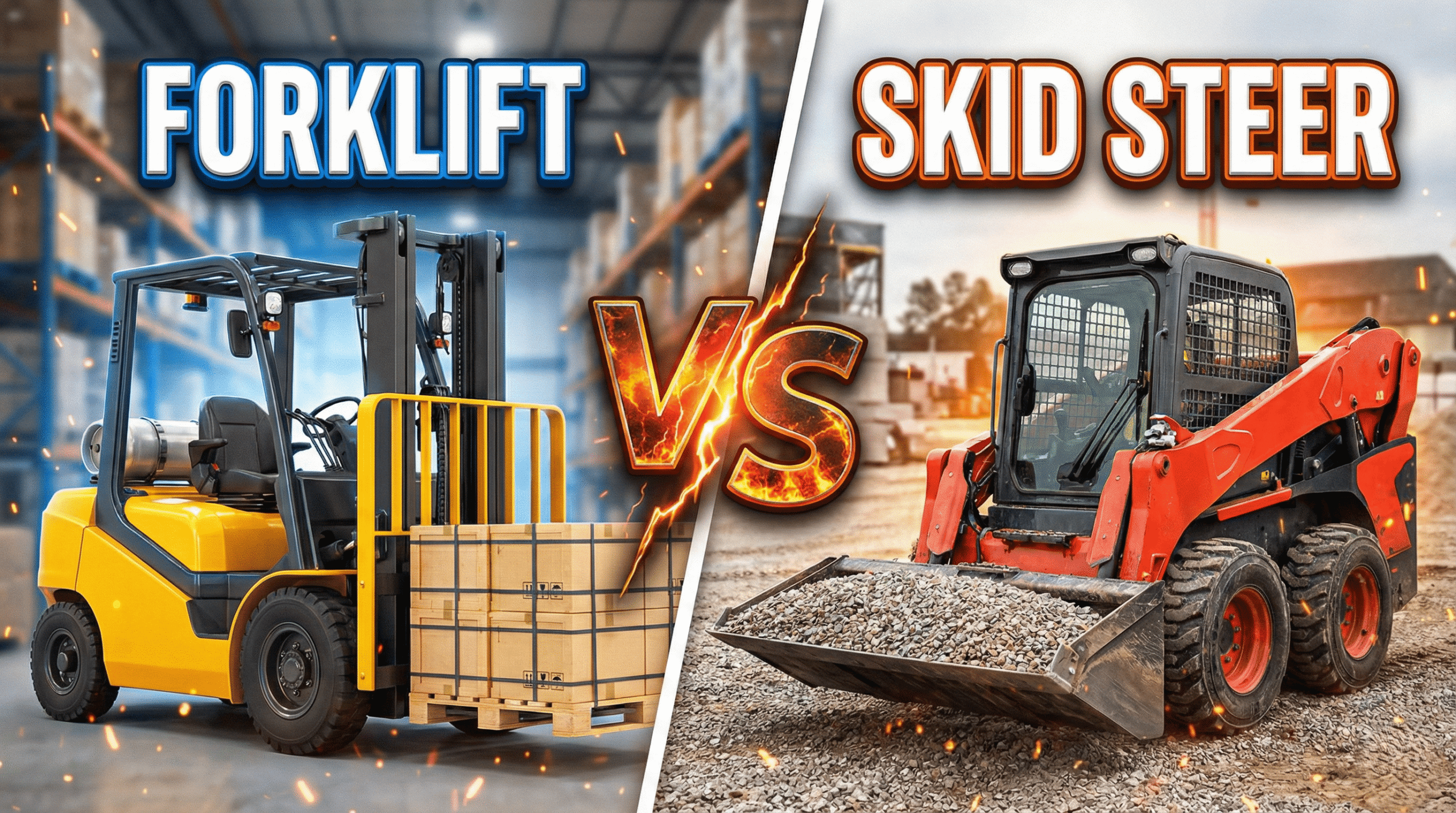
Forklift vs Skid Steer: Heavy Machinery Face-to-Face
Nothing affects your warehouse or site operations like the right choice of machinery and equipment. The productivity factor and, in the end, the profitability of your business greatly depend on this choice. At Machinery Online, we know very well how familiar the question forklift vs skid steer is for project managers and business owners.
Indeed, the two machines are both material handling powerhouses, but in fact, they are designed for totally different types of environments and tasks.
It is no secret that both types of machines, forklifts and skid steers, present a rewarding challenge for the equipment buyer. Stocking up on these industrial giants means that you will be able to get the job done fast and correctly any time.
And this is great, of course! But go through this heavy machinery comparison guide on Machinery Online to get insights on how these machines compete and which one better suits your needs.
Understanding the Core Differences: Forklift vs Skid Steer
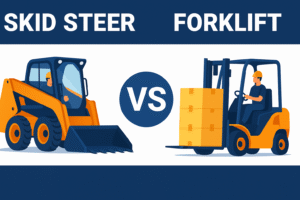
Simply put, the main difference between these machines rests in their core DNA – their inherent nature, their means of movement, and their primary purpose. Besides that, a forklift should be seen as a precision instrument intended for verticality, whereas a skid steer is more like a power tool that is multi-functional and can work on tough grounds.
- Purpose: Forklifts use rear-wheel steering to facilitate smooth movements on flat surfaces while skid steers move by “skidding” where the wheels on each side move independently.
- Performance Surface: Forklifts usually need even paved surfaces like concrete while skid steers perform well on dirt, gravel, and uneven grounds.
- Main Job: Forklifts are designed for palletized loading and unloading; skid steers serve as “Swiss army knives” in the construction industry.
Comparison Overview: Forklift vs Skid Steer
| Feature | Forklift (Industrial) | Skid Steer Loader |
| Steering System | Rear-wheel steering | Skid steering (Zero-turn) |
| Best Terrain | Smooth concrete/Asphalt | Rough, uneven, or soft ground |
| Lifting Mechanism | Vertical Mast | Radial or Vertical Lift Arms |
| Standard Attachment | Pallet Forks | Bucket |
| Maneuverability | High in structured aisles | High in tight, open spaces |

The Forklift vs Skid Steer Performance and Maneuverability Battle
Weighing forklift vs skid steer on the criterion of maneuverability, it really depends on what kind of workspace you have. For instance, in a warehouse with 10-foot aisles, a forklift is essential because it has a predictable turning radius. On the other hand, outdoor areas that are rather cramped would benefit from skid steers as they can make a 360-degree spin in the space equal to their footprint.
- Zero-Radius Turning: The skid steer can rotate on its axis thus it is perfect for small spaces such as residential landscaping or mini demolition sites.
- Aisle Precision: The “car-like” control of forklifts allows for precise placement of heavy pallets such as a 5,000-lb one, on racks without damaging the shelves.
- The speed and travel aspect: Forklifts tend to be faster on flat surfaces though skid steers, while slower, have more stability on slopes.
1. Forklift vs Skid Steer: Lifting Capacities and Vertical Reach
In terms of sheer power, the forklift vs skid steer debate usually goes to the forklift, which is capable of heavy lifting and tall heights. Although a large skid steer loader is capable of lifting a heavy weight, it is not built for that as its primary focus.
- The majority of warehouse forklifts can handle 3,000 to 8,000 lbs, but there are models built for extreme loads that can carry 50,000 lbs and beyond.
- Forklift masts can extend 20 ft or more, whereas most skid steer loaders are limited to 10–12 ft when it comes to loading trucks.
- Lift Path: Forklifts operate with a straight lift (vertical), whereas skid steers lift in a curve (radial) which alters the center of gravity when lifting a load.
2. Versatility: The Magic Comes From Add-ons
When your work is more than just about moving pallets, then the forklift vs skid steer discussion becomes more skewed towards the latter. Skid steers with the correct hydraulic attachments can be as many as three or four separate machines.
- Skid Steer Attachments: You can exchange a bucket with an auger, a trencher, a brush cutter or even a snowblower in a matter of minutes.
- Forklift Attachments: It is possible to install side-shifters, rotators or fork extensions, but the forklift is still essentially a lift machine.
- The Hybrid Option: If you add pallet forks to a skid steer, you have created a “rough terrain forklift,”, however, it is less precise and has poorer visibility than a dedicated lift truck.
3. Operating Environments: Indoor vs Outdoor
The environment often decides the winner in the debate between forklift and skid steer.
- Indoor Safety: This is where forklifts (specifically electric ones) shine because they emit no pollutants, and their tires don’t leave marks on the floor of the warehouse.
- Outdoor Dominance: Skid steers feature high ground clearance and deep-tread tires (or tracks) that keep them moving even in muddy places.
- Rough Terrain Forklifts: There is one more option – the rough terrain forklift that is equipped with large tires for outdoor use but lacks the attachment flexibility of the skid steer.
4. Maintenance and Long-Term Cost Analysis
When making a purchase decision through Machinery Online, you have to think beyond the initial price and see how much the machinery will cost you over its lifetime. We can say that the forklift vs skid steer price of ownership competition goes in favor of the forklift that is generally cheaper to maintain but more specialized.
- Skid steers: Skid steers feature complex hydraulic systems and because the tires or tracks are frequently subject to wear and tear due to the “skidding” motion, routine costs can become quite high.
- Electric forklifts: Electric forklifts provide you with the lowest cost per hour of operation, whereas diesel skid steers are costlier to run in terms of fuel consumption.
Both types of equipment tend to hold their value, however, popular machine models from top brands like Bobcat or Caterpillar often get a better resale percentage in markets for used equipment.
Forklift vs Skid Steer Safety Considerations For Your Job
Safety is the key, no matter what. However, operating a forklift or skid steer necessitates different qualifications and safety measures.
- Visibility: The operator of a forklift generally gets a better view straight ahead when the mast is lowered than a skid steer operator has, who may have the rear and side areas obscured.
- Stability: Relying on momentum to get around corners, forklifts will easily upset themselves if the operator turns too quickly; similarly, skid steers can also topple when a high load is raised on a slope.
- Operator Training: Using a forklift at work places has to be by a person equipped with a “Powered Industrial Truck” certificate obtained through OSHA. In contrast, training for a skid steer is more in line with general heavy equipment courses, which includes safety standards.
FAQ – Forklift Vs Skid Steer
Can a skid steer replace a forklift?
Potentially yes, in the case when a skid steer is fitted with pallet forks, it can move pallets, but it will never be a full-fledged warehouse forklift replacement. It just doesn’t have the requirements for indoor logistics: vertical lift height, precision, and “clean” operation (non-marking tires).
Is a forklift or a skid steer better for a farm?
A skid steer is indisputably more versatile and thus better for a farm. One can easily switch between handling manure, feed, and hay with various attachments. On the other hand, if your operations involve only moving large pallets of seed or fertilizer on a paved pad, a forklift would be more efficient.
Which one is easier to drive, a forklift or a skid steer?
In general, most people find it more straightforward to drive a forklift because it operates with the help of a steering wheel. In contrast, joysticks or foot pedals regulate the separate movement of the right and left sides of a skid steer, a method that takes more time to get used to.
Can you use a forklift on gravel?
The thought of putting a standard warehouse forklift on gravel should be dismissed because these forklifts are bound to get stuck or tip over. On such surfaces, you would be required to have a “Rough Terrain Forklift” equipped with big tires.
Which is cheaper to rent: forklift vs skid steer?
On the whole, if you want to rent a standard warehouse forklift, then you will need to prepare less money. It is normal that the rental price for a skid steer is higher because it is a high wear-and-tear machine that comes with expensive attachments such as buckets or forks.
Do I need a license to operate a skid steer vs a forklift?
Yes, in the case of professional use. OSHA states that proper certification is a must for all forklift operators. That being said, there is no official “license” for a skid steer similar to one for a forklift. Yet, an employer is responsible for ensuring that all operators are sufficiently trained and competent as per general safety standards.
Which machine has a better resale value?
Skid steers generally attract higher resale value because they find applications in a broader range of industries such as landscaping, construction, and agriculture, whereas used forklifts are mainly sought after by warehouse and logistics companies.
Conclusion: Making the Right Choice Between Forklift vs Skid Steer
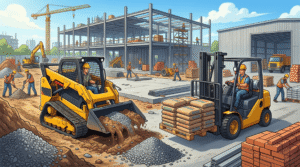
At the bottom of the ladder, deciding between a forklift or skid steer just boils down to the one simple question, “What are you mainly going to use it for?” If you work in a controlled environment and all you do is move standardized pallets, then the forklift should be your go-to machine. But if your machine needs to do anything from digging a hole in the morning to moving a pallet in the afternoon, then the skid steer is the way to go.
For excellent bargains on both new and used machinery, you can always count on Machinery Online. We offer a wide selection of equipment suitable for any situation you are in, irrespective of the terrain.