Skid Steer vs. Forklift
Skid Steer vs. Forklift: The Battle for Job Site Dominance
Look, if you’ve been in this game long enough, you know the feeling. It’s 6:00 AM, the coffee hasn’t kicked in yet, and you’re staring at a flatbed truck loaded with two tons of palletized stone. You stare at the mud pit that was your driveway while the delivery driver checks his watch.
This is where the debate isn’t just theoretical—it’s about whether you get the job done or spend the next three hours winching a stuck machine out of the muck.
I get asked this question constantly by guys just starting their contracting businesses or warehouse managers looking to expand their fleet: “Should I buy a skid steer with forks, or just get a dedicated forklift?”
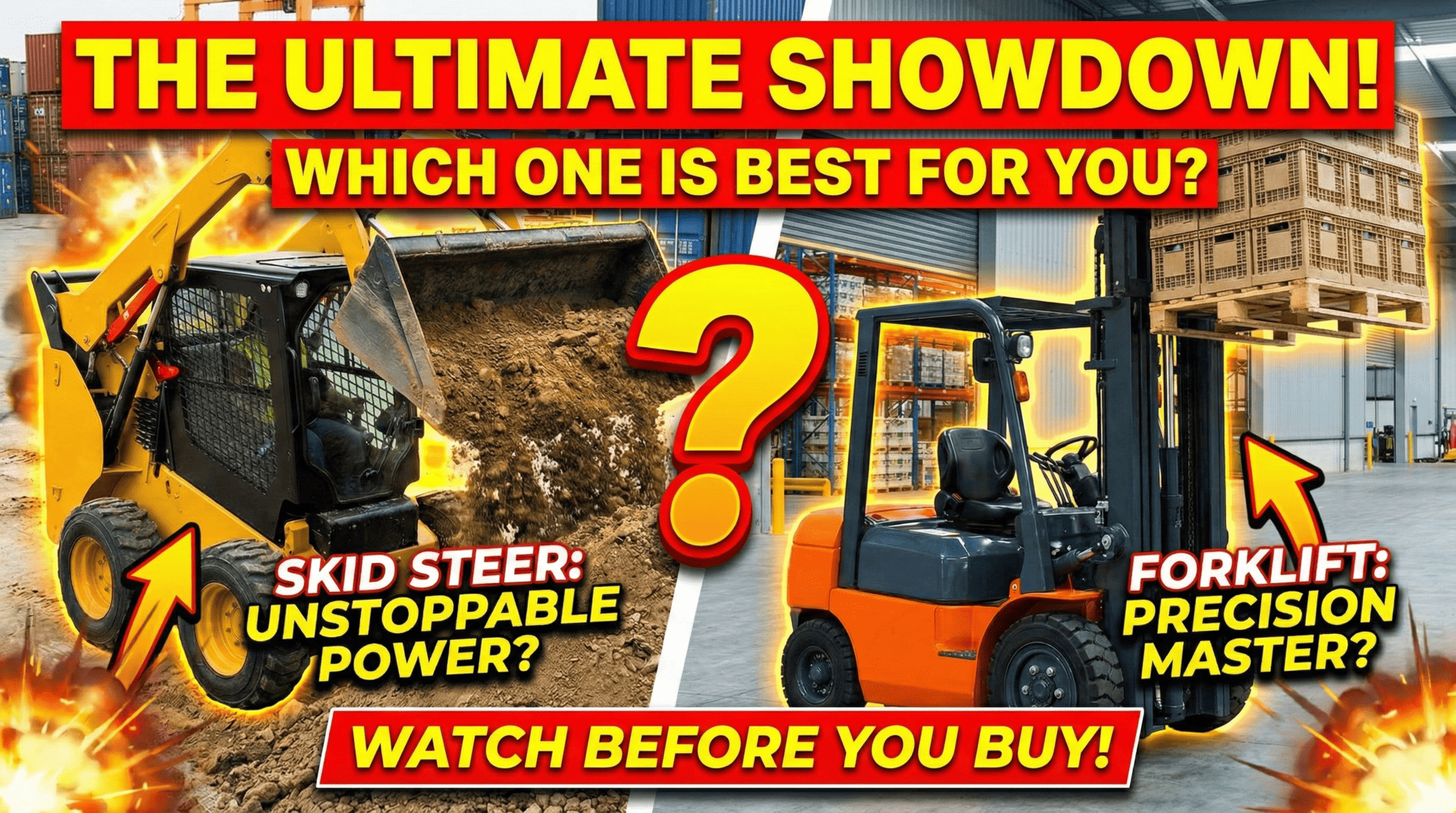
The answer isn’t a simple yes or no. It depends on whether you’re moving dirt, moving pallets, or—like most of us—trying to do both without going bankrupt. Let’s break down the skid steer vs. forklift debate, not with spec-sheet jargon, but with the reality of daily operations.
The Core Dilemma: Jack of All Trades vs. Master of One
Understanding the DNA of these machines is crucial to this choice. They may share forks, but that’s the extent of their similarities.
The Skid Steer: The Swiss Army Knife
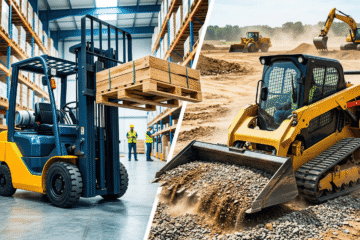
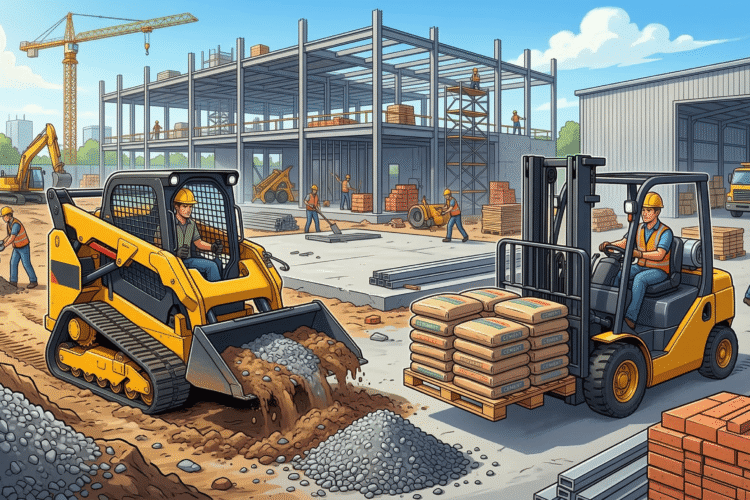
We call the skid steer the “Swiss Army Knife” for a reason. With a universal quick-attach plate, a skid steer (or its cousin, the compact track loader) can be a bucket loader, a trencher, a snowplow, an auger, and yes, a forklift.
The Reality Check:
When you slap pallet forks on a skid steer, you are compromising. You don’t have a vertical mast; you have lift arms. This means your visibility is often blocked by the machine’s own boom or the quick-attach plate itself. You’re trading lifting precision for the ability to turn around and grade a driveway five minutes later.
The Forklift: The Specialist
The forklift has one job: pick heavy things up and put them down safely. It’s designed with a counterweight that allows for massive lifting capacities relative to its size. The vertical mast gives you a straight up-and-down lift that is stable and predictable.
The Reality Check:
A standard industrial forklift is a fish out of water the second it leaves concrete or asphalt. I’ve seen guys try to take a cushion-tire forklift onto a gravel site. It doesn’t end well. Even rough-terrain forklifts (the big telehandlers or masted rough terrains) are generally too large for tight residential backyards.
Head-to-Head: Performance in the Field
Let’s look at how these machines stack up when the rubber (or track) hits the road.
1. Terrain and Traction
This is usually the dealbreaker.
- Skid Steers: If your job site is a muddy mess, a tracked skid steer (CTL) is the only option. They float over soft ground where a forklift would sink to its axles. If you are doing landscaping, new construction foundations, or site prep, the skid steer wins hands down.
- Forklifts: Standard forklifts require hard, improved surfaces. If you are running a supply yard, a warehouse, or a project on an existing parking lot, the forklift is faster and smoother. But the moment you hit soft turf, you’re done.
2. Lifting Geometry and Stability
Here is where the “pucker factor” comes in.
- The Forklift Advantage: A forklift lifts vertically. The load center stays relatively consistent (until you tilt). You can precisely inch a pallet onto a rack 15 feet in the air with confidence.
- The Skid Steer Risk: Skid steers lift in a radius (unless you have a vertical lift path model, and even then, it’s not a perfect straight line). As you lift a heavy pallet, the load can shift forward or backward relative to the machine’s center of gravity. Plus, skid steers are “tippy.” A heavy pallet on a skid steer feels a lot less stable than on a forklift because the machine has a shorter wheelbase.
3. Visibility
- Forklift: You have a clear view through the mast (mostly). You can see your fork tips. This makes picking up a pallet fast and safe.
- Skid Steer: Visibility to the fork tips is notoriously bad on skid steers. You often have to rely on a spotter or pure muscle memory to know where your forks are. It takes a skilled operator to not puncture a bag of cement when driving a skid steer.
The Financial Breakdown: ROI and Ownership Costs
Let’s talk money. This is what your accountant cares about.
Purchase Price & Resale
A decent used skid steer and a decent used pneumatic tire forklift can often be found in similar price ranges ($20k–$40k depending on hours and age), but the Skid Steer holds its value differently. Because it can do so many jobs, it’s easier to sell to a wider market (landscapers, farmers, homeowners) than a dedicated forklift.
Maintenance Costs
- Skid Steer: High wear and tear. You are engaging the ground. Tires wear out fast on pavement. Tracks are expensive to replace (thousands of dollars). Hydraulic systems for attachments add complexity.
- Forklift: Generally lower maintenance if used correctly. No ground engagement tools to break. Tires last forever if you stay on concrete. The mast chains and hydraulics are simple and robust.
The “One Machine” Economy
If you are a small operator, buying a skid steer eliminates the need to rent a separate machine for grading. One machine, one insurance policy, one trailer. That is a massive cost saving that often outweighs the forklift’s superior lifting performance.
Critical Analysis: Daily Job Site Scenarios
Here is a quick reference table to help you visualize where each machine belongs.
| Feature | Skid Steer (with Forks) | Industrial / Rough Terrain Forklift |
| Primary Terrain | Mud, Dirt, Snow, Gravel | Concrete, Asphalt, Hard Pack |
| Lifting Precision | Low to Medium | High |
| Visibility | Poor (Blind spots at ground level) | Good (Through-mast visibility) |
| Versatility | High (Buckets, Augers, Trenchers) | Low (Lifting only) |
| Transport | Easy (Fits on standard equipment trailer) | Difficult (Often heavier, requires lowboy) |
| Turning Radius | Zero-Turn (Pivots in place) | Wide (Rear-wheel steer) |
The Verdict: Which One Should You Buy?
Choose the Skid Steer If:
- You are a Solo Operator or Small Crew: You need a machine that digs a trench at 8 AM and unloads a delivery at 10 AM.
- Your Sites are Messy: You work on raw land, residential backyards, or muddy construction sites where a forklift would get stuck.
- Space is Tight: You need to pivot 360 degrees in a driveway to position a load.
Choose the Forklift If:
- You Run a Supply Yard or Warehouse: You are moving pallets 8 hours a day. The comfort and speed of a forklift will double your efficiency.
- You Lift High and Heavy: If you need to place heavy loads on second-story scaffolding or high racks, a skid steer cannot compete safely.
- Precision is Key: You are handling fragile or expensive materials where “bumping” the controls of a twitchy skid steer could cost you thousands in damage.
Safety Analysis: The Risks You Can’t Ignore
We have to talk about safety because this is how people get hurt and insurance premiums skyrocket.
The Skid Steer Blind Spot
The most common accident I see with skid steers on forks is damage to property. Because you can’t see the tips, operators “feel” for the pallet. This often results in punching a hole through the drywall behind the pallet or scraping the side of a delivery truck.
- Pro Tip: If you use a skid steer for forks regularly, mark your fork tips with bright fluorescent paint. It helps visibility significantly.
The Forklift Stability Triangle
Forklifts operate on a “stability triangle” (the two front wheels and the center of the rear axle). If the center of gravity moves outside this triangle—usually from turning too fast with a raised load—the forklift tips over sideways.
- The Difference: A skid steer usually tips forward (stoppie). A forklift usually tips sideways. Sideways tips are often more lethal for the operator if they aren’t wearing a seatbelt.
Frequently Asked Questions (FAQs)
Q: Can I put forks on any skid steer? A: Technically, yes, as long as it has a universal quick-attach plate (which almost all modern ones do). However, small-frame skid steers (under 1,500 lb rated capacity) are dangerous with forks. The weight of the pallet plus the leverage of the forks can easily tip a small machine.
Q: Is a “telehandler” considered a forklift or a skid steer? A: It’s a hybrid beast. A telehandler (Zoom Boom) has the boom of a crane, the forks of a forklift, and the tires of a tractor. They are superior to both for lifting height and rough terrain, but they are too big for many residential sites and much pricier to rent or own.
Q: Which machine is easier to learn for a new employee? A: The forklift. It has a steering wheel and pedals like a car. The lift controls are intuitive (up/down). A skid steer requires learning joystick coordination and understanding how the machine pivots. It takes much longer to become proficient on a skid steer.
Q: Does a skid steer damage pavement? A: Yes. A wheeled skid steer turns by skidding its tires (hence the name). This leaves black rubber marks on concrete and can tear up asphalt on a hot day. Tracked machines (CTLs) are gentler but can still scuff surfaces. Forklifts are much friendlier to finished surfaces.
Q: Can I use a forklift on grass or dirt? A: Only if it is a “rough terrain” forklift with large pneumatic tractor tires. A standard warehouse forklift with small cushion tires will get stuck on wet grass instantly. Do not try it. The toll bill isn’t worth it.
Conclusion: The Right Tool Philosophy
After years in this industry, here is my final take: Stop trying to find the “perfect” machine and start looking at your 80% scenario.
If 80% of your work is inside a warehouse, on a paved supply yard, or loading trucks from a dock, buy the forklift. The efficiency, visibility, and safety are unmatched. You will move three pallets in the time it takes a skid steer to move one, and you won’t tear up your pavement doing it.
However, if 80% of your work is in the dirt—landscaping, residential construction, fencing, or general contracting—buy the skid steer (specifically a compact track loader). Yes, the visibility with forks is annoying. Yes, you have to be careful with heavy loads. However, that machine will prove its worth every hour of the day. It will unload the truck in the morning, grade the site at noon, and drill post holes in the afternoon.
The forklift is a luxury of specialization. The skid steer is a necessity for survival. For the growing contractor, the skid steer is almost always the first purchase. The forklift comes later, when you have a shop big enough to need one.
My advice? Buy the biggest track loader you can afford, paint your fork tips neon orange, and get to work.