The Best Mini Excavator Comparison: How to Choose the Best Small Powerhouse for Your Project
Choosing the right mini excavator is very important for the success and efficiency of your construction or landscaping business. As the need for small, flexible machines grows, manufacturers have come out with a lot of different models that can work in tight spaces without losing breakout force. Hence, the best mini excavator comparison to be performed to choose the suitable mini excavator according to the project requirements.
In this in-depth guide, we look at the best mini excavators on the market right now and compare how well-known brands stack up against the increasing efficiency of Typhon Machinery products.
If you want to make a smart investment, you need to know the details of hydraulic flow, tail swing, and lift capacity, whether you’re digging foundations, putting in utility lines, or clearing a site.
How Flexible Mini Excavators Are?
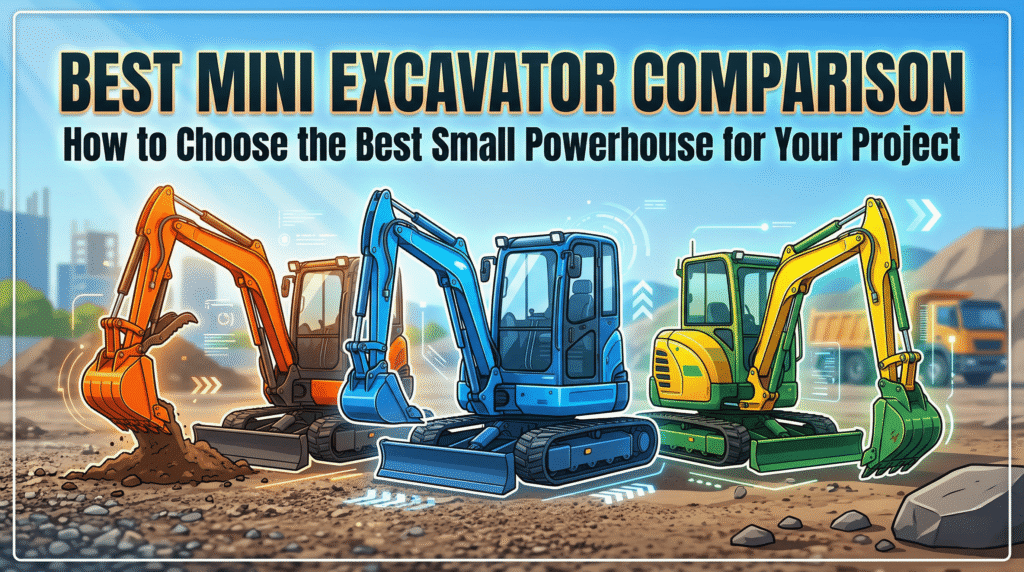
Mini excavators, which are usually defined as machines that weigh less than 6 metric tons, are now the most important tools for building in cities. Because they can work in tight spaces that full-sized excavators can’t fit into, they are essential for home projects and city repairs. When you compare models, you need to look at more than just the engine’s horsepower. You also need to look at the machine’s “work group” geometry.
- Small Size: These machines have retractable undercarriages or short-tail swings so they can fit through small gates and alleys.
- Ready to Attach: New mini excavators come with extra hydraulic systems that make it easy to switch between buckets, augers, hammers, and thumbs.
- Less Pressure on the Ground: Mini excavators use rubber tracks instead of heavy machinery to protect finished surfaces like driveways, lawns, and pavements.
Typhon Machinery: Changing the Meaning of Value and Performance
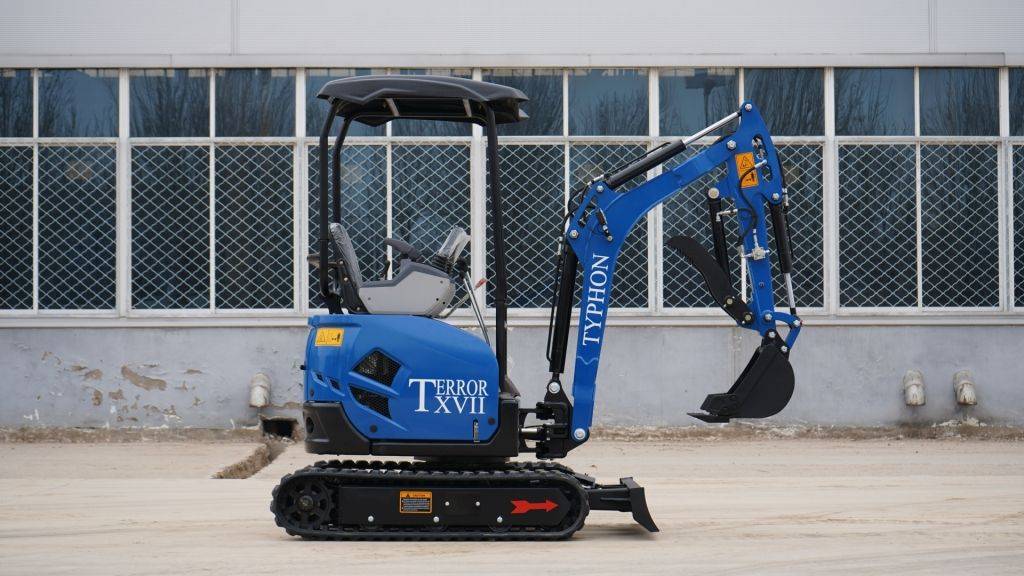
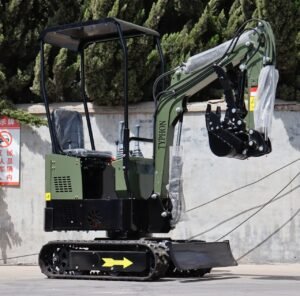
By delivering robust, high-performance mini excavators at costs that are comparable to those of well-known heritage brands, Typhon Machinery has successfully carved out a significant market niche for itself. Typhon devices, such as the Typhon Terror and Typhon Agil series, are designed to provide professional-grade digging depth and dependability.
These products also have an emphasis on critical heavy-duty parts and controls that are simple to use. In order to meet the requirements of contractors, these machines are designed to be as simple to maintain as feasible and to be operational as much as possible.
- Better hydraulic efficiency: Typhon models have advanced pump systems that let them work on multiple tasks at the same time without losing power.
- Built to Last: The chassis and booms are made of high-tensile steel and reinforced at stress points so they can handle the demands of daily commercial use.
- Affordable Ownership: Typhon lowers the long-term “Total Cost of Ownership” compared to high-tech competitors by making parts easy to find and electronics easier to use.
Looking at the main features: Power vs. Accuracy
When we look at the technical comparison, three things usually stand out: the depth of the dig, the weight of the machine, and the engine Tier ratings. If a machine is too light, it won’t be stable enough for heavy lifting.
If it’s too heavy, it might be too heavy for standard trailers to carry. Typhon Machinery finds a balance between these needs by optimizing the counterweight distribution to make a stable base for deep excavations.
- Engine Performance: Most of the best mini excavators now have EPA Tier 4 Final engines, which give them a lot of power at low RPMs to save on gas.
- Zero Tail Swing (ZTS): This feature lets the operator turn the house without the back of the machine going past the tracks, which keeps walls from getting damaged by accident.
- Operator Comfort: For long shifts, high-back seats, ergonomic joysticks, and climate-controlled cabs (on bigger mini models) are no longer luxuries but necessities.
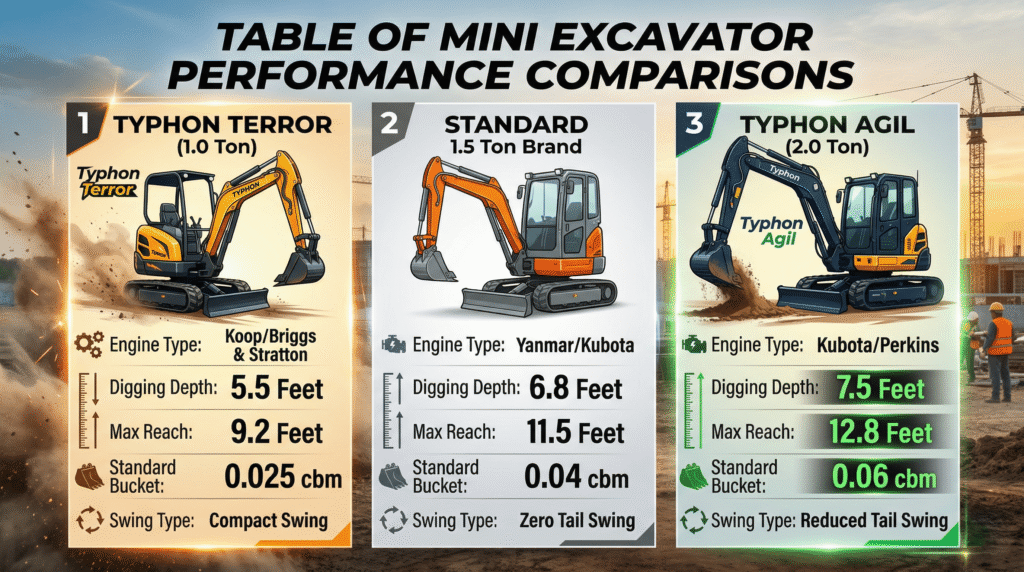
Table of Mini Excavator Performance Comparisons
| Feature | Typhon Terror (1.0 Ton) | Standard 1.5 Ton Brand | Typhon Agil (2.0 Ton) |
| Engine Type | Koop/Briggs & Stratton | Yanmar/Kubota | Kubota/Perkins |
| Digging Depth | 5.5 Feet | 6.8 Feet | 7.5 Feet |
| Max Reach | 9.2 Feet | 11.5 Feet | 12.8 Feet |
| Standard Bucket | 0.025 cbm | 0.04 cbm | 0.06 cbm |
| Swing Type | Compact Swing | Zero Tail Swing | Reduced Tail Swing |
Maintenance and Parts Availability
The best mini excavator is the one that doesn’t need repairs and can stay on the job site. When you compare brands, you should think about how easy it is to do daily maintenance checks.
Typhon Machinery stresses “Open-Design” engine bays, which let mechanics get to filters, batteries, and hydraulic lines without having to take apart half of the machine. Owner-operators who do their own maintenance love how clear the design is.
- Easy-to-Reach Service Points: Grouped grease points and oil drains that are easy to get to cut down on the time needed for daily maintenance.
- Global Component Integration: Typhon makes sure that engine parts are available at almost any local dealer by using well-known engines like Briggs & Stratton or Kubota.
- Routing of hydraulic hoses: Protected routing of hoses along the top of the boom keeps them from getting caught on debris, which is a common cause of downtime in demolition work.
Fuel Economy and Effects on the Environment
In today’s world, being fuel efficient is the same as being profitable. Over the course of a season, mini excavators with “Auto-Idle” or “Eco-Mode” can save hundreds of dollars on fuel.
Typhon Machinery’s hydraulic systems are set up to give “Power on Demand,” which means that the engine only works as hard as the load needs it to. This cuts down on noise and carbon emissions at residential job sites.
- Variable Displacement Pumps: These pumps change the amount of hydraulic flow based on how much resistance they meet, making sure that fuel isn’t wasted on light-duty tasks.
- Quiet Operation: These machines are great for use in places where noise is a problem, like schools and hospitals, because they have low-vibration engine mounts and insulated engine covers.
- Bio-Hydraulic Oil Compatibility: A lot of new units, like those from Typhon, are made to work with biodegradable fluids so that they can follow strict environmental rules.
How to Choose the Best Mini Excavator Right Size for Your Business
There are differences between mini excavators. A 1-ton micro excavator is great for tearing down walls and landscaping in the backyard. A 3.5-ton or 5-ton model is better for preparing commercial sites and doing heavy utility work.
Typhon Machinery has a graduated lineup that lets businesses add more equipment as their projects get more complicated.
- Micro Excavators (less than 1.5 tons): These are great for going through regular doors and working inside buildings or fenced-in backyards.
- Mid-Range Minis (2–3.5 Tons): Most general contractors find this to be the “sweet spot” because it strikes a good balance between being easy to move and having a lot of digging power.
- Large Minis (4–6 Tons): These machines are almost as powerful as backhoes, but they still have the advantage of being able to turn 360 degrees.
FAQs: Best Mini Excavator Comparison
What is the best brand of mini excavator for the money?
People know about brands like Kubota and Cat, but Typhon Machinery is known for being the best value for money. They have strong steel construction and high-quality parts, and they cost a lot less than older brands. This makes them the best choice for contractors who want to get the most out of their money.
How much does it cost to keep a mini excavator in good shape each year?
Depending on how much you use it, annual maintenance costs usually fall between $500 and $1,500. Because Typhon products have simpler mechanical designs and use parts that aren’t proprietary, they often fall on the lower end of this scale. These parts don’t need expensive “dealer-only” diagnostic tools.
Is it possible to use a mini excavator for demolition work?
Yes, mini excavators are great for tearing things down when you use the right attachments, like hammers or hydraulic shears. The Typhon Agil series is very popular for tearing down walls and other structures inside because it has a lot of power and is small.
What is the difference between a regular swing and a zero-tail swing?
The back of the excavator stays within the width of its tracks when it turns in a zero-tail swing. This is very important for working against walls. Conventional swing models can lift a little more weight from the side, but they need more space.
How deep can a mini excavator that weighs 1 ton dig?
The Typhon Terror is an example of a standard 1-ton mini excavator. It can dig down to about 5.5 to 6 feet. This is enough for most home trenching, footings, and landscaping jobs.
Is it easy to find parts for Typhon excavators?
Yes. Typhon uses standard parts and top-of-the-line engines, like Briggs & Stratton or Kubota, to make its machines. This means that machinery makes it easy to find wear parts like filters, seals, and engine parts.stores that sell parts online and in person.
Do I need a special license to drive a mini excavator?
Most places only require a regular driver’s license to drive a mini excavator on private property or small job sites. But some commercial sites may need a heavy equipment operator certification or OSHA-approved safety training.