Forklift vs Telehandler: Which One Suits You Best?
Deciding between a forklift vs telehandler is a giant step for any project manager or warehouse supervisor. Not only are both machines capable of lifting and moving materials, but they also cater to completely different needs. Using a forklift where a telehandler is the right choice might mean no progress at all.
On the other hand, a telehandler for simple indoor jobs may just be a waste of money. Here at Machinery Online, we believe that the perfect equipment equals the highest level of efficiency. This detailed article covers all aspects: we compare the differences, highlight pros and cons of each, explore different use cases so as to help you make the right choice.
What are the major difference between Forklift vs Telehandler Boom?
Knowing Inner Workings: Forklift vs Telehandler Boom
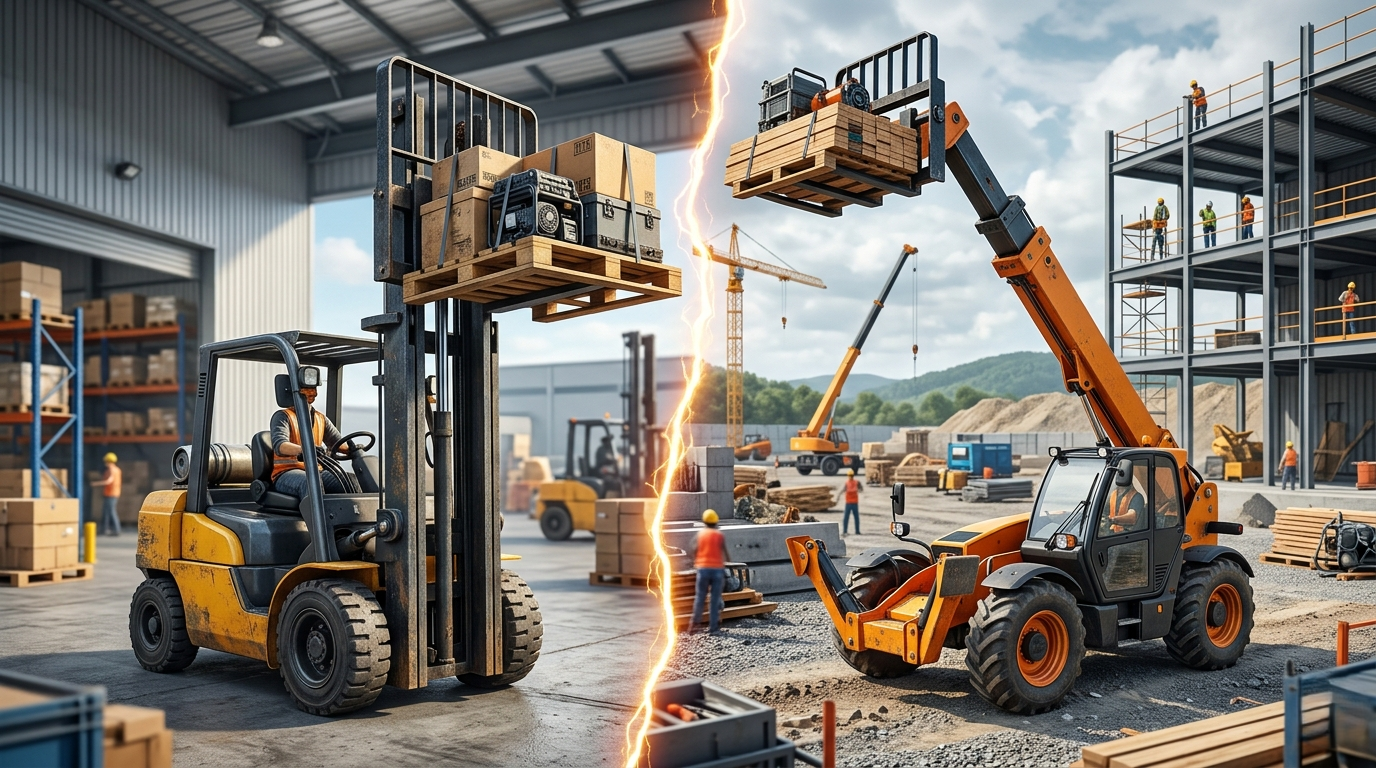
The main point that sets these two powerful workhorses apart is what they actually do to lift things. A forklift has a vertical mast along which it moves its payload strictly up and down. Thanks to this setup, it guarantees stability and accuracy even in the most cramped warehouse.
Meanwhile, a telehandler aka telescopic handler has a boom that can be not only raised but also extended forward. This “reach” feature turns the machine into something between a forklift and crane, enabling it to place materials over obstacles or on tall scaffolding.
- Vertical Dextrousness: Forklifts highlight vertical stacking where the load stays near the machine’s center of gravity.
- Telescopic Reach: Telehandlers are able to deliver the load forward and backward without vehicle base movement.
- Operational Arc: A telehandler works in a wide arc while a forklift is bound to a vertical path only.
Terrain and Surroundings: Which One is Your Work Environment?
Environment choices often end up being the final factor in the forklift vs telehandler debate. Basic forklifts are really masters of concrete. They are made for really smooth, flat grounds such as the floors of warehouses or paved docks.
They are indispensable in narrow aisles as well due to their small size and tight turning radius. Telehandlers, however, are made for the “wild” kind of work. With their big and treaded tires, 4WD system, they can very comfortably handle the uneven, muddy, and stony grounds like the ones on construction sites or farms.
- Indoor Dexterity: Forklifts still deliver better handling in very tight spots and enclosed areas.
- Off-road Expertise: Telehandlers come with lofty ground clearance and solid suspensions to perform best on rugged terrains.
- Surface Stability: While forklifts need stable grounds for safety, telehandlers generally use outriggers for stability even on slopes.
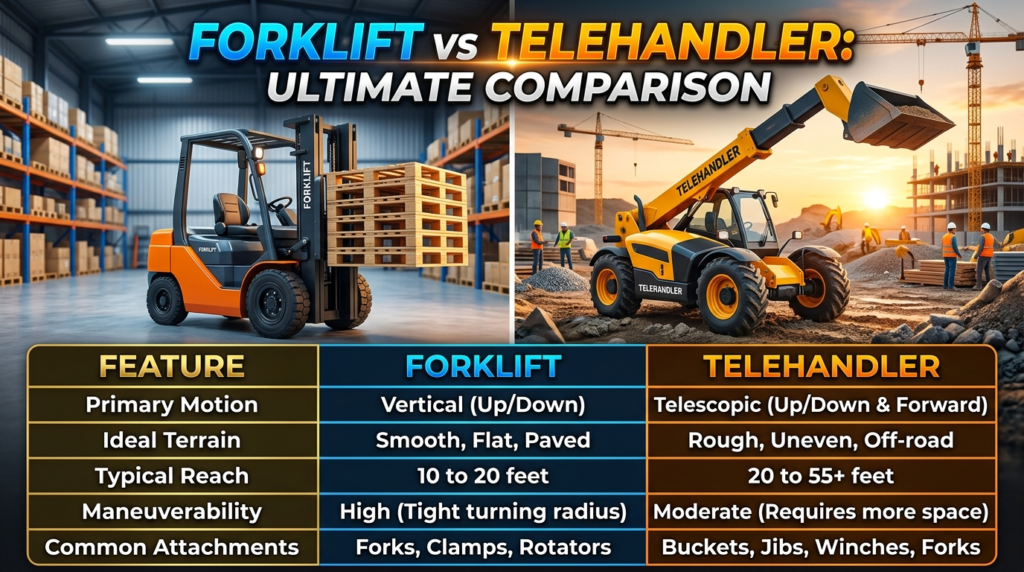
Comparison Table: At a Glance Forklift vs Telehandler Master
| Feature | Forklift | Telehandler |
| Primary Motion | Vertical (Up/Down) | Telescopic (Up/Down & Forward) |
| Ideal Terrain | Smooth, Flat, Paved | Rough, Uneven, Off-road |
| Typical Reach | 10 to 20 feet | 20 to 55+ feet |
| Maneuverability | High (Tight turning radius) | Moderate (Requires more space) |
| Common Attachments | Forks, Clamps, Rotators | Buckets, Jibs, Winches, Forks |
Flexibility and Attachments: Turning Machines into Swiss Army Knives
Suppose your assignment entails more than just pallet handling. In that case, adaptability should be your number one consideration. You can view forklifts as utensils with one blade only, however, they do give you a chance to add side-shift or clamp features for specific industrial work.
On the other hand, a telehandler is called the “Swiss Army machine” simply because its boom can accommodate a wide array of attachments. By changing the forks for a bucket, a lifting jib, a smaller crane or aerial work platform, the telehandler can come to your rescue.
- All-in-One: Telehandlers are ready to be converted to different kinds of work using different attachments.
- Specialized Lifting: Forklift accessories are mostly oriented to dealing with palletized goods and increasing warehouse efficiency.
- Expanding Operation: Telehandlers can take materials to roofs or places hidden behind walls unlike forklifts which have limited reach.
Balance and Weight Handling: Prioritizing Safety Above Everything
Handling heavy loads at heights comes with significant safety risks. Because the forklift’s center of gravity remains pretty much the same, they are safer for heavy, low-level lifts. When it comes to telehandler, the stability shifts with the movement of the boom.
With each extension, the lifting capacity lessens as the weight moves further away from the machine. Operators need to be extremely knowledgeable and experienced in reading load charts so as not to tip over the machine when the boom is fully extended.
- Constant Gravity Center: Forklifts hold their rated load capacity over vertical lifts more consistently.
- Variable Load Charts: Telehandler drivers need to take into account the boom angle and extension when determining the load to be lifted.
- Operator Certification: Both require licenses but operating telehandlers requires a greater understanding of weight distribution and leverage.
Cost Issues: Initial Price vs. Long-Term Benefits
Your budget will always have a lot to do with the final decision between forklift vs telehandler. In the majority of cases, forklifts are much cheaper whether it comes to buying, leasing or maintenance.
They do not have so many complicated hydraulic systems and parts are in good supply. Telehandlers, on the other hand, cost quite a bit but in the long run, they yield higher profits for outdoor projects that require several types of equipment to be replaced.
If a single telehandler is able to do what a forklift and a small crane can do, it is pretty easy to justify the high price.
- Maintenance Expenses: Forklifts are mechanically easier and cheaper to service in the long run.
- Fuel Economy: Smaller forklifts, particularly the electric ones, provide real energy cost savings.
- Project Combination: Telehandler’s multiple role abilities can cut the number of machines needed on-site.
The Final Call: Forklift vs Telehandler – What Is Right for You?
Deciding on the “winner” really comes down to your workplace and your aims. In case you run a high-volume distribution center with paved floor and tight aisles, the forklift is your best bet for its speed, accuracy, and low operating costs.
Nevertheless, if you are developing a housing site from scratch or managing a large farm where material handling involves getting to a second story across a muddy yard, the telehandler is clearly your champion.
- Go for the Forklift if: Your work happens indoors, speed in narrow aisles is your main priority, and you mostly handle palletized goods.
- Go for the Telehandler if: You are predominantly an outdoor worker on rough terrain who has to lift loads high up or over obstacles.
- Get Expert Help: Machinery Online advises you to examine your hardest “worst-case” scenario before purchasing or leasing any particular piece of equipment.
FAQs – Forklift vs Telehandler
Is a telehandler the same as a forklift?
It is not a forklift though sometimes called “telescopic forklift”. Telehandler is a cross between different machines as a forklift but with a reach of a crane. Different certifications and/or licenses are required in some regions for operating telehandlers than for running standard warehouse forklifts.
Do telehandlers have the same lifting power as forklifts?
It varies by model, but generally, forklifts can handle heavier loads at lower heights. The maximum capacity of telehandlers is usually quite high but that capacity reduces substantially when the boom is extended so you should always refer to the load chart for each particular machine.
Which machine suits narrow aisles better?
Without a doubt, the forklift is better suited to narrow aisles. There are quite a few forklift models designed specifically for Very Narrow Aisle (VNA) usage. On the other hand, telehandlers have a much bigger footprint and a bigger turning radius which makes them difficult to use in a standard warehouse layout.
Do telehandlers offer enough safety when working on slopes?
Compared to standard forklifts, telehandlers are definitely a lot safer when working on uneven ground due to their 4WD and larger tires. Anyhow, several models come with stabilizers or outriggers that allow leveling the machine before the lift performance though utmost care is always necessary when working on slopes.
Is it OK to use a forklift outdoors?
Yes, but rough terrain forklifts or forklifts equipped with pneumatic tires are required for such users. Standard warehouse forklifts carrying solid tire cushions are not at all safe on gravel or dirt and they could easily get stuck if the ground is uneven or not firm.
Will I need two licenses to operate these?
Yes, in the vast majority of cases. Although the basics of carrying materials are similar for both, the telescopic boom of a telehandler undoubtedly poses unique safety risks (such as tipping) which are absent in vertical mast forklifts. Regulators like OSHA will probably require specific training for each type.
Which equipment has better resale value?
Due to their versatility and demand within the construction and agricultural sectors, telehandlers often keep a high resale value. That said, because they are frequently used in harsh environments, their condition can vary significantly affecting the final price.