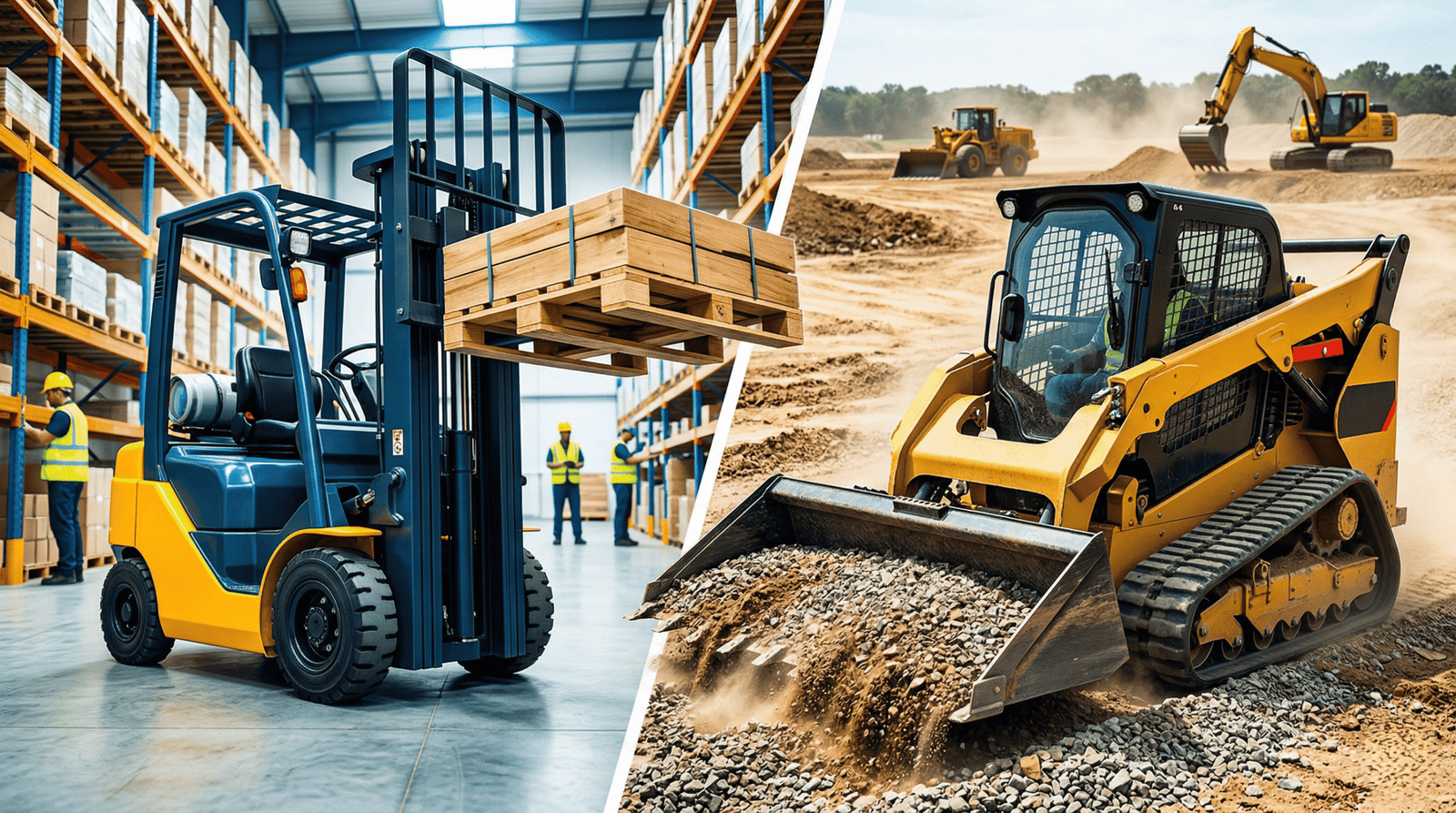
What to pick for business projects: Forklift vs. Skid Steer?
When deciding between Forklift vs. Skid Steer, it’s usually a matter of the materials being moved and the environment. Both machines are very useful for commercial projects, but they are built for very different purposes. If you choose the wrong machine, your project could get stuck, but if you choose the right one, you could finish it much faster and get a better return on investment.
We know that commercial projects need power and accuracy at Machinery Online. This full guide will explain everything you need to know about picking between a forklift vs. skid steer for your next big project.
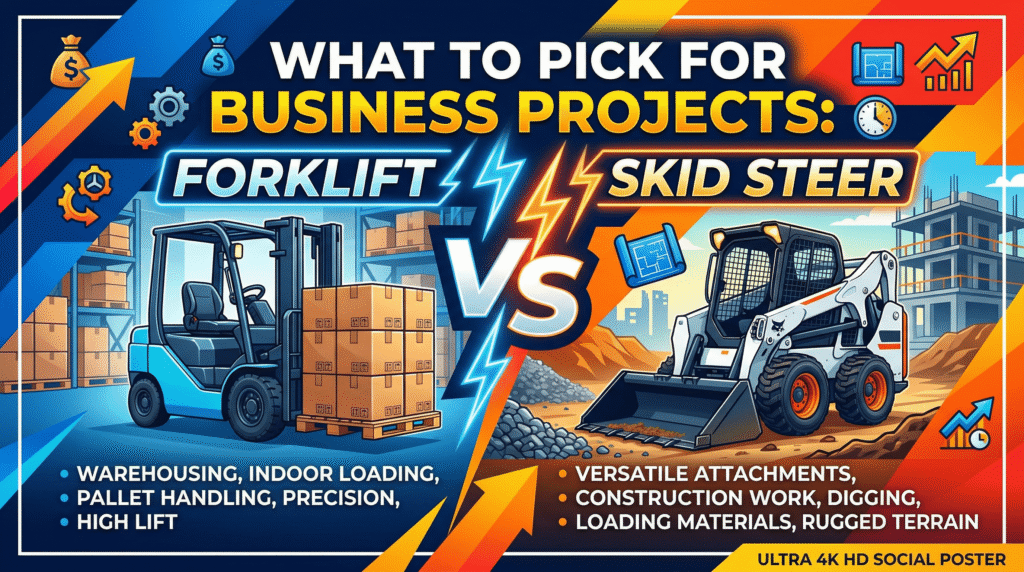
What to Choose for Commercial Projects: Forklift or Skid Steer?
The Main Goal: Accuracy vs. Flexibility
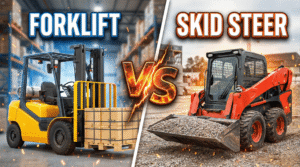
The biggest difference between a forklift vs. skid steer is how they are designed to work.
A forklift is a specialized machine that is made to lift and move standardized, palletized goods both vertically and horizontally. It works best in structured settings where “precise positioning” is the goal.
On the other hand, a skid steer can do many different jobs. It is a small, sturdy machine with lift arms that can hold a lot of different attachments. A skid steer can quickly change from a bucket loader to a trencher or a breaker, but a forklift is mostly limited to its forks.
- Forklifts are made specifically for moving pallets and storing things in high-density areas.
- Skid Steers put a lot of emphasis on being able to do more than one thing at a time and being able to change with the job site.
- Choice Factor is the forklift is your main tool if your project involves moving uniform pallets around in a warehouse or yard. The skid steer is the best tool for clearing debris, digging, and moving a few pallets.
Adaptability to the environment and terrain
What you move is just as important as where you work. Forklifts, especially those used in warehouses and factories, need flat, hard surfaces like concrete or asphalt to work safely. They are easy to tip over on uneven ground because their tires are small and they don’t have much ground clearance.
Skid steers do well in the mess of an outdoor commercial construction site. They come in both wheeled and tracked (Compact Track Loader) versions and can easily get through mud, sand, and rough debris.
- Indoor Projects: Forklifts, especially electric ones, are the best choice for indoor commercial spaces because they don’t produce any emissions and have very tight turning circles.
- Outdoors/Rough Terrain: Skid steers can go anywhere and can handle slopes and rough ground that would leave a regular forklift stuck.
- Surface Impact: Tracked skid steers evenly distribute weight to reduce ground pressure, which is very important for landscaped areas or sub-grades that are sensitive.
Space and ability to move around
Space is often hard to come by in the world of business logistics. How these machines turn can affect how you set up your warehouse or project site.
Forklifts usually have rear-wheel steering, which makes them easy to turn in tight spaces like narrow warehouse aisles. But skid steers can turn “zero-radius.” A skid steer can literally turn on a dime within its own footprint by locking the wheels or tracks on one side while the other side turns.
- Aisle Operation: Forklifts are best for moving straight and making 90-degree turns into racking systems.
- Small Spaces: Skid steers are better for “inner-city infills” or tight demolition zones where there isn’t enough room for a regular three-point turn.
- Speed: Forklifts can usually go faster on flat surfaces, which makes them better for moving materials over long distances in a big building.
Comparison of Lift Capacity and Height
The forklift is almost always the best at lifting things when you compare it to a skid steer. Heavy-duty industrial forklifts can lift more than 60,000 pounds, while small electric forklifts can only lift 3,000 pounds.
Most skid steers can only carry between 1,500 and 4,000 pounds. Forklifts can also reach much higher heights—often 20 feet or more—while a skid steer’s lift height usually stops at 10 to 12 feet.
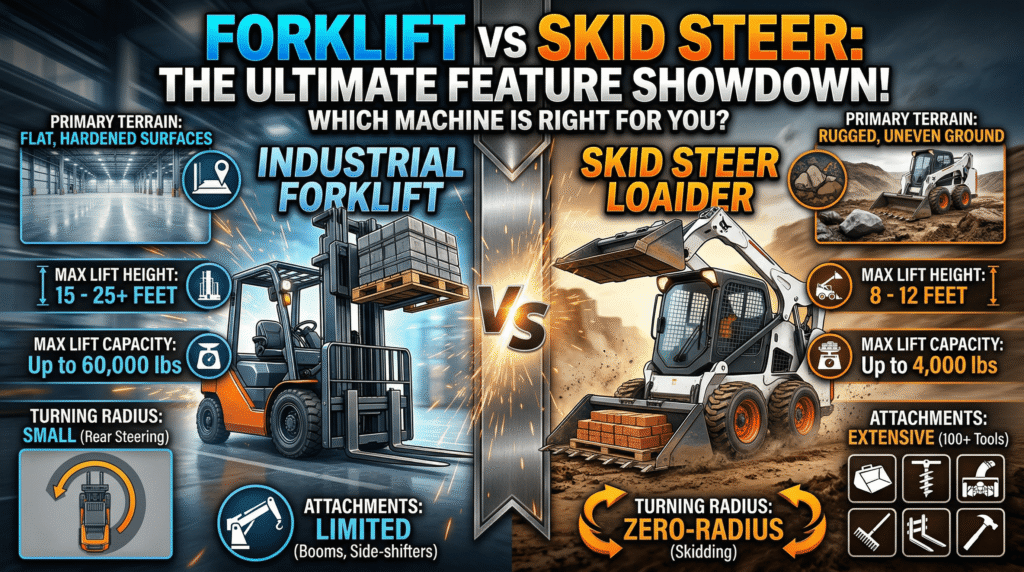
Table: Forklift vs. Skid Steer Feature
| Feature | Industrial Forklift | Skid Steer Loader |
| Primary Terrain | Flat, Hardened Surfaces | Rugged, Uneven Ground |
| Max Lift Height | 15 – 25+ Feet | 8 – 12 Feet |
| Max Lift Capacity | Up to 60,000 lbs | Up to 4,000 lbs |
| Turning Radius | Small (Rear Steering) | Zero-Radius (Skidding) |
| Attachments | Limited (Booms, Side-shifters) | Extensive (100+ Tools) |
Attachment Flexibility: The “Swiss Army Knife” Factor
The skid steer is most useful for commercial projects that need to do more than just move things around. A single operator can change roles in less than two minutes with a quick-attach hydraulic system.
- Moving dirt: Use a bucket attachment to grade, backfill, and remove dirt.
- Demolition: Use a hydraulic breaker to break up floors or concrete.
- Handling materials: Add pallet forks to make it look like a forklift for lighter loads.
Forklifts can be made to have side-shifters, rotators, or boom attachments, but they will always be used to lift things. They can’t dig a trench or level a road.
Cost-Effectiveness and Upkeep
The bottom line is what many project managers think about when making a decision. A skid steer may cost more to buy at first because its hydraulic systems are complicated, but it can replace several machines, which lowers the overall cost of the fleet.
- Maintenance: Forklifts need less maintenance because they have fewer moving parts. This is especially true for electric models. When skid steers work in dirt and mud, they need to be cleaned and cared for more often.
- Labor Efficiency: With a skid steer, one person can do five different jobs, so there is less need for specialized crews.
- Rental Market: You can easily rent both machines. Skid steers usually cost more to rent per day, but they are more useful on a wide range of job sites.
Safety and Visibility for Operators
Safety is the most important thing in business. When forklift operators are carrying heavy loads, they often have “blind spots” that block their view of the road ahead, so they have to drive in reverse.
The cabins of modern skid steers have “ROPS” (Rollover Protective Structure) and “FOPS” (Falling Object Protective Structure) to keep people safe. The operator can usually see the area around them better because they are higher up and closer to the attachment. However, the engine compartment can block their view of the rear.
- Stability: Forklifts are more stable when lifting heavy loads to their highest points on level ground.
- Protection: Skid steers give you better protection when you’re tearing something down or when something falls.
- Training: Both need special certification, but people who are used to using joystick-based heavy machinery often say that skid steer controls are easier to understand.
Forklift vs. Skid Steer: Frequently Asked Questions
Is it possible for a skid steer to take the place of a forklift on a construction site?
Yes, for a lot of things. A skid steer can move things like bricks or lumber if you add pallet forks to it. But it can’t stack things as precisely as a forklift or carry loads that are very heavy (over 5,000 pounds).
Which is better for getting rid of snow: a skid steer or a forklift?
A skid steer is better for clearing snow because it can use snow blowers, plows, and salt spreaders. Some forklifts can have plows added to them, but they don’t have enough traction to work on icy, unpaved surfaces.
Which machine works better in a warehouse?
The forklift is the best choice for inside use. Electric forklifts don’t pollute the air at all. They are made to fit in the tight spaces and high racking systems of modern commercial warehouses.
Do I need a separate license for a skid steer and a forklift?
Yes. OSHA and other regulatory bodies require that “Powered Industrial Trucks” (forklifts) and “Compact Power Equipment” (skid steers) be trained and certified in certain ways. You can’t use the same certifications for different things.
How much weight can a skid steer lift with its forks at most?
Most medium- to large-sized skid steers have a Rated Operating Capacity (ROC) of 2,000 to 3,500 pounds. If you lift too much, the machine can tip over, especially on uneven ground.
Are tracked skid steers better for commercial jobs than wheeled ones?
It depends on the land. Tracked models (CTLs) work better on soft, muddy, or sandy ground because they float better. Wheeled skid steers are faster and cheaper to use on hard surfaces like packed gravel or asphalt.
Is it more expensive to keep a forklift or a skid steer in good shape?
In general, skid steers are more expensive to keep up with. Compared to an indoor forklift, they work in harsher conditions (dirt, mud, debris) and have more complicated hydraulic systems and undercarriages that need to be serviced more often.
In conclusion, you need to make a choice – Forklift vs. Skid Steer
The “core task” of your commercial project will help you decide between a forklift and a skid steer. If your project is mostly moving pallets on a finished floor, a forklift is the best tool for the job. But if your job includes preparing the site, clearing debris, and handling different types of materials on raw earth, the skid steer is the clear winner.
We at Machinery Online have the tools and information you need to make your business successful. We have everything you need, from the accuracy of a lift to the flexibility of a loader.